Clear Sky Science · en
Arctic sea-ice ridges are biomass hotspots harboring diverse microbial communities
Hidden life in broken Arctic ice
When we picture Arctic sea ice, we often imagine a smooth white sheet stretching to the horizon. In reality, much of that ice is crumpled into ridges where floes collide and pile up. This study reveals that these jagged structures are not just frozen obstacles for ships—they are bustling neighborhoods for microscopic life. By showing that sea-ice ridges can hold most of the ice‑bound algae and host uniquely diverse microbial communities, the research changes how we think about life and carbon cycling in a rapidly warming Arctic.
What makes ridges different from flat ice
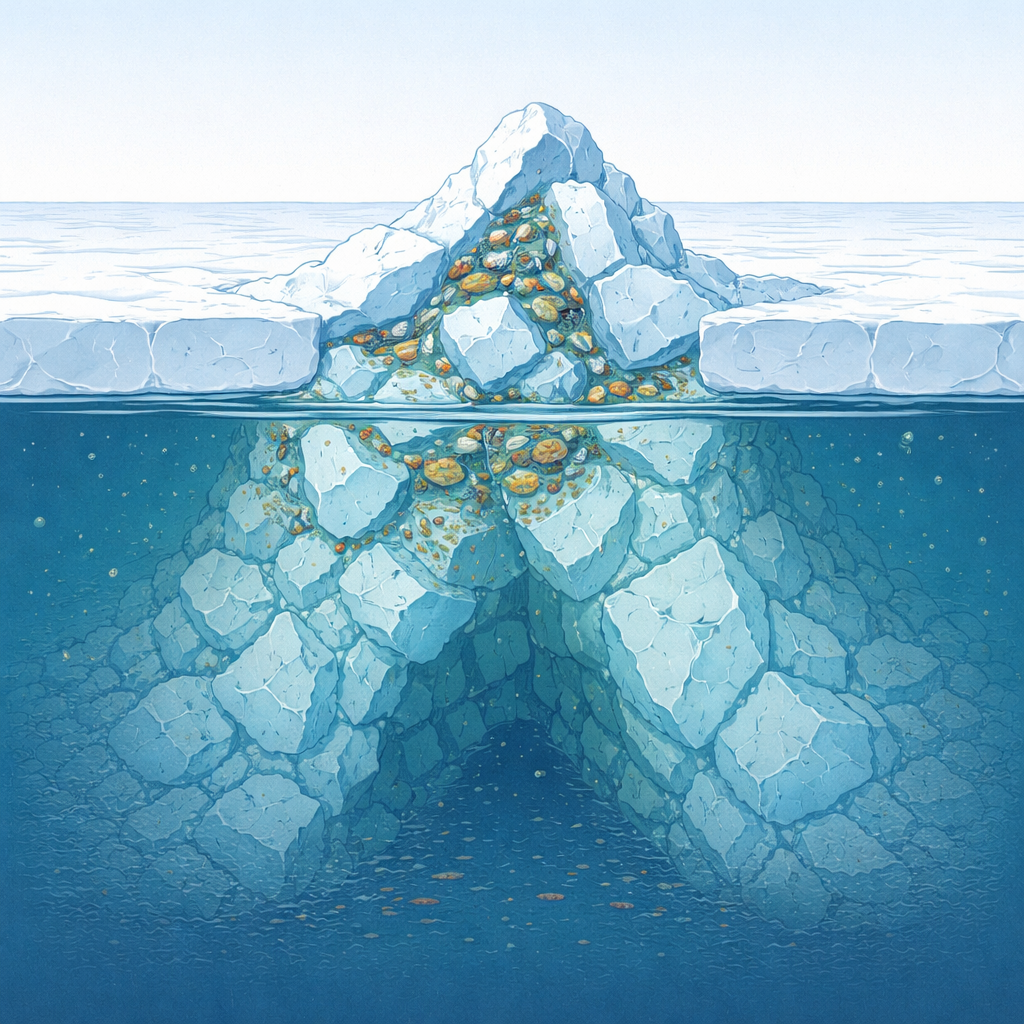
Sea‑ice ridges form when drifting ice sheets crash together, shattering into blocks that heap up to form a “sail” above the water and a deep “keel” below. The keel can extend several meters into the ocean and is built from jumbled ice blocks with gaps between them. These gaps start out filled with seawater and create a maze of tiny pools and channels, while the block surfaces face many directions and experience different light and salinity conditions. Compared with thin, flat ice, a ridge offers far more internal surface area and sheltered space, and much of it can persist through summer even as level ice melts away.
Ridges as seasonal safe houses for algae
Using the year‑long MOSAiC drift expedition in the central Arctic, the researchers drilled into three ridges in winter, spring, and summer and combined measurements of ice structure, temperature and salt content with detailed counts of algae and microbes. They found that the highest algal concentrations were consistently linked to the water-filled cavities and surrounding ice near the tops of ridge keels. In summer, these interior ridge habitats stored up to eight times more algal pigment (chlorophyll a) than typical level ice and surface waters, and ridges, though covering only about one fifth of the ice area, could contain roughly 80 percent of all ice‑associated algal biomass in the study region. The sheltered cavities appear to help algae endure the dark winter and then fuel intense growth when light returns.
A patchwork of microscopic communities
The study shows that life inside ridges is not only abundant but also compositionally distinct. Within short distances, conditions change sharply from soft, porous upper ice to more consolidated lower layers, and from open water pockets to solid ice. Correspondingly, the mix of microscopic algae, protists, bacteria, and archaea shifts from place to place and from season to season. Genetic surveys revealed that ridge habitats host many genera not found in surrounding level ice, especially among diatoms and ciliates. While local diversity within a single sample was similar across environments, the total number of distinct eukaryotic taxa across all ridge samples was higher than in first‑year or second‑year flat ice, indicating that ridges add substantially to overall Arctic sea‑ice biodiversity.
From plant‑like growth to microbial recycling
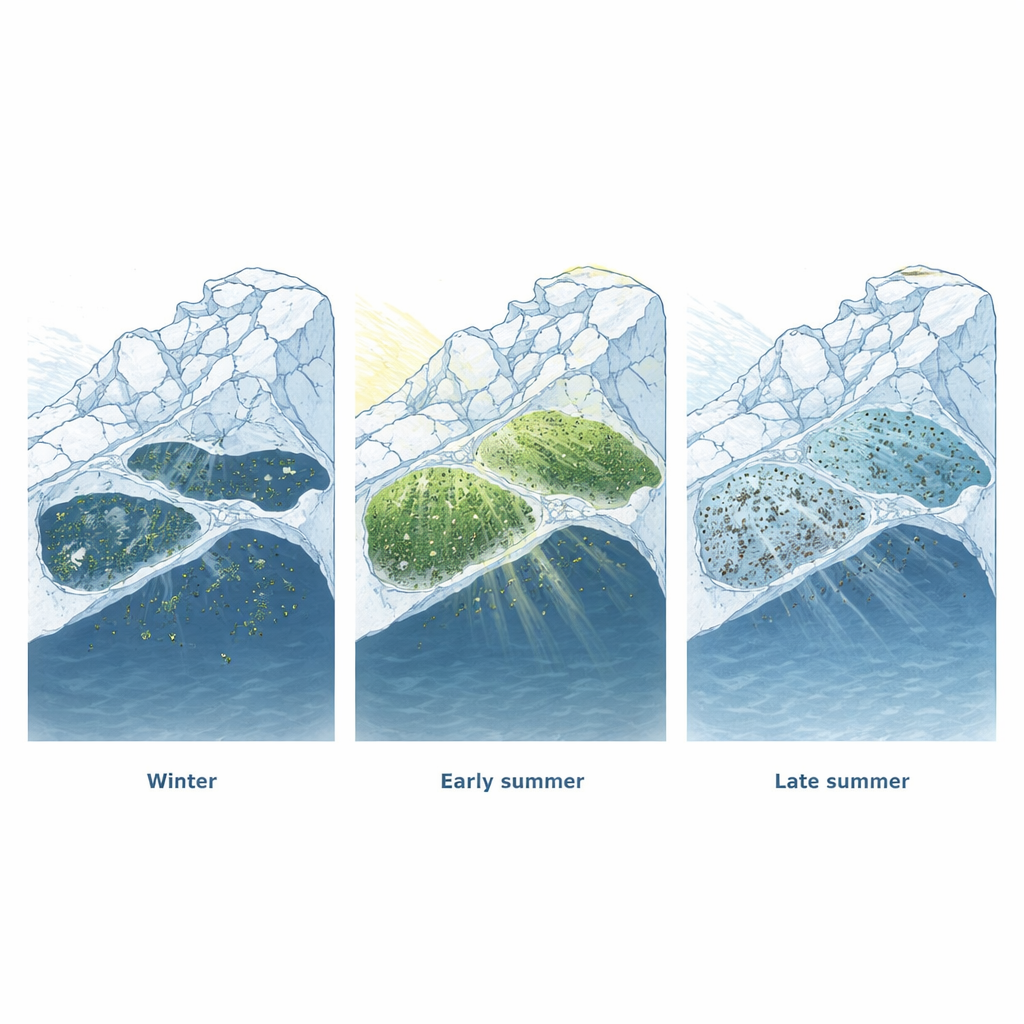
As summer progressed, a dramatic transformation occurred inside the ridges. Early in the season, water‑filled cavities bathed in light favored algae and other photosynthetic organisms, making the ridges strong sites of primary production. Later, as surface melt ponds drained and low‑salinity water infiltrated the keels, some cavities froze. This change triggered a downturn in algal biomass but a surge in fast‑growing bacteria and in genes linked to breaking down complex organic matter and cycling nitrogen. Certain bacterial groups, particularly cold‑adapted Gammaproteobacteria such as Colwellia, became highly dominant and carried enzyme sets well suited to degrading algal‑derived sugars and other carbon‑rich compounds. In effect, the same ridge that acted as a summer plant nursery turned into a microbial recycling plant once its internal pools froze.
Why this matters for a changing Arctic
The findings highlight sea‑ice ridges as key pieces of the Arctic puzzle. By providing long‑lasting, structurally complex refuges, ridges allow ice‑associated organisms to survive winter darkness, build up large summer algal stocks, and then feed active bacterial communities that transform and release that carbon. Because ridges occupy a large fraction of the Arctic ice volume and can hold most of its algal biomass, changes in how often and how strongly ridges form, consolidate, and melt are likely to ripple through food webs and carbon pathways. Understanding these overlooked features is essential for predicting how Arctic ecosystems—and the climate processes they influence—will respond as sea ice becomes thinner, younger, and more dynamic.
Citation: Müller, O., Gardner, J., Olsen, L.M. et al. Arctic sea-ice ridges are biomass hotspots harboring diverse microbial communities. Commun Earth Environ 7, 385 (2026). https://doi.org/10.1038/s43247-026-03364-8
Keywords: Arctic sea ice, pressure ridges, ice algae, microbial communities, carbon cycling