Clear Sky Science · en
Negative emissions technologies and practices could challenge global resource supply and environmental limits
Why pulling carbon from the air matters for everyone
Even if we slash greenhouse gas emissions, scientists expect that simply cutting pollution will not be enough to keep global warming in check. We will likely also need to pull vast amounts of carbon dioxide back out of the atmosphere. This study asks a deceptively simple question with far-reaching consequences: if we build carbon-removing technologies at the huge scales envisioned for meeting climate goals, do we run into new problems with water, land, minerals, fertilizers, and human health? The answers matter for food prices, mining, biodiversity, and the overall safety of the climate solutions we choose.
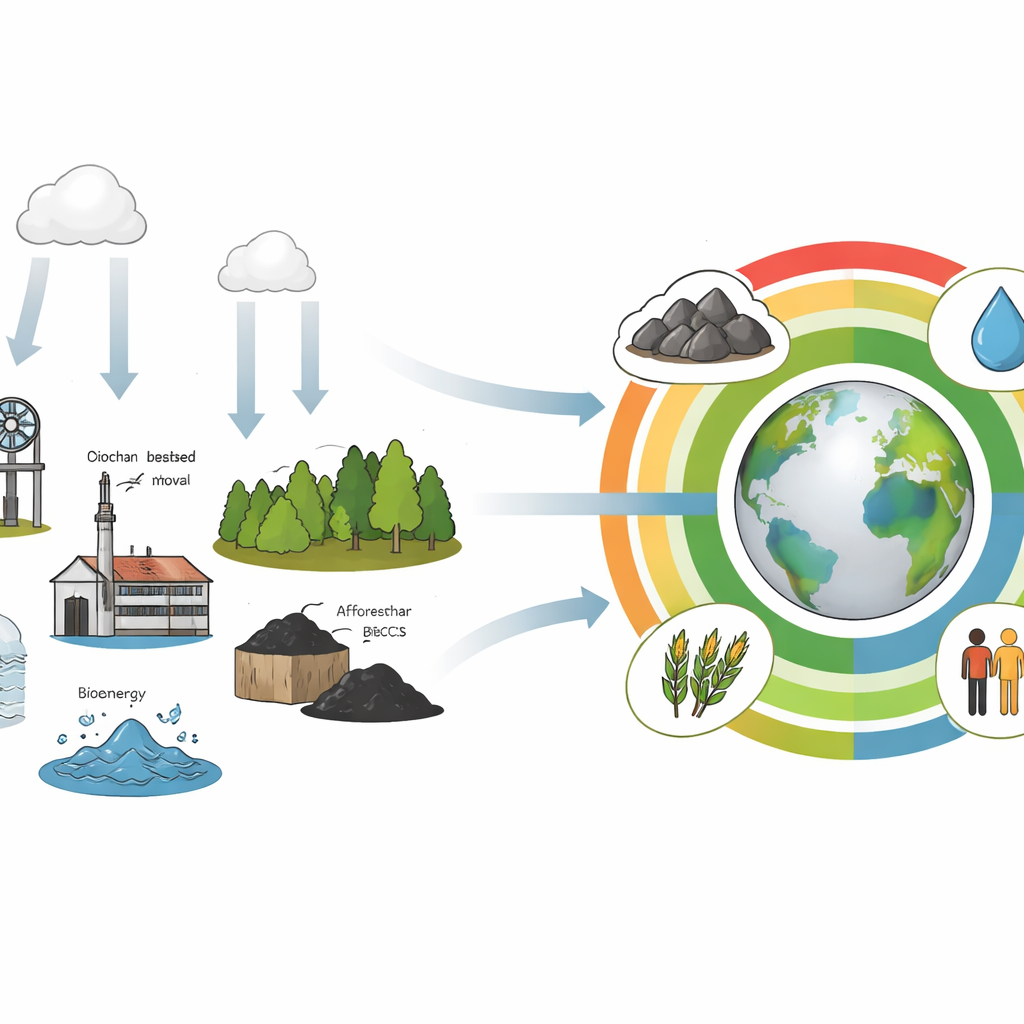
Different ways to clean up the atmosphere
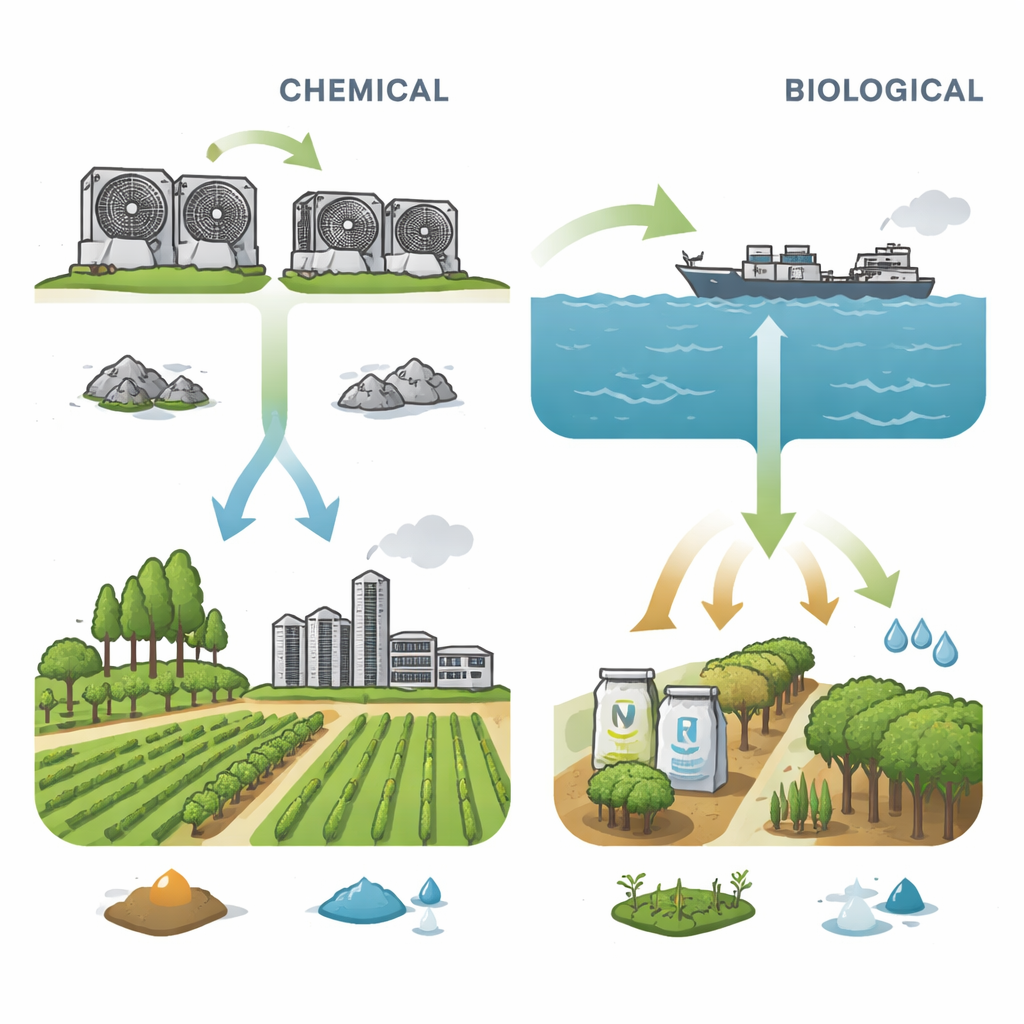
The authors examine a broad menu of “negative emissions” options that remove carbon dioxide from the air and store it for decades or longer. Some are chemical systems, like direct air capture machines that scrub carbon from ambient air, and ocean liming, which adds a processed form of limestone to seawater so the ocean can absorb more carbon. Others are biological approaches that work through plants: growing forests, burning biomass for energy while capturing the resulting emissions (known as BECCS), and turning plant material into charcoal-like biochar that can be buried in soils or used in construction materials. The team models 24 future scenarios from 2030 to 2050, each dominated by one of these approaches, all designed to remove enough carbon to help keep warming near 1.7 °C by the end of the century.
How efficient and helpful are these methods?
To judge performance, the study looks beyond simple “tons of CO2 removed.” It tracks how much warming is actually avoided once the emissions from building and operating each system are counted, and it tallies impacts on human health and ecosystems over the first 20 years. Chemical methods powered by renewable electricity come out on top in pure carbon terms: wind- or solar-driven direct air capture and ocean liming can keep roughly 90–97% of the carbon they pull down from being canceled out by their own emissions. Biochar used in building materials and BECCS can also perform well, especially when they use agricultural and forestry residues rather than crops grown specifically for energy. But tree planting and soil-applied biochar lose some of their initial gains over time, as fires and gradual decay send part of the stored carbon back into the air.
Hidden costs in health, nature, and planetary limits
When the authors factor in broader side effects, a more mixed picture emerges. In the short term, chemical options generally bring net health and ecosystem benefits: by helping to slow warming, they reduce climate-related harm more than they add pollution. Biological options are more problematic. Large energy-crop plantations and intense use of fertilizers and irrigation increase pressure on rivers, soils, and wildlife. The study shows that BECCS and biochar, if scaled aggressively, could push the already stressed “planetary boundaries” for land ecosystems, freshwater use, and nutrient cycles closer to dangerous levels. Forest-based carbon removal is even less straightforward than it seems: higher risks of wildfires under climate change can erase much of the stored carbon and create air pollution with major health impacts.
The resource squeeze: minerals and nutrients
A key contribution of this work is its detailed look at physical resources. Chemical methods need large amounts of metals and minerals to build plants, wells, and, in the case of ocean liming, to mine and process limestone. The analysis finds that by 2050, meeting carbon removal targets mainly with direct air capture could require nickel and barium mining equal to up to roughly 80% of today’s global output of those materials, potentially competing with batteries and other clean technologies. Biological methods pose a different kind of risk: they demand huge extra quantities of fertilizers, especially potassium, phosphorus, and magnesium. In some scenarios, potassium mining would need to rise by as much as 70% compared with current levels to feed energy crops and biochar systems, raising concerns about food security and the availability of critical nutrients for agriculture and industry.
What this means for future climate choices
The authors conclude that no carbon removal method is free of trade-offs, reinforcing the idea that cutting fossil fuel use must remain the top priority. Among the options studied, direct air capture and ocean liming powered by renewable energy look environmentally safer overall, though they still drive extra mining and, in practice, remain expensive. In contrast, heavy reliance on tree planting, BECCS, or large-scale biochar could damage ecosystems, strain water supplies, and intensify competition for fertilizers, especially if they depend on dedicated energy crops rather than residues. For policymakers and investors, the message is clear: carbon removal must be planned as part of a balanced portfolio that respects planetary boundaries, safeguards food and water, and builds supply chains able to handle the added demand for minerals and nutrients—rather than treating any single method as a simple, no-regret fix.
Citation: Cobo, S., Galán-Martín, Á. & Guillén-Gosálbez, G. Negative emissions technologies and practices could challenge global resource supply and environmental limits. Commun Earth Environ 7, 354 (2026). https://doi.org/10.1038/s43247-026-03348-8
Keywords: carbon dioxide removal, negative emissions technologies, direct air capture, bioenergy with carbon capture, planetary boundaries