Clear Sky Science · en
Seismic effects of deep crustal high-density material in the southeastern Korean Peninsula
Hidden Weight Beneath the Crust
Why did two of South Korea’s largest recorded earthquakes strike in nearly the same region just a year apart? This study looks beyond the familiar ideas of plate collisions and human activity to a much less visible player: a heavy slab of rock buried deep in the crust beneath the southeastern Korean Peninsula. By modeling how this dense material bends the crust and reshapes stresses on faults, the authors show that what lies tens of kilometers underground can quietly prime faults for powerful earthquakes at the surface.
A Region of Unusual Shaking
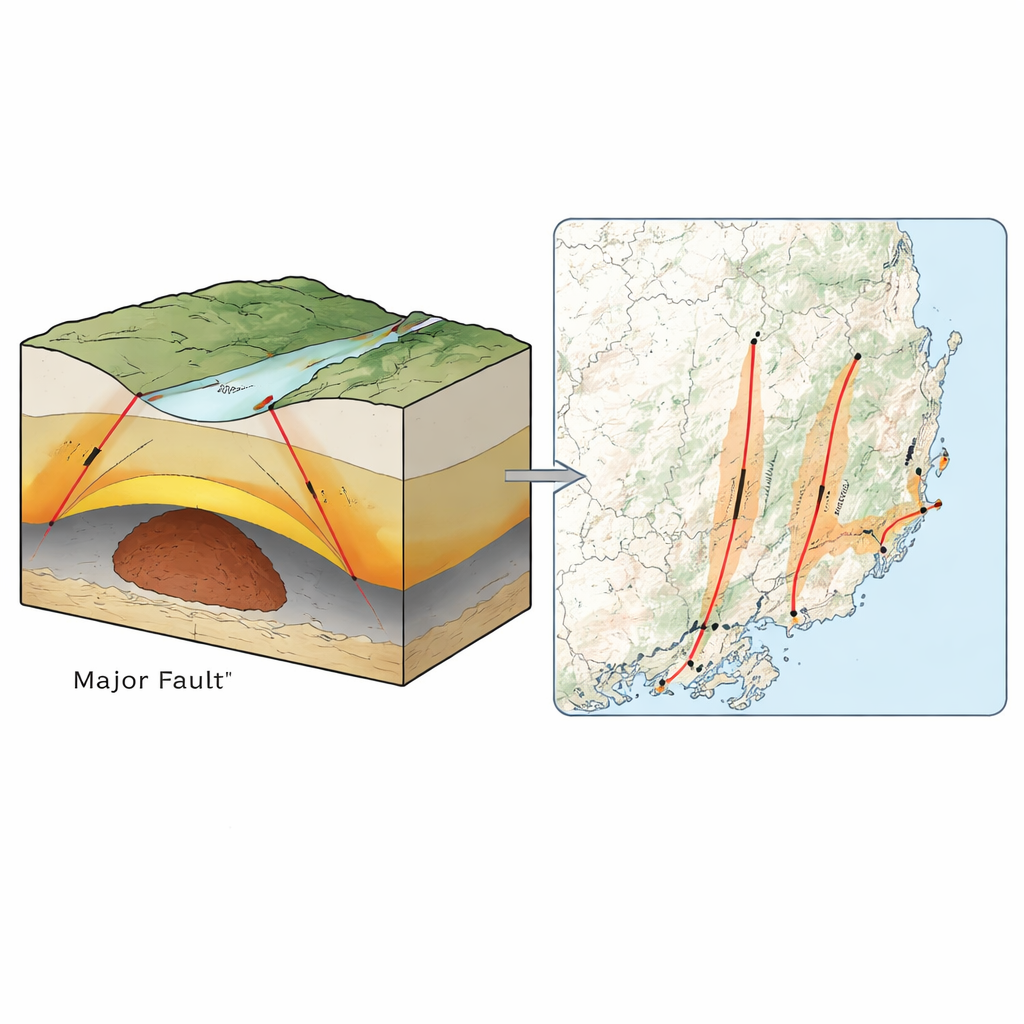
The 2016 Gyeongju and 2017 Pohang earthquakes, both magnitude 5.5, occurred near the Yangsan Fault system in southeastern Korea, an area already known for relatively high earthquake activity. The Pohang event drew global attention because it was linked to fluid injection at a geothermal project, but the amount of injected water was too small to fully explain the quake’s large energy release. At the same time, gravity measurements over this region reveal a strong positive anomaly, a clue that something unusually dense sits deep in the crust. Previous seismic and magnetic surveys suggested the presence of a thick zone of mafic, or iron- and magnesium-rich, rock thought to have formed when magma pooled and solidified at the base of the crust as the nearby East Sea opened millions of years ago.
A Buried Slab That Bends the Crust
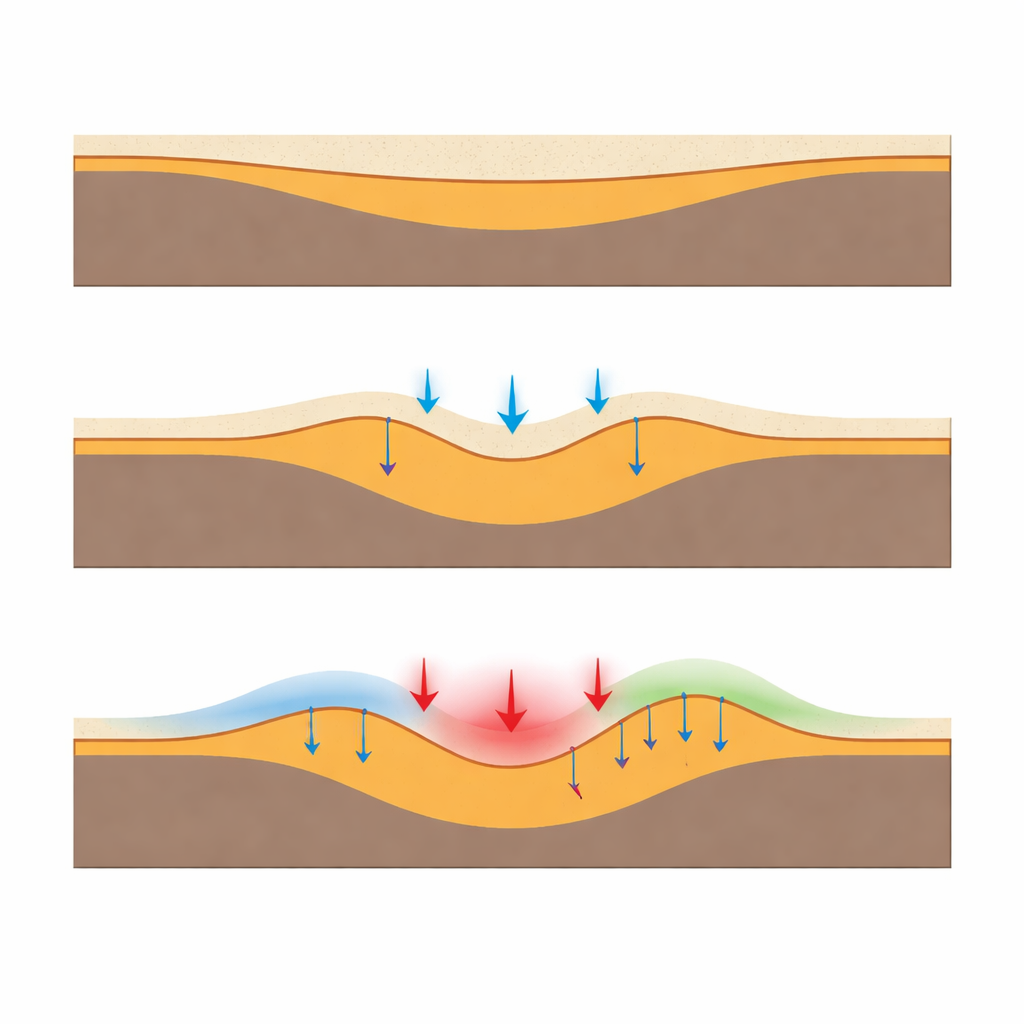
The researchers set out to understand how this high-density material, interpreted as magmatic underplating, changes stresses in the crust and influences major faults. They first used detailed gravity and seismic data to build a two-dimensional picture of crustal density from inland Korea out to the East Sea, then converted it into a three-dimensional model of the region. In their simulations, the dense body sits just above the boundary between crust and mantle, and is thicker to the east beneath the coastal area and thinner to the west inland. Because it is heavier than the surrounding rock, it acts like a buried weight that slowly pushes the crust downward where it is thick, while causing gentle upward flexing near its edges.
Heat, Flow, and Shifting Stresses
Temperature plays a crucial role in this story. Measurements on land and at sea show that southeastern Korea and the adjacent Ulleung Basin are hotter than the Korean Peninsula on average. Warmer rock in the lower crust and upper mantle is softer and flows more easily, allowing the dense body to sink more and bend the overlying crust more strongly. The team ran 3D viscoelastic models with different temperatures at the crust–mantle boundary, from relatively cool to quite hot. In the hotter cases, the dense layer pulled down more, amplifying stress changes in the upper crust. Directly above the thicker eastern part, the subsiding weight created extra compressive stress; toward the thinner western margin, the flexing produced zones of tension. These stress differences extended upward to depths where earthquakes occur and outwards by tens of kilometers.
Faults Poised Closer to Failure
To see how this deep loading might affect real earthquakes, the authors calculated changes in a quantity called Coulomb failure stress on mapped faults, including the planes that ruptured in the Gyeongju and Pohang events. Positive changes mean a fault is pushed closer to slipping; negative changes mean it is stabilized. Even without the dense body, far-field tectonic compression from plate motions already loads many faults in southeastern Korea. Adding the high-density layer, however, systematically increased the failure stress by roughly 0.2 to 1 megapascal on the Pohang and Gyeongju fault planes and on several nearby fault segments, especially above the thicker eastern part of the body. These stress boosts were larger than the direct stress changes calculated from the Pohang fluid injection itself, and they became stronger as the modeled crust became hotter and weaker.
Rethinking Earthquake Hazard in “Stable” Regions
This work concludes that a deep, heavy slice of rock beneath southeastern Korea has been quietly raising the background stress on faults for a long time, helping explain why this region hosts the country’s most significant recent earthquakes. Human activities such as fluid injection may still act as the final trigger, but only because the faults were already near a critical state due to tectonic loading enhanced by the buried dense body. For people living in areas often considered geologically stable, the message is clear: earthquake hazard is not controlled by plate boundaries alone. Subtle variations in crustal density, temperature, and rheology can concentrate stresses far from plate edges, so robust seismic risk assessments must look deep below the surface, integrating gravity, heat flow, and detailed subsurface imaging with traditional tectonic models.
Citation: Kim, M., Choe, H., Cheon, Y. et al. Seismic effects of deep crustal high-density material in the southeastern Korean Peninsula. Commun Earth Environ 7, 328 (2026). https://doi.org/10.1038/s43247-026-03345-x
Keywords: intraplate earthquakes, seismic hazard, magmatic underplating, crustal stress, Korean Peninsula