Clear Sky Science · en
Anaerobic urea oxidation is an overlooked but globally relevant nitrogen loss pathway in marine sediments
Why hidden nitrogen pathways matter
Excess fertilizer and wastewater pour huge amounts of nitrogen into the ocean, fueling algal blooms and low‑oxygen "dead zones." Scientists know that microbes living in seafloor mud help clean up this excess by turning reactive nitrogen into harmless nitrogen gas. Until now, only two main clean‑up routes were widely recognized. This study reveals that a third, overlooked route—an oxygen‑free way of burning urea in sediments—quietly removes a meaningful share of nitrogen, especially in the deep sea. 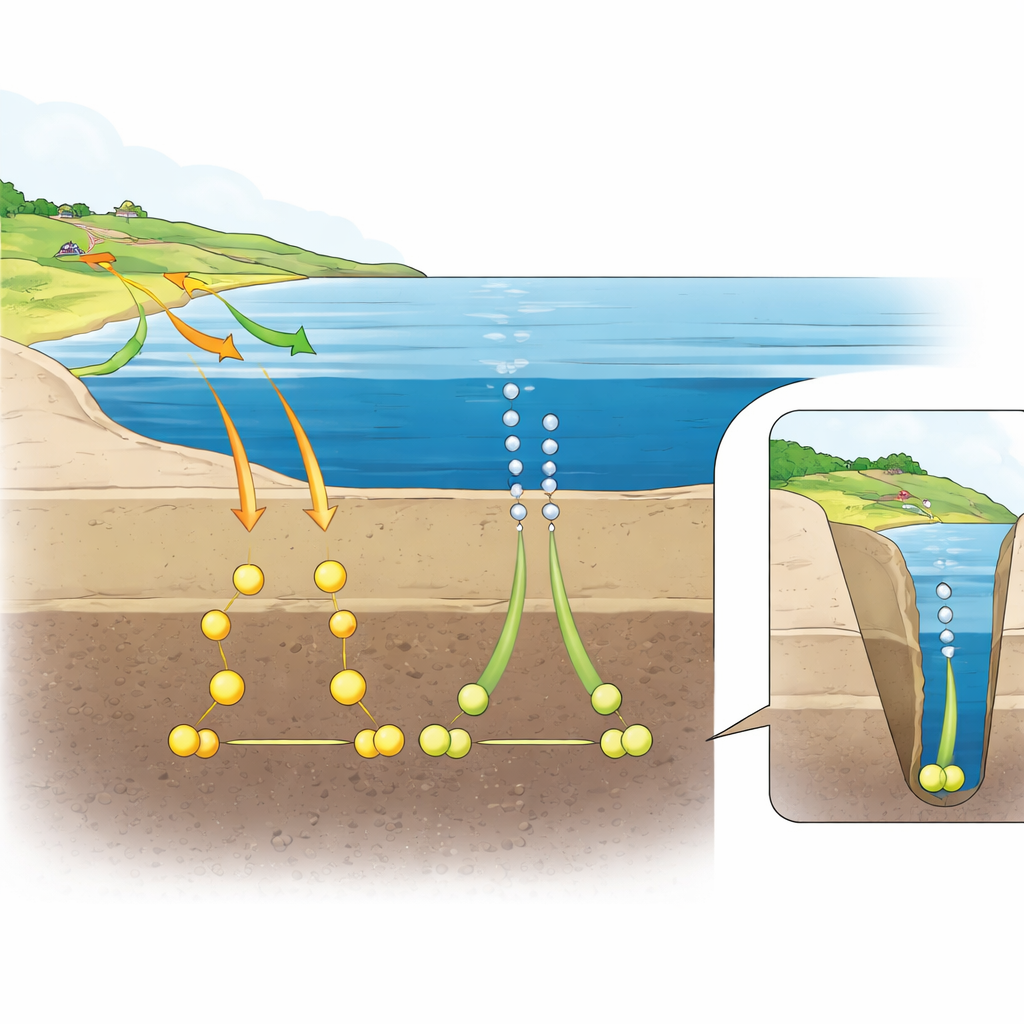
A quiet chemical in busy coastal seas
Urea is best known as a waste product from animals, but in the ocean it is also made by microbes and added by human activities. The authors measured urea in mud beneath China’s coastal seas, from the Bohai and Yellow Seas to the East China Sea. They found that, although urea is generally less abundant than ammonium, it can make up a substantial slice of dissolved organic nitrogen in sediment porewaters. Concentrations were higher near the surface and dropped with depth, a sign that microbes are steadily consuming it. In key layers where oxygen is gone but nitrate and nitrite are still present, urea and these oxidized nitrogen forms overlap, creating the right conditions for a previously suspected but unproven pathway: anaerobic urea oxidation.
Proving a hidden pathway in the mud
To detect this process directly, the team used a sensitive tracer method. They spiked sediment slurries with urea carrying a heavy form of nitrogen and watched for the appearance of labeled nitrogen gas. At most stations they saw a clear, linear build‑up of labeled gas under oxygen‑free conditions, which disappeared when the mud was sterilized or starved of nitrate and nitrite, proving that living microbes were at work. However, some of the signal could come from a side route, where urea first breaks down into ammonium that is then processed by already known microbes. The researchers built a refined calculation scheme that separates this indirect route from true direct urea oxidation, using simultaneous measurements of labeled ammonium and gas. After this correction, they still detected direct anaerobic urea oxidation in 90% of the sampled sites, showing that the pathway is widespread.
How competition shapes this hidden process
With the process confirmed, the authors asked how important it is compared with the familiar route in which microbes oxidize ammonium without oxygen. In China’s marginal seas, urea‑based oxidation ran more slowly, contributing on average about 15% of the rate of ammonium oxidation and only a few percent of total nitrogen loss when classic denitrification is included. Yet the share from urea was not fixed. Experiments showed that both urea and ammonium routes respond similarly to temperature, but microbes appear to favor ammonium because it is easier to use. Where porewater ammonium was high, the relative contribution from urea was strongly suppressed; where ammonium was scarce, urea played a bigger role. This tight, quantitative link between ammonium levels and the urea pathway allowed the team to build a predictive relationship for other parts of the ocean. 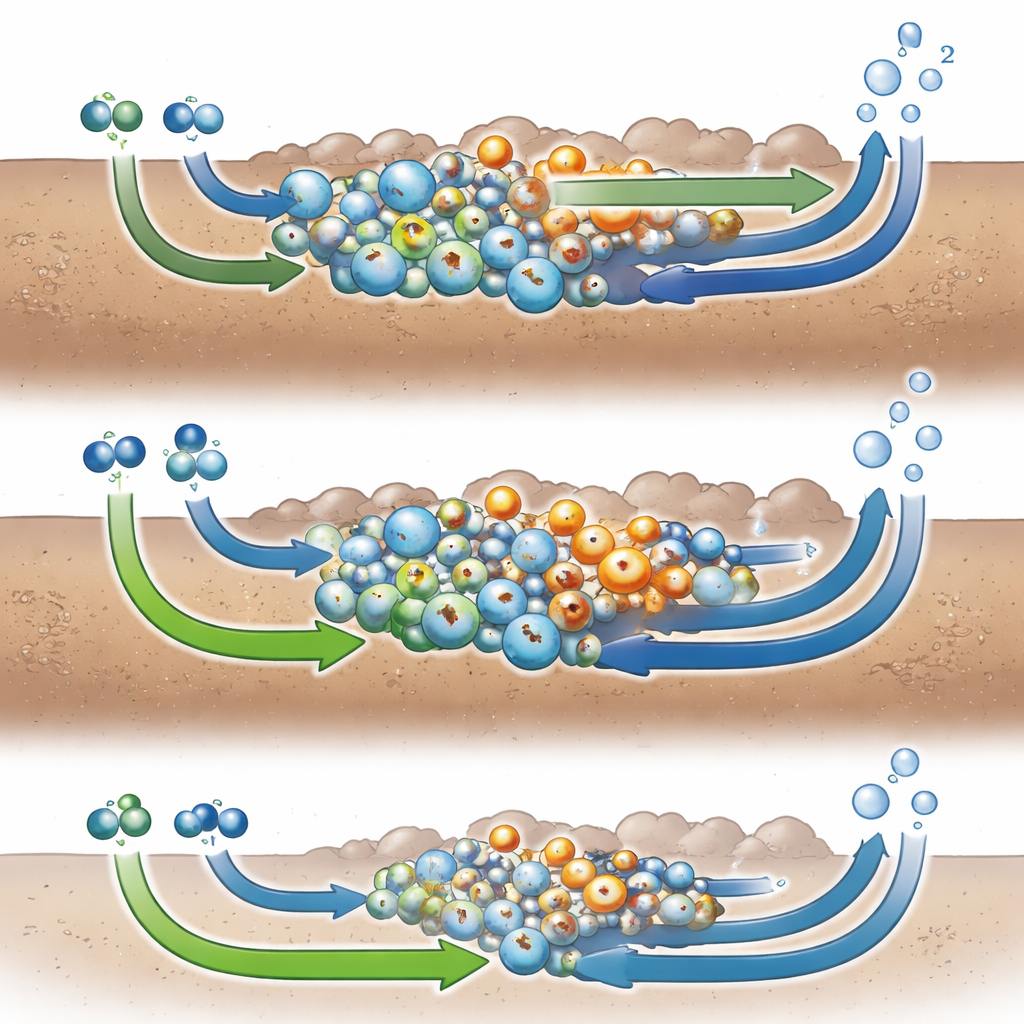
A global view from shallow shelves to deep trenches
Armed with this relationship and published data on nitrogen cycling and ammonium in sediments worldwide, the researchers estimated how much nitrogen anaerobic urea oxidation removes on a global scale. They found that the absolute rate is comparable across most depth zones but drops in the deepest trenches. In contrast, its share of total nitrogen loss climbs steadily with depth: it is modest on productive continental shelves, larger on the continental slopes, and reaches around one‑fifth of nitrogen loss in some abyssal and hadal sediments. Overall, the authors calculate that this pathway accounts for roughly 7% of nitrogen removed from marine sediments each year, with deep, nutrient‑poor seafloor contributing a disproportionate fraction.
What this means for the ocean’s nitrogen balance
For non‑specialists, the message is that the ocean’s "self‑cleaning" of excess nitrogen is more complex than previously appreciated. Microbes in dark, oxygen‑free mud do not rely only on one or two nitrogen foods; they can also tap urea directly, especially in deeper, low‑ammonium sediments. Even though this pathway is slower than its ammonium‑based cousin, it is widespread enough to matter for the planet‑scale balance of nitrogen. Because existing models of the marine nitrogen cycle largely ignore anaerobic urea oxidation, this work suggests that current estimates of how quickly the ocean can rid itself of reactive nitrogen—and how it will respond to continued human inputs and climate change—need to be revised.
Citation: Xu, H., Song, G., Zhu, R. et al. Anaerobic urea oxidation is an overlooked but globally relevant nitrogen loss pathway in marine sediments. Commun Earth Environ 7, 299 (2026). https://doi.org/10.1038/s43247-026-03323-3
Keywords: marine nitrogen cycle, seafloor sediments, urea oxidation, anammox, deep sea biogeochemistry