Clear Sky Science · en
Above canopy and understory nitrogen additions lead to divergent spatio-temporal nitrogen retention patterns in a temperate forest
Why Extra Nitrogen in Forests Matters
Across the globe, human activities are showering forests with more and more reactive nitrogen, a key nutrient in fertilizers and air pollution. This invisible fallout can boost tree growth, but it can also destabilize soils, waterways, and biodiversity. To predict which future we are heading toward, scientists need to know a simple but surprisingly tricky thing: when nitrogen lands on a forest, where does it actually end up? This study tackles that question by comparing nitrogen added above the treetops with nitrogen sprayed directly onto the forest floor in a temperate forest in China.
Two Ways Nitrogen Enters a Forest
Most experiments that mimic nitrogen pollution simply add fertilizer to the ground. In reality, though, much of the nitrogen in rain, snow, and dry particles first hits the leafy canopy, where it can be intercepted, transformed, or even lost before reaching the soil. The researchers took advantage of a young secondary oak forest in the Qinling Mountains, a region that has become a hotspot for atmospheric nitrogen deposition. They used drones to spray tiny amounts of nitrogen enriched with a stable isotope "tag" above the canopy, and backpack sprayers to apply the same tagged nitrogen below the canopy to the understory and soil. By tracking this harmless tracer over a full year, they could follow nitrogen’s journey into leaves, wood, roots, and soil layers with unusual precision. 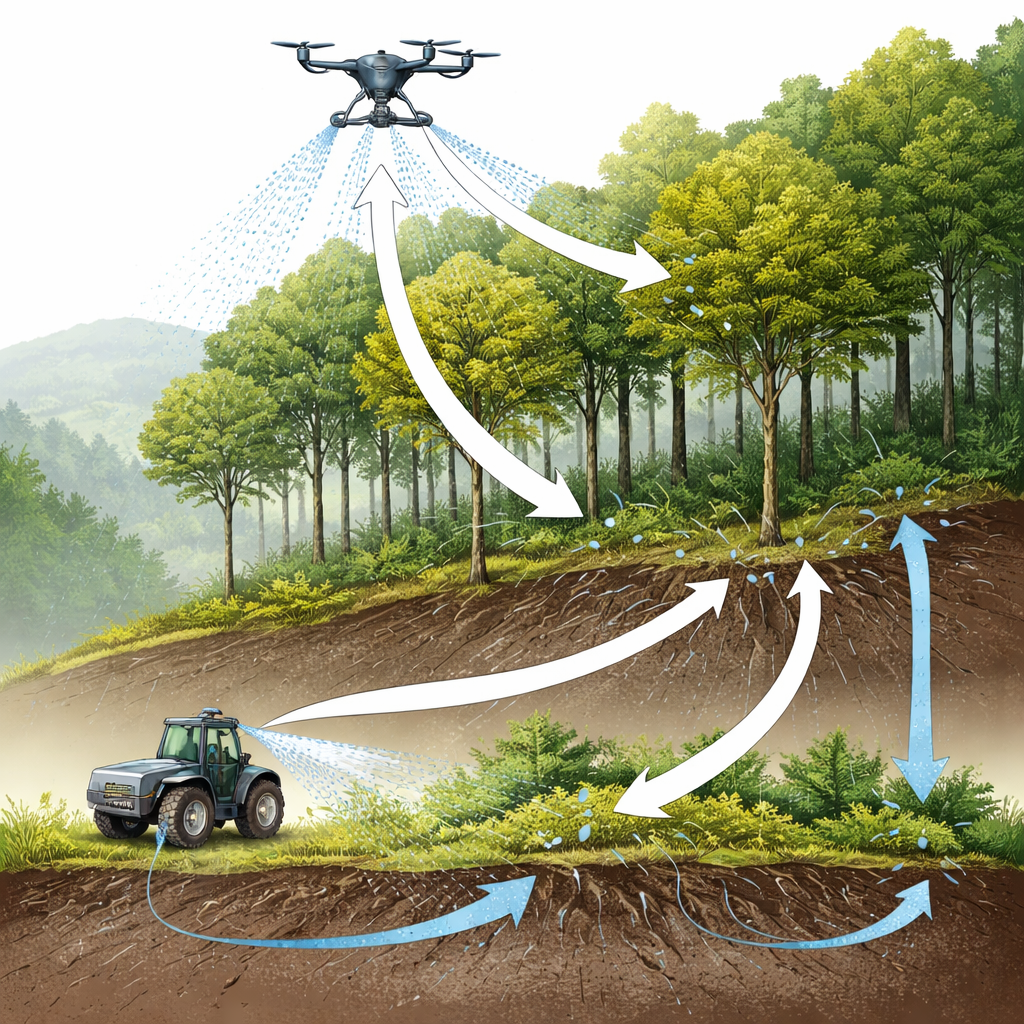
Following Tagged Nitrogen Through the Forest
The team applied two common forms of inorganic nitrogen, ammonium and nitrate, in both canopy and understory treatments. They then sampled foliage, branches, stems, understory plants, roots, and soils down to 40 centimeters at several time points over 365 days. The isotope tag allowed them to separate newly added nitrogen from the forest’s existing supply. Right after application, understory fertilization led to a higher share of the new nitrogen being found in the ecosystem as a whole than canopy fertilization, mainly because little was intercepted or lost before it hit the ground. However, over the course of the year, this gap narrowed: by day 365, the forest had retained about 82 percent of the added tracer when applied to the understory and nearly 70 percent when applied to the canopy, indicating substantial long-term storage under both scenarios.
Different Storage Spots for Canopy and Ground Inputs
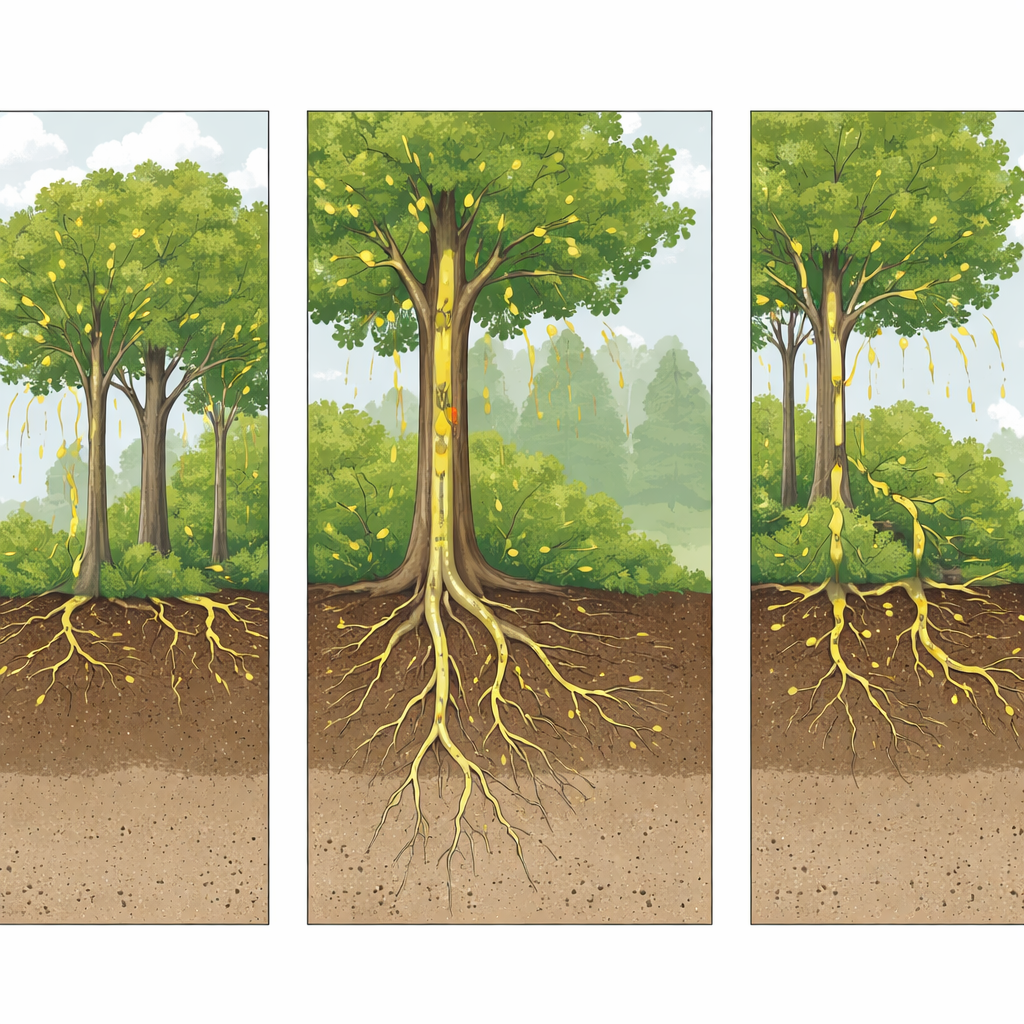
Although total retention ended up similar, the place where nitrogen was stored differed sharply between the two methods. When added above the canopy, more of the tracer ultimately accumulated in tree biomass, especially in woody stems, which became the single largest storage pool after one year. In this case, trees held nearly twice as much of the new nitrogen as the soil did, and a greater share also moved into deeper soil layers. In contrast, when nitrogen was applied to the forest floor, it was first captured strongly by understory shrubs, herbs, and surface litter, and then increasingly stored in the upper 40 centimeters of soil. Understory addition promoted high retention in shallow soil layers rather than in tree wood, reflecting immediate uptake by roots and microorganisms near the surface and less filtering by the canopy.
How Nitrogen Form Shapes Its Fate
The chemical form of nitrogen also influenced how it moved through the forest. Overall, the ecosystem retained similar total amounts of ammonium and nitrate, but plants showed a clear preference for nitrate. Trees and shrubs incorporated more nitrate into their tissues, particularly long-lived stems, while soils held ammonium and nitrate in roughly comparable amounts. This pattern likely arises because nitrate is more mobile in soil water and more easily transported inside plants, whereas ammonium tends to stick to soil particles. Interestingly, at this relatively nitrogen-rich site, microbes and soil chemistry were able to immobilize both forms efficiently, helping to keep much of the added nitrogen from being quickly lost.
What This Means for Forests and Climate
To a lay observer, the study’s key message is that how we simulate nitrogen pollution in experiments can strongly influence the answers we get. Adding nitrogen only to the ground overestimates how much ends up in surface soils and underestimates the canopy’s role as a gatekeeper and long-term storage hub in wood and deeper soil. In this young temperate forest, nitrogen falling onto the canopy slowly feeds trees and deeper soil, while nitrogen reaching the understory directly is trapped quickly by small plants and topsoil. Both routes can store a large share of incoming nitrogen, but in different places and on different timescales. These insights should help improve models that link nitrogen pollution to forest growth and carbon storage, ultimately refining predictions of how forests will respond to ongoing changes in air quality.
Citation: Yang, Z., Guerrieri, R., Ye, N. et al. Above canopy and understory nitrogen additions lead to divergent spatio-temporal nitrogen retention patterns in a temperate forest. Commun Earth Environ 7, 316 (2026). https://doi.org/10.1038/s43247-026-03313-5
Keywords: nitrogen deposition, forest canopy, soil nutrients, stable isotope tracing, carbon sequestration