Clear Sky Science · en
Marine cloud brightening mitigates the warming induced by the aerosol reductions toward carbon neutrality
Why brighter clouds matter for our future
As the world cuts air pollution and moves toward carbon neutrality, an unexpected problem emerges: some of the particles we are removing have been quietly cooling the planet. This study asks whether we could deliberately brighten certain ocean clouds to make up for that lost cooling, holding global temperature and rainfall close to today’s levels while we keep reducing greenhouse gases.
Turning sea spray into a planetary shade
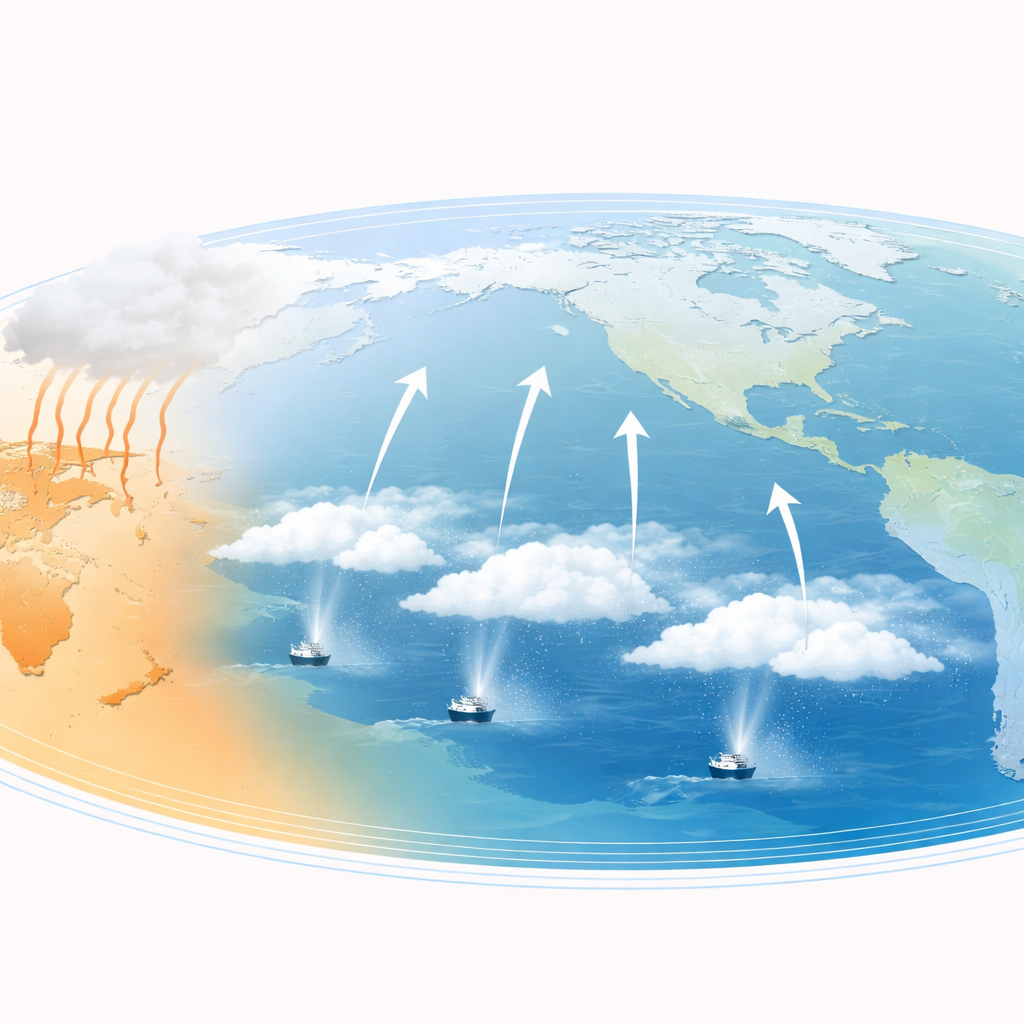
Over the oceans, vast decks of low clouds already bounce a portion of sunlight back to space. The idea behind marine cloud brightening is to spray extra fine sea-salt particles into the air so that these clouds form many more, smaller droplets. That makes them whiter and longer‑lived, increasing their cooling power. The authors use a sophisticated climate model to simulate adding such sea-salt particles in four cloudy regions over the eastern Pacific Ocean from 2020 to 2100, following a stringent emissions pathway in which the world aggressively cuts both greenhouse gases and air pollutants.
Hidden warming from cleaner air
In a carbon‑neutral future, human‑made air pollution drops sharply. While this is a major win for health, it also removes particles that currently reflect sunlight and help form bright clouds. In the model, this cleanup alone adds about 0.9 °C of global warming by late century compared with 2020, with particularly strong warming over land and in the Arctic. Rainfall also increases globally, and many regions see more intense precipitation. These changes are driven not by extra greenhouse gases—the simulations hold those constant—but by the loss of the cooling effect from aerosols.
Brightening clouds to hold the line
To counter this effect, the researchers gradually ramp up sea‑salt injections over the four eastern Pacific regions, reaching roughly 94 billion kilograms of extra sea salt per year by 2100. In the model, this brightens low clouds, increases their liquid water, and expands their coverage, especially over the targeted ocean areas. As a result, more sunlight is reflected back to space. Globally, this extra cooling nearly cancels the warming from aerosol reductions: the simulated average surface temperature and overall rainfall stay close to 2020 values throughout the century.
Uneven regional impacts and shifting storms
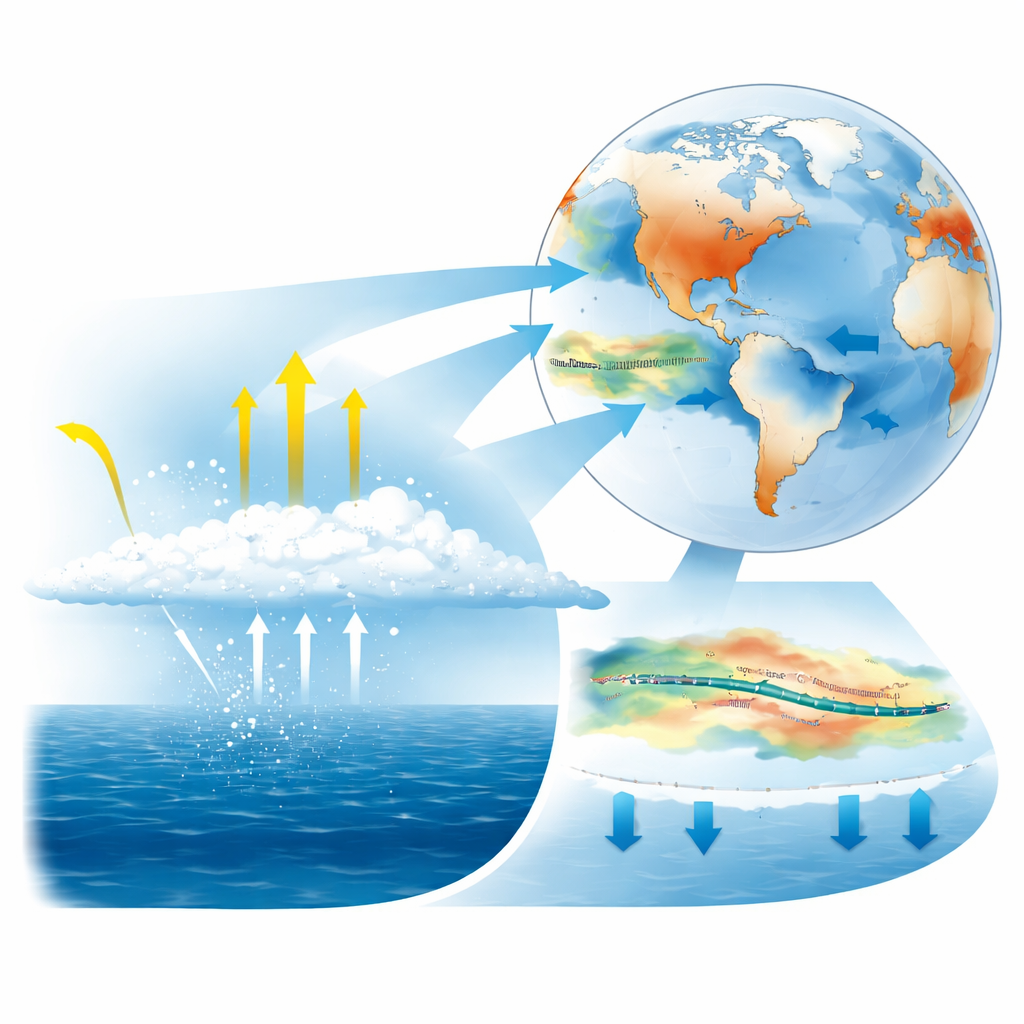
Although the global averages look promising, the regional story is much more complicated. The strong cooling over the eastern Pacific alters winds and ocean currents in a way that resembles the La Niña phase of the El Niño–Southern Oscillation: cooler waters in the eastern tropical Pacific, strengthened trade winds, and changes in tropical rainfall belts. Some areas, including the Sahel, India, Australia, and the Amazon, end up cooler and wetter than today. But important regions such as Europe, the United States, and northeastern China still warm relative to 2020, and parts of the U.S. become drier. The model also shows changes in a major Atlantic circulation system that help carry extra heat toward Europe and North America, offsetting some of the intended cooling there. Sea ice loss in the Arctic and Antarctic slows but is not fully prevented.
What this means for using bright clouds as a tool
For a layperson, the takeaway is that brightening selected ocean clouds could, in principle, keep the planet’s average temperature and rainfall from rising as we clean up air pollution. Yet the same intervention would rearrange climate patterns, bringing extra cooling and rain to some regions while leaving others hotter or drier. Because these outcomes depend sensitively on where and how the clouds are seeded, and on the climate model used, marine cloud brightening is not a simple global thermostat. Any serious consideration of this approach would require far more research, careful design, and international debate about who bears the risks and who receives the benefits.
Citation: Yu, Y., Yang, Y., Wang, H. et al. Marine cloud brightening mitigates the warming induced by the aerosol reductions toward carbon neutrality. Commun Earth Environ 7, 275 (2026). https://doi.org/10.1038/s43247-026-03304-6
Keywords: marine cloud brightening, solar geoengineering, aerosol reduction, carbon neutrality, climate risk