Clear Sky Science · en
Carbonic anhydrase traced by cadmium isotope fractionations in Archean to Holocene stromatolitic carbonates
A Hidden Story in Ancient Layered Rocks
Some of the oldest rocks on Earth, called stromatolites, are built by microbes and preserve a chemical diary of our planet’s early life and oceans. This study shows that a tiny metal, cadmium, locked inside these layered rocks can reveal when a key enzyme for handling carbon dioxide—carbonic anhydrase—began to shape Earth’s carbon cycle. By reading subtle differences in cadmium atoms from rocks up to 3.35 billion years old, the authors trace how early microbes learned to use metals in ever more sophisticated ways, paving the way for modern-style photosynthesis and, eventually, an oxygen-rich world.
Layered Microbial Worlds Through Time
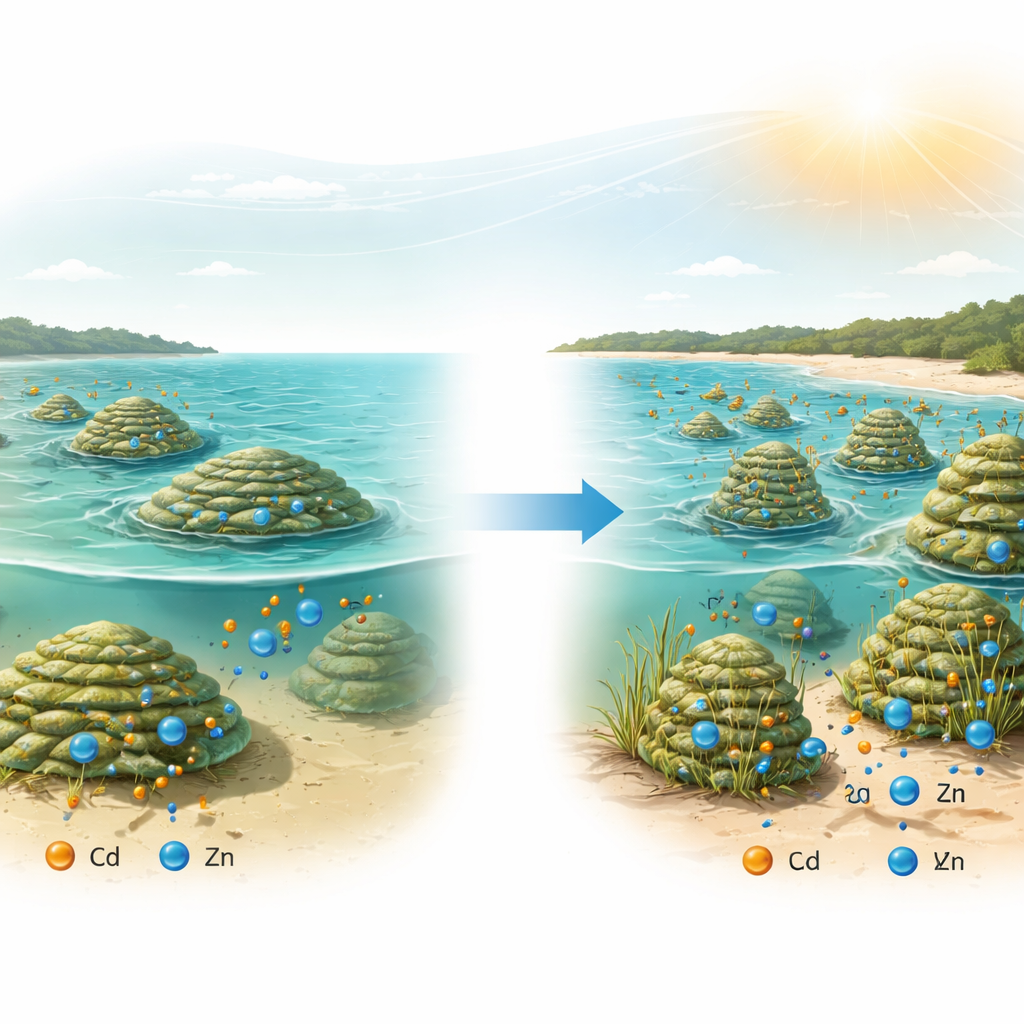
Stromatolites form where microbial mats trap and bind sediment and encourage minerals to precipitate, building up layer upon layer like a rocky tree ring. Western Australia preserves spectacular examples from three very different times: ancient marine stromatolites in the Strelley Pool Formation (~3.35 billion years old), lake or shallow-lagoon stromatolites in the Tumbiana Formation (~2.72 billion years old), and modern stromatolites in the hypersaline Hamelin Pool of Shark Bay. Because these rocks are unusually well preserved, their chemistry still reflects the waters and microbial communities in which they formed, making them ideal archives of how early life interacted with its environment.
Why a Metal Enzyme Matters for Life
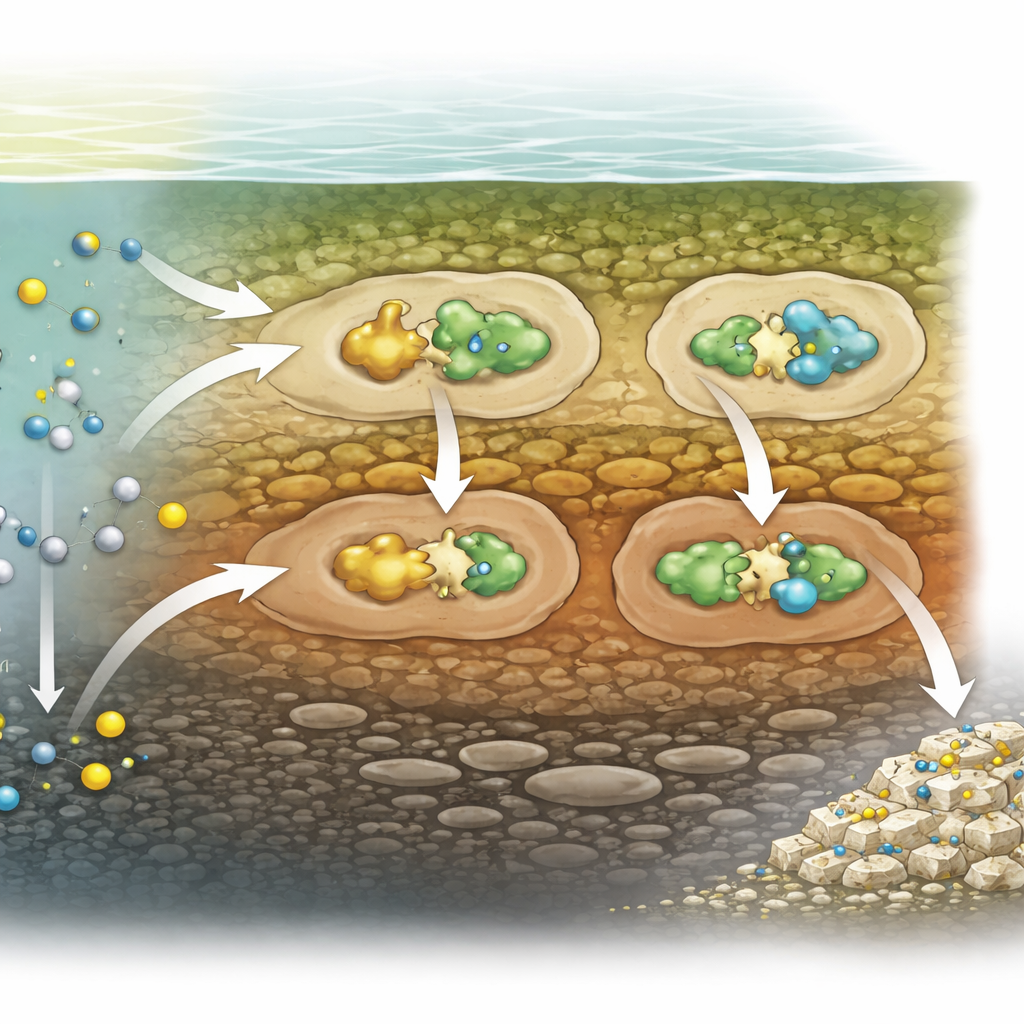
In microbial mats, chemistry can change dramatically over just a few millimeters, as light, oxygen, and acidity shift between day and night and with depth. Carbonic anhydrase is an enzyme that helps microbes rapidly switch dissolved inorganic carbon between different forms so they can fix carbon efficiently and keep their internal chemistry in balance. Today this enzyme usually uses zinc as its metal helper, but in some modern microbes it can swap zinc for cadmium when zinc is scarce. That swap leaves a distinctive fingerprint in the ratios of cadmium isotopes—atoms of cadmium that differ slightly in mass—that can be preserved when carbonate minerals form within or around the microbial mat.
Reading Cadmium Signals in Ancient Rocks
The authors carefully dissolved only the carbonate part of stromatolite samples and measured cadmium concentrations and isotopes, along with other nutrients like phosphorus, zinc, copper, nickel, and sulfur. They ruled out contamination from clay minerals, late alteration by fluids, and purely inorganic processes such as adsorption onto metal oxides or random uptake of cadmium by cells. In all three settings, the stromatolites show cadmium that is both enriched relative to background crustal values and isotopically “heavier,” a pattern that matches what is seen when modern primary producers preferentially take up lighter cadmium isotopes into enzymes. In the modern Hamelin Pool, the cadmium data follow a classic Rayleigh-type pattern: as microbes draw cadmium and nutrients from a semi-closed water reservoir, the remaining dissolved cadmium becomes progressively heavier, and this evolving signal is captured in the forming carbonates.
From Simple Metal Use to Sophisticated Carbon Control
Comparing the ancient and modern sites reveals how microbial metal use evolved. The Archean (very ancient) stromatolites from Strelley Pool and Tumbiana contain more cadmium, zinc, copper, nickel, and phosphorus than their modern counterparts, reflecting different ocean chemistry and weaker biological removal of metals from surface waters. In the Neoarchean Tumbiana lake system, cadmium isotopes, phosphorus, and zinc all vary together in a way that strongly suggests cadmium and zinc were being used interchangeably as metal helpers in carbonic anhydrase. At the same time, high nickel levels and their relationship to cadmium point to active methane-producing and methane-consuming metabolisms. The older Strelley Pool stromatolites show only modest cadmium isotope shifts and lower cadmium-to-zinc ratios, hinting that carbonic anhydrase either was less widespread, used different metals, or played a smaller role in those early ecosystems.
A Metal Fingerprint for the Rise of Advanced Microbes
Taken together with similar data from other ages, this work indicates that enzymatic processes capable of strongly fractionating cadmium isotopes—especially the use of cadmium in carbonic anhydrase—were firmly established by the middle to late Archean and have persisted ever since. The study suggests that as Earth’s environments became more complex and metals like zinc grew harder to access, microbes increasingly turned to cadmium to keep carbonic anhydrase running, boosting carbon fixation and helping build the conditions needed for rising oxygen. For non-specialists, the key message is that by analyzing tiny shifts in a trace metal inside ancient microbial rocks, scientists can reconstruct when life developed more advanced machinery for handling carbon, offering a new window into how early ecosystems engineered the planet we inhabit today.
Citation: Hohl, S.V., Viehmann, S., Gleissner, P. et al. Carbonic anhydrase traced by cadmium isotope fractionations in Archean to Holocene stromatolitic carbonates. Commun Earth Environ 7, 276 (2026). https://doi.org/10.1038/s43247-026-03291-8
Keywords: stromatolites, cadmium isotopes, carbonic anhydrase, early Earth, microbial mats