Clear Sky Science · en
Heat loss and internal dynamics of Venus from lithosphere strength
Why a hot planet’s cool-down matters
Venus is often called Earth’s twin: it’s almost the same size and made of similar rock. Yet under its cloud-wrapped sky, the planet behaves very differently. Earth constantly renews its surface through moving plates that help vent heat from within. Venus, in contrast, seems to wear a single rigid shell. This study asks a deceptively simple question with big implications: how much heat is Venus actually losing today, and what does that reveal about the way the planet works inside?
Taking the planet’s temperature from orbit
We cannot drill into Venus, so the authors use an indirect approach to estimate its heat loss. They start from how strong the outer rocky shell, or lithosphere, is. A stiffer shell bends less under the weight of mountains and valleys, while a weaker one bends more. By carefully comparing global maps of Venus’s surface heights and gravity, the team updated a world map of lithospheric strength. From this, they inferred how thick the mechanically strong outer layer is around the planet. Because rock strength depends on temperature, this thickness can be translated into how hot the interior is and how much heat is flowing upward through the surface.

A global heat map of Venus
Using these strength measurements and a model of how heat moves through rock, the researchers produced the first global map of surface heat flow on Venus at a resolution of about 200 kilometers. On average, Venus releases roughly 31 milliwatts of heat through every square meter of its surface—less than Earth does. The hottest spots, mainly along great rift valleys and some volcanic regions, reach values comparable to active areas on our own planet. However, the contrast between “hot” and “cold” regions is modest: the highest modeled values are only about ten times the lowest, and most of the planet lies in a fairly narrow middle range.
A quiet interior, not a boiling cauldron
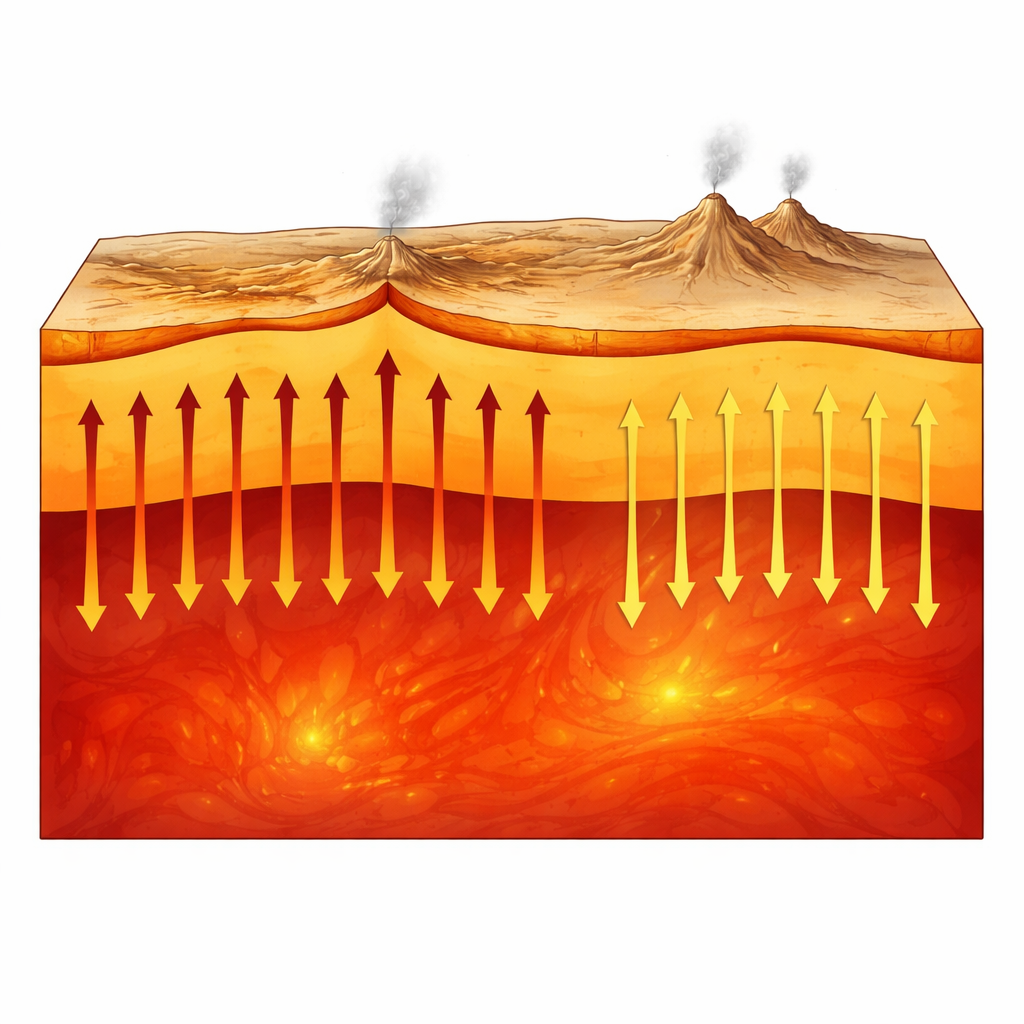
Summing up the map, the team finds that Venus sheds about 11–17 trillion watts (terawatts) of heat in total. That is roughly half of what Earth loses, even though the two planets are nearly the same size. When this output is compared with estimates of how much heat Venus generates internally from the decay of radioactive elements, a striking picture emerges: the planet’s heat loss is similar to, or only slightly higher than, its heat production. In other words, Venus today is barely cooling and could even be slowly warming inside. This behavior contrasts with Earth, where heat loss is two to three times greater than internal production, indicating vigorous long-term cooling driven by plate tectonics and seafloor spreading.
Stable crust with only local hotspots
The authors also test whether the inferred heat levels would melt the lower crust or transform it into denser rock that might sink into the mantle. Their temperature estimates at the base of the crust only rarely reach the conditions needed for widespread melting or for the key mineral changes that lead to sinking slabs. That suggests Venus’s crust is largely stable over long times, with localized activity at rifts and volcanic rises rather than planet-wide recycling of the outer shell. Some very hot regions, such as the deep rift known as Dali Chasma, do stand out, but these occupy a small fraction of the surface and contribute little to the global heat budget.
What this means for Venus’s past and future
To a non-specialist, the conclusion is surprisingly simple: despite its fiery reputation, Venus now lets go of its internal heat more slowly and more evenly than Earth does. The planet appears to operate in its own unique mode, without the efficient conveyor belt of moving plates that cools our world. This sluggish heat loss helps explain Venus’s smoother, more uniform surface and hints that its interior has changed little over hundreds of millions of years. Any successful story of Venus’s history—whether it involved past plate tectonics, episodic global resurfacing, or long-lived volcanic activity—must now match this key constraint: a planet that, today, is losing only a modest amount of heat and whose deep interior is cooling, at best, very slowly.
Citation: Ruiz, J., Jiménez-Díaz, A., Egea-González, I. et al. Heat loss and internal dynamics of Venus from lithosphere strength. Commun Earth Environ 7, 286 (2026). https://doi.org/10.1038/s43247-026-03278-5
Keywords: Venus interior, planetary heat flow, lithosphere strength, plate tectonics, mantle cooling