Clear Sky Science · en
Oxidation of zirconium alloys for nuclear fuel cladding
Why the skin of nuclear fuel matters
Nuclear power plants rely on long, thin metal tubes to hold their fuel and keep radioactivity contained. These tubes are made from zirconium alloys, which must survive years in hot, high-pressure water and, in rare emergencies, blasts of scorching steam. This review article explains how those alloys slowly rust, why that rust can suddenly worsen, how it lets hydrogen seep into the metal, and what scientists are doing to design safer, longer lasting fuel cladding for future reactors.
How zirconium cladding rusts in service
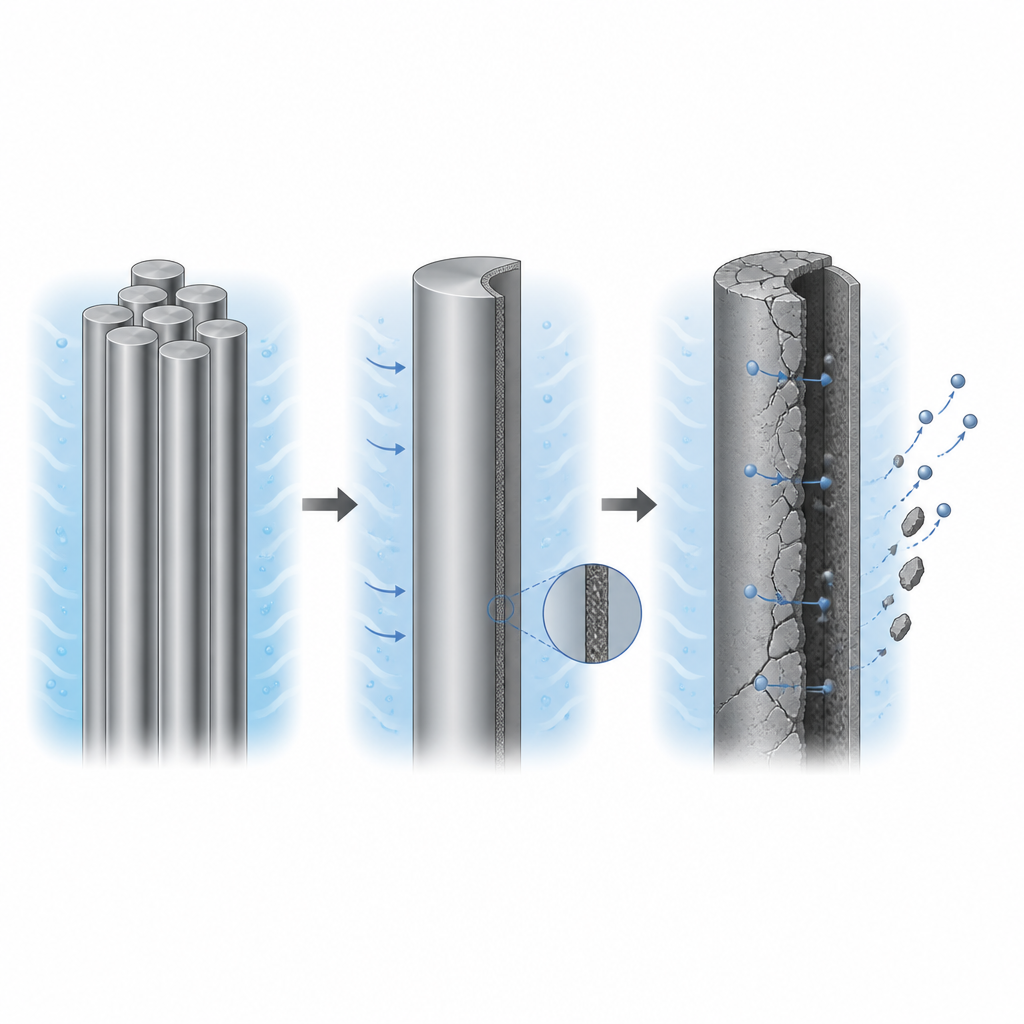
In a working reactor, zirconium alloy tubes sit in water at roughly three times the pressure at the bottom of the ocean and temperatures similar to a kitchen pressure cooker. Water molecules break apart at the metal surface, oxygen joins with zirconium to form a ceramic skin, and hydrogen is released. This oxide skin usually grows in a controlled way and acts as a barrier that slows further attack. Over years of operation, however, the layer thickens, internal stresses build up, and microscopic cracks appear. These cracks open quick routes for water and hydrogen, speeding corrosion and reducing how long the cladding can safely remain in the reactor.
What happens in an accident
During a loss of coolant accident, such as those considered after the Fukushima disaster, the same cladding can be suddenly exposed to steam at temperatures approaching those inside a pizza oven. Under these extreme conditions the oxide layer grows much faster and becomes uneven. Dense inner regions are covered by more porous outer regions, and local "blisters" of very thick oxide can form. The rusting no longer follows the gentle, slowing curve seen in normal service but can switch to an almost straight line, indicating runaway oxidation. This aggressive reaction also generates large amounts of heat and hydrogen, which threatens both the metal tubes and overall plant safety.
Hidden changes inside the rust layer
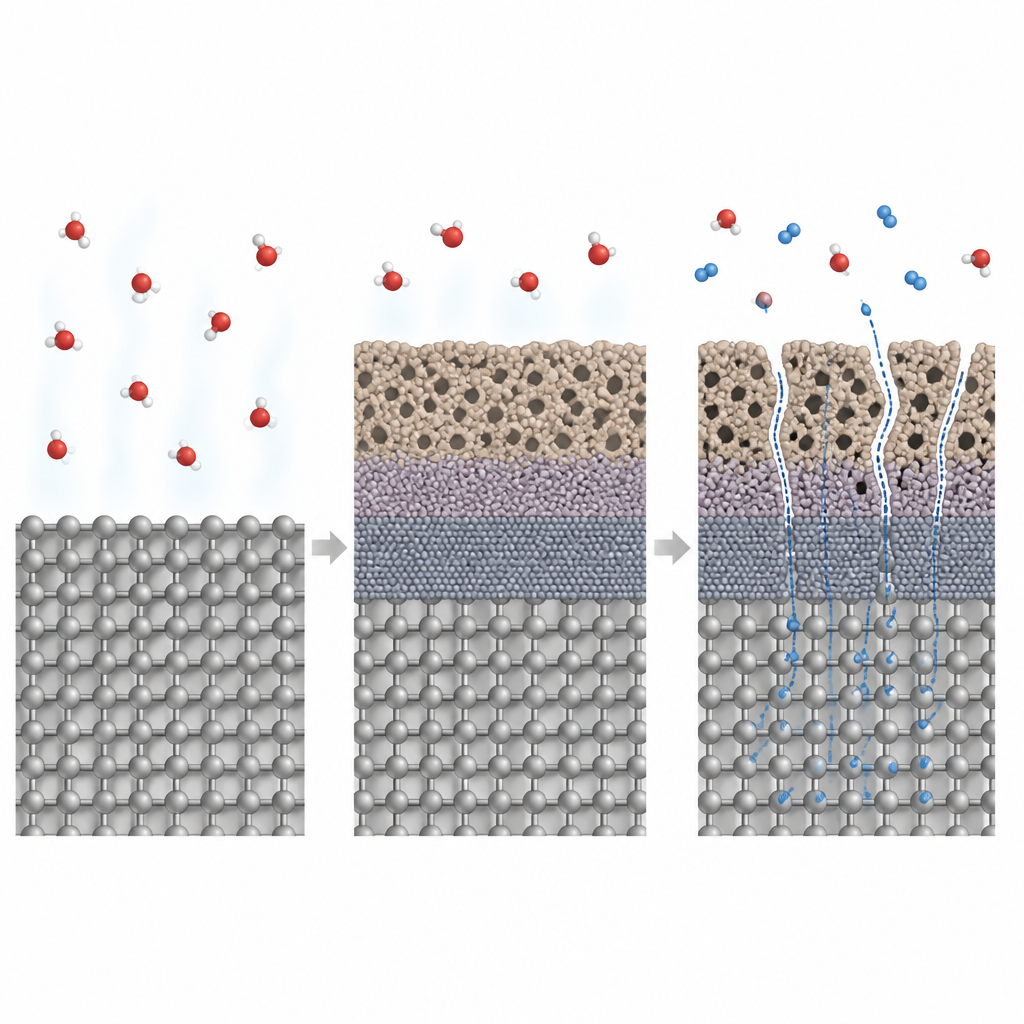
Although the oxide looks like a simple white film, its internal structure is complex and constantly changing. The protective skin is mainly zirconium dioxide, which can take on different crystal forms. A higher portion of a form called tetragonal tends to keep the layer more compact and protective, while a shift to a monoclinic form causes volume changes that crack and peel the oxide. Stress inside the layer, grain size, and tiny pores or tubes all influence this shape-changing behavior. These defects act like highways for oxygen and hydrogen, helping them reach the metal underneath, where hydrogen can collect and form brittle hydrides that weaken the cladding.
How alloy design and environment shape corrosion
The review shows that the exact recipe and microstructure of zirconium alloys strongly affect how they age. Additions of tin, niobium, iron, chromium, copper, and other trace elements can either slow or speed rusting, depending on their amount and how they cluster into small particles. Grain size, texture, and internal defects in the metal also matter, because they guide how the oxide layer starts and where it cracks. On top of that, the chemistry of the coolant water, including lithium and boron additives used to control the reactor, and the levels of dissolved oxygen and hydrogen, all shift the balance between smooth, uniform corrosion and harmful nodular attack. Neutron radiation in the core further stirs alloying elements and changes the oxide structure over time, adding another layer of complexity.
Looking at atoms to guide safer alloys
To untangle these many influences, researchers now combine advanced microscopes with computer simulations that track individual atoms. Calculations based on quantum mechanics and molecular dynamics follow how oxygen sticks to zirconium surfaces, diffuses along grain boundaries, and helps build the first layers of oxide. Larger scale models link these atom-level events to the growth rates and cracking patterns observed in real cladding. The review argues that future progress will depend on turning these insights into practical design rules that connect alloy composition and processing to long term behavior in reactors.
What this means for future nuclear energy
For non specialists, the main message is that the safety of nuclear fuel depends heavily on a thin, evolving rust layer that forms on its metal shell. This review brings together what is known about how that layer grows, changes shape, cracks, and lets hydrogen into the metal, and where major gaps in understanding remain. By clarifying how alloy recipes, water chemistry, temperature, radiation, and stress interact, the work points the way toward new zirconium based cladding that resists oxidation longer and takes up less hydrogen. Such accident tolerant alloys could give operators more time to respond in emergencies while keeping everyday corrosion under tighter control.
Citation: Liu, TY., Han, WZ. Oxidation of zirconium alloys for nuclear fuel cladding. Commun Mater 7, 137 (2026). https://doi.org/10.1038/s43246-026-01201-1
Keywords: zirconium alloys, nuclear fuel cladding, oxidation, hydrogen embrittlement, accident tolerant fuels