Clear Sky Science · en
Radiation damage in tungsten under high-energy He-ion irradiation
Why this matters for future clean power
Fusion power plants promise lots of low carbon electricity, but their inner walls must survive constant blasts of energetic particles. This review explains how tungsten, the leading wall material, changes when it is bombarded by fast helium ions, and what scientists are doing to make it tougher. Understanding this hidden damage helps determine whether fusion devices can run safely for years without their metal walls cracking, swelling, or failing.
The tough metal facing a harsh fireball
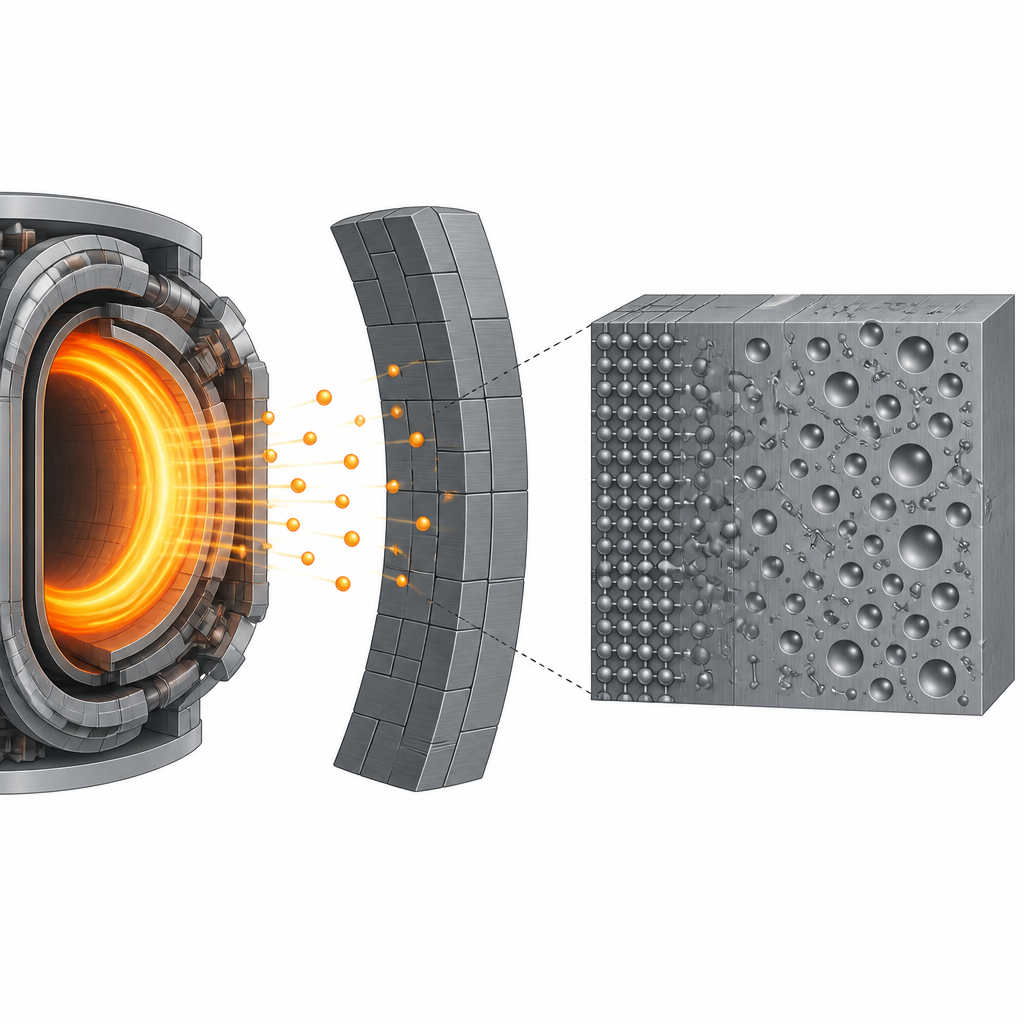
Inside a fusion reactor, a doughnut shaped cloud of super hot gas made of hydrogen isotopes produces helium nuclei and high energy neutrons. The surrounding metal surfaces, called plasma facing components, must endure intense heat and particle impacts. Tungsten is a top candidate because it melts at extremely high temperatures, conducts heat well, and sheds very little material into the plasma. Yet this strength comes with a weakness: under long term exposure to helium and neutrons, tungsten can become brittle and its internal structure can change in ways that threaten its reliability.
How helium reshapes tungsten from the inside
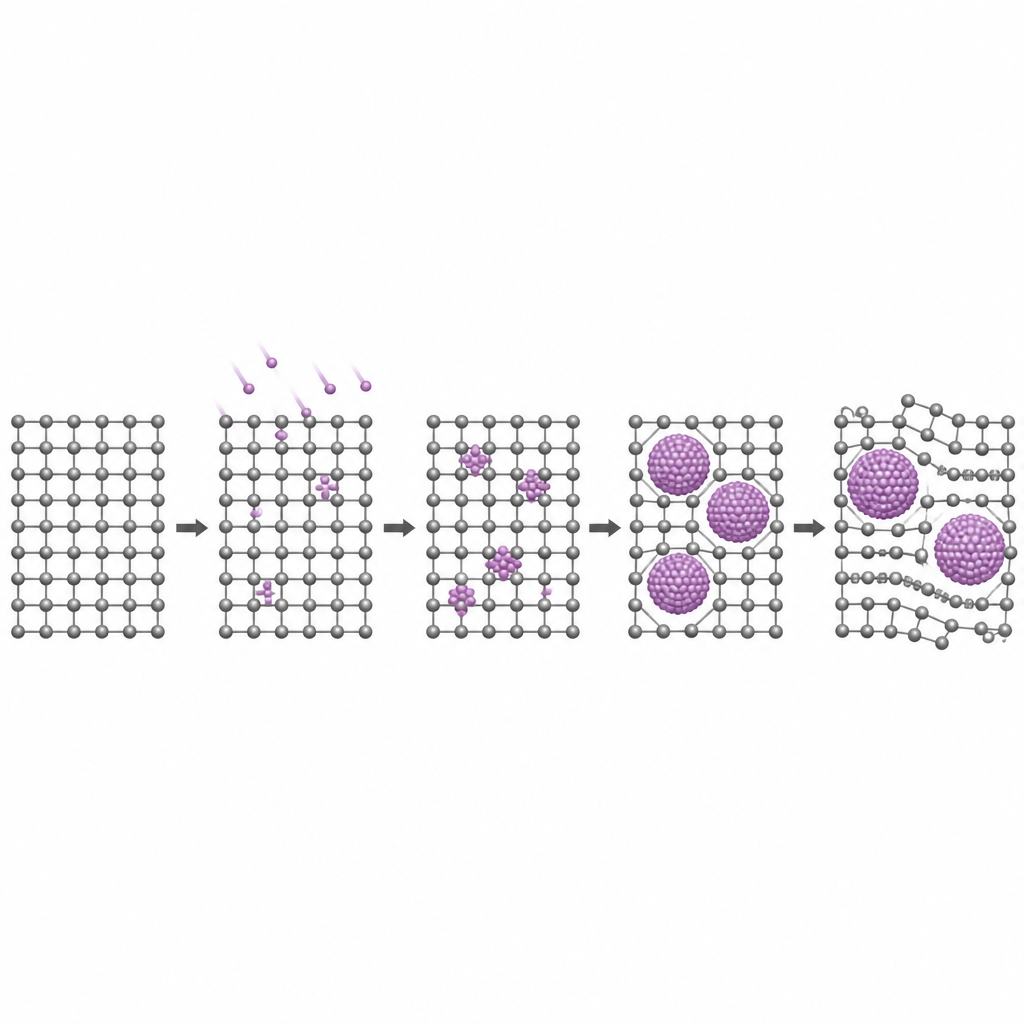
The article focuses on what happens when high energy helium ions penetrate into bulk tungsten, rather than just grazing its surface. Once inside, helium atoms move quickly through the metal, get trapped at empty lattice sites, and gather into tiny clusters. These clusters evolve into nanometer sized helium filled bubbles and related defects known as dislocation loops. The balance between bubbles and loops depends strongly on the helium dose and temperature: at lower doses loops dominate, while at higher doses and higher temperatures bubbles take over and grow, causing local swelling of the material.
Why temperature and dose matter so much
Drawing together many experiments and computer simulations, the authors show that the size and number of helium bubbles change in a systematic way with irradiation temperature and fluence. Warmer tungsten allows vacancies and helium atoms to move more easily, encouraging bubbles to coarsen and sometimes to arrange in ordered patterns. At certain intermediate temperatures, swelling caused by bubbles reaches a peak, similar to behavior seen under neutron irradiation but shifted by roughly a couple of hundred degrees. Heating after irradiation can further transform invisible helium clusters into visible bubbles, reshaping the damage without actually removing the trapped gas.
From invisible defects to harder and more brittle metal
These nanoscale changes have clear mechanical consequences. Helium bubbles, dislocation loops, and even sub microscopic helium vacancy clusters act as obstacles to the motion of dislocations, the carriers of plastic deformation. As a result, helium irradiation makes tungsten harder but less ductile, raising the temperature at which it switches from brittle to ductile behavior. Tests using nanoindentation and tensile loading reveal that higher doses and certain defect types, especially particular kinds of loops, contribute strongly to this hardening, while bubbles decorating grain boundaries can in some cases lead to local softening and crack initiation.
Designing smarter tungsten for extreme environments
The review also highlights strategies to make tungsten more tolerant of helium. Refining the grain size to the nanoscale increases the number of boundaries that can absorb defects, reducing bubble density inside grains. Adding stable carbide particles or forming complex multicomponent alloys and high entropy alloys introduces extra internal interfaces and lattice distortions that disrupt bubble growth and help limit swelling. Some new tungsten based high entropy alloys even show grain refinement and stable cavity volumes under extreme dual beam irradiation, marking them as promising directions for fusion wall materials.
What this means for future fusion reactors
Overall, the article concludes that while tungsten remains a strong candidate for fusion reactor walls, helium induced damage is complex and still not fully understood. Key open questions include how much helium shifts the brittle to ductile transition, exactly how bubbles nucleate by punching out atomic defects, and how combined helium and neutron exposure affects real components. Answering these questions, along with studying additively manufactured tungsten structures, will be essential for designing long lasting, damage tolerant materials that can withstand the demanding conditions inside future fusion power plants.
Citation: Liu, Y., McElroy, T.O., Xia, C. et al. Radiation damage in tungsten under high-energy He-ion irradiation. Commun Mater 7, 140 (2026). https://doi.org/10.1038/s43246-026-01182-1
Keywords: tungsten, helium irradiation, fusion reactor materials, radiation damage, plasma facing components