Clear Sky Science · en
Designing printable alloys by tuning liquid short-range order
Why metal 3D printing still struggles
Metal 3D printing can build complex parts with little waste, but most existing engineering alloys still crack or deform when printed. This article explains a new way to make more alloys printable by focusing not on the solid metal, but on the hidden atomic patterns in the molten pool just before it freezes.
From smooth layers to hidden cracks
In metal additive manufacturing, a powerful heat source rapidly melts and re-solidifies powder or wire. The metal cools so fast that long, column-shaped crystals tend to grow instead of many small grains. These tall grains line up with the heat flow, making the printed part behave differently in different directions and more prone to hot cracks. Traditional fixes, such as heat treatments or clever laser paths, help only partly and can weaken the material. Many high-strength aluminum and nickel alloys remain very difficult to print without cracks or extreme texture.
Alloy tweaks that changed the game
Researchers have tried to sidestep these problems by redesigning alloys so that more grains start to form as the metal solidifies. One route adds tiny particles that become high-temperature phases and act as seeds for new grains, as was shown in once “unprintable” aluminum 7075. Other work engineers the solidification path so that softer phases appear late in freezing, turning dangerous tensile strains into safer compressive ones and reducing cracking. These ideas improve grain refinement and toughness, but they still treat the molten metal as a simple, disordered liquid.
Hidden order in the liquid metal
New experiments and simulations reveal that the liquid itself can carry subtle atomic patterns. In many undercooled metallic melts, atoms briefly arrange into tiny icosahedron-like clusters, where one atom is surrounded by twelve neighbors. These motifs, called icosahedral short-range order, can resemble the building blocks of certain complex solid phases. The review shows that, under the fast cooling of 3D printing, such motifs can act as templates for solid crystals, giving rise to special clusters of grains that share a fivefold-like symmetry and numerous twin boundaries. These signatures have now been observed in aluminum, nickel superalloys, and stainless steels produced by modern printing processes. 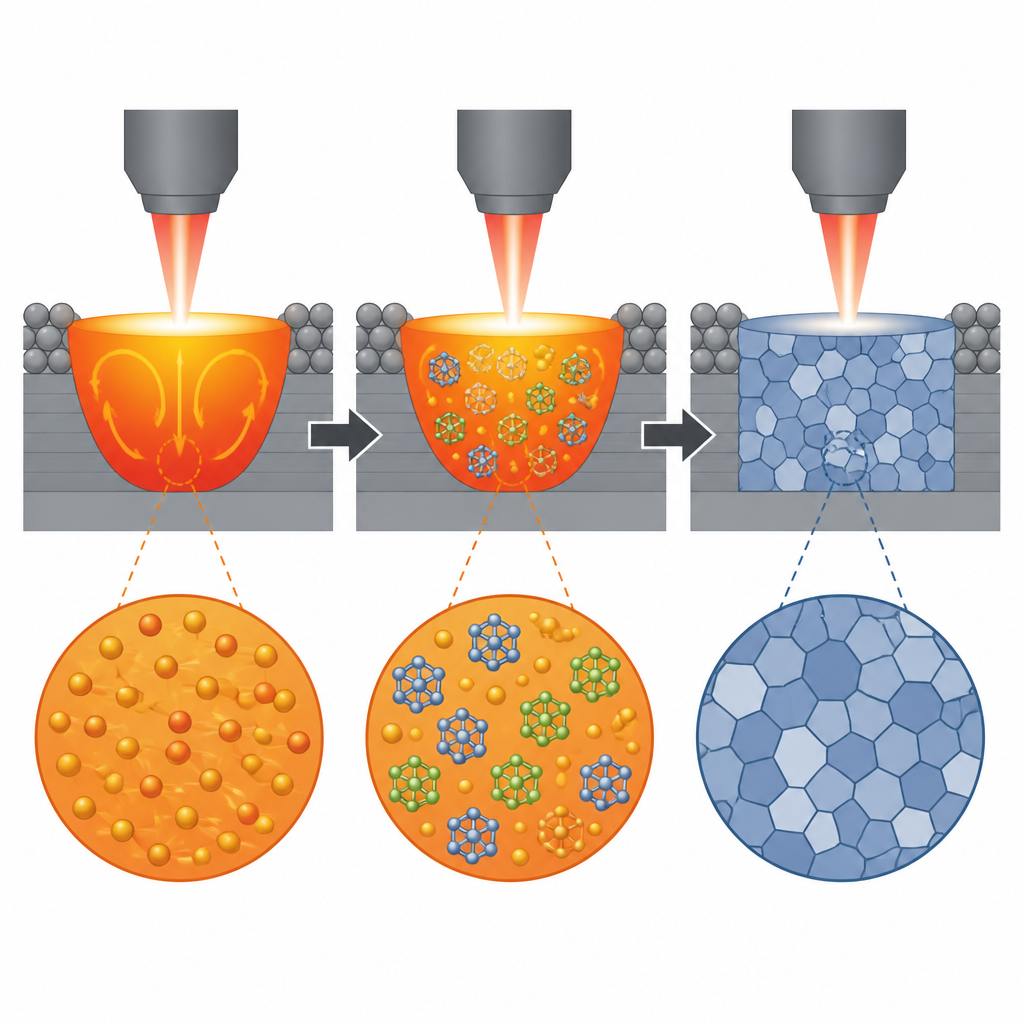
A new pathway for crystal birth
Because these liquid motifs differ from the final crystal structure, they do not fit the traditional picture of how crystals start to form. Instead of a single solid phase emerging directly from a featureless liquid, the system can pass through metastable states: complex intermetallic compounds that contain icosahedral patterns, or even just dense pockets of such motifs in the liquid. Solid grains then nucleate on these templates, often in groups that are related by twinning. This “ISRO-mediated” nucleation can produce many fine, equiaxed grains right at melt pool boundaries, even in alloys that would otherwise grow long columns. At the same time, the same motifs can slow diffusion and raise the viscosity of the melt, subtly changing how the molten pool flows and how defects form. 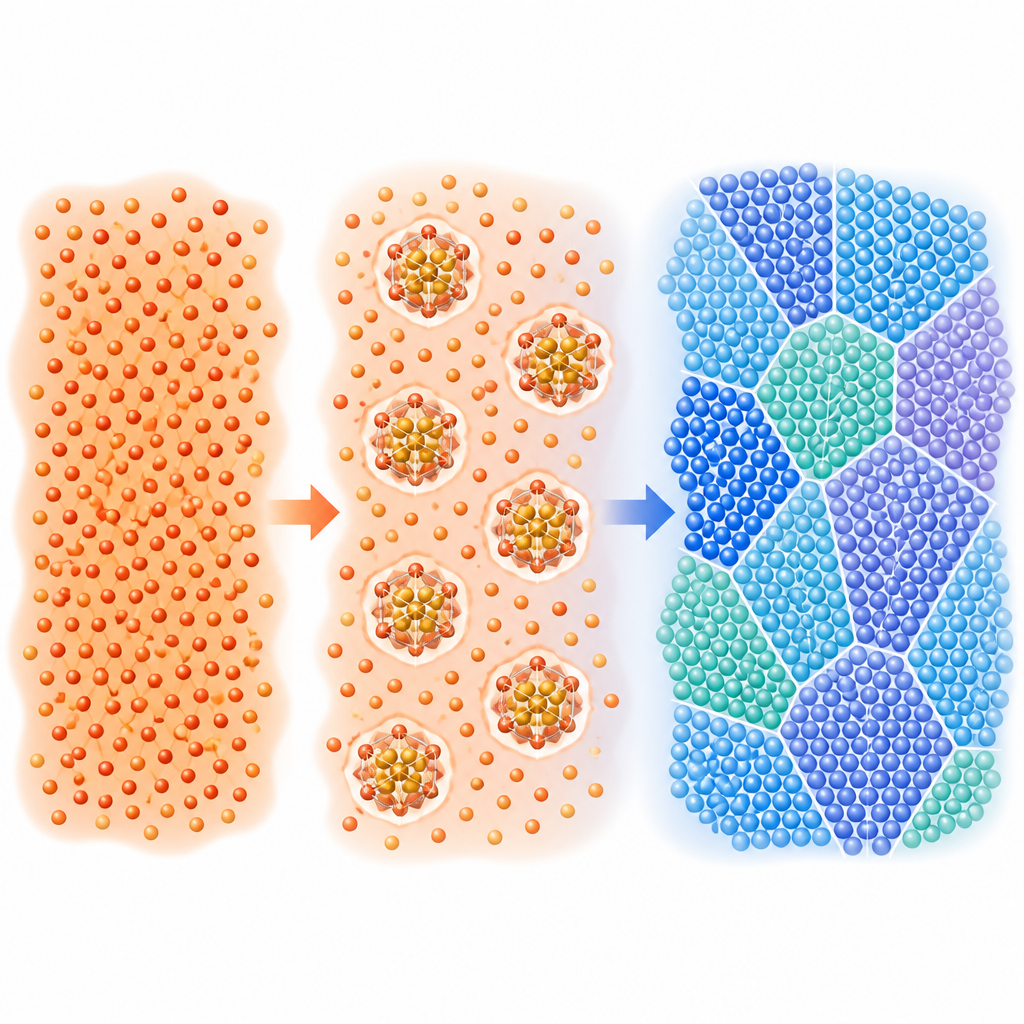
Designing alloys from the liquid up
The article argues that controlling these fleeting liquid structures can become a powerful design lever for printable alloys. By carefully choosing alloying elements and processing conditions that favor beneficial icosahedral motifs at the right temperatures and cooling rates, engineers could trigger bursts of grain nucleation and create twin-rich microstructures in a single printing step. Such “quantum engineering” of metallic liquids would go beyond tweaking solid phases and instead co-design alloys and printing paths to tune local liquid order. The review closes by outlining the experimental and simulation tools needed to observe these motifs in operating melt pools and to turn them into practical design rules, paving the way for more crack-resistant, isotropic metal 3D printed parts.
Citation: Charpagne, M.A. Designing printable alloys by tuning liquid short-range order. Commun Mater 7, 129 (2026). https://doi.org/10.1038/s43246-026-01180-3
Keywords: metal additive manufacturing, short-range order, grain refinement, twin boundaries, alloy design