Clear Sky Science · en
Mean field magnetism and spin frustration in a double perovskite oxide with compositional complexity
Why mixing metals can make new magnets
Magnetic materials usually rely on tidy, repeating atomic patterns, so packing many different elements into the same crystal might seem like a recipe for chaos. This study shows that a carefully engineered oxide made from five different rare earth elements still behaves as a well ordered magnet and then, at colder temperatures, slips into a more disordered, glass like magnetic state. The work helps explain how magnetism survives in chemically messy materials and points toward designer magnets with tunable properties.
Building a complex crystal
The researchers focused on a family of oxides called double perovskites, where nickel and manganese atoms sit in a regular checkerboard surrounded by rare earth ions. In their new compound, written as (La0.4Nd0.4Sm0.4Gd0.4Y0.4)NiMnO6, the nickel and manganese network stays ordered, but each surrounding site can host any of five different rare earth atoms. This deliberate mixing creates a large spread in ionic sizes, a situation often called high entropy or compositionally complex, which is expected to distort the crystal and disrupt magnetic interactions. To test whether a clean magnetic state can still form, they grew thin films of this material on a strontium titanate substrate using pulsed laser deposition and verified smooth, single crystalline layers with X ray reflectivity and diffraction. Optical measurements showed that the film is an electrical insulator with a band gap similar to related, less disordered materials. 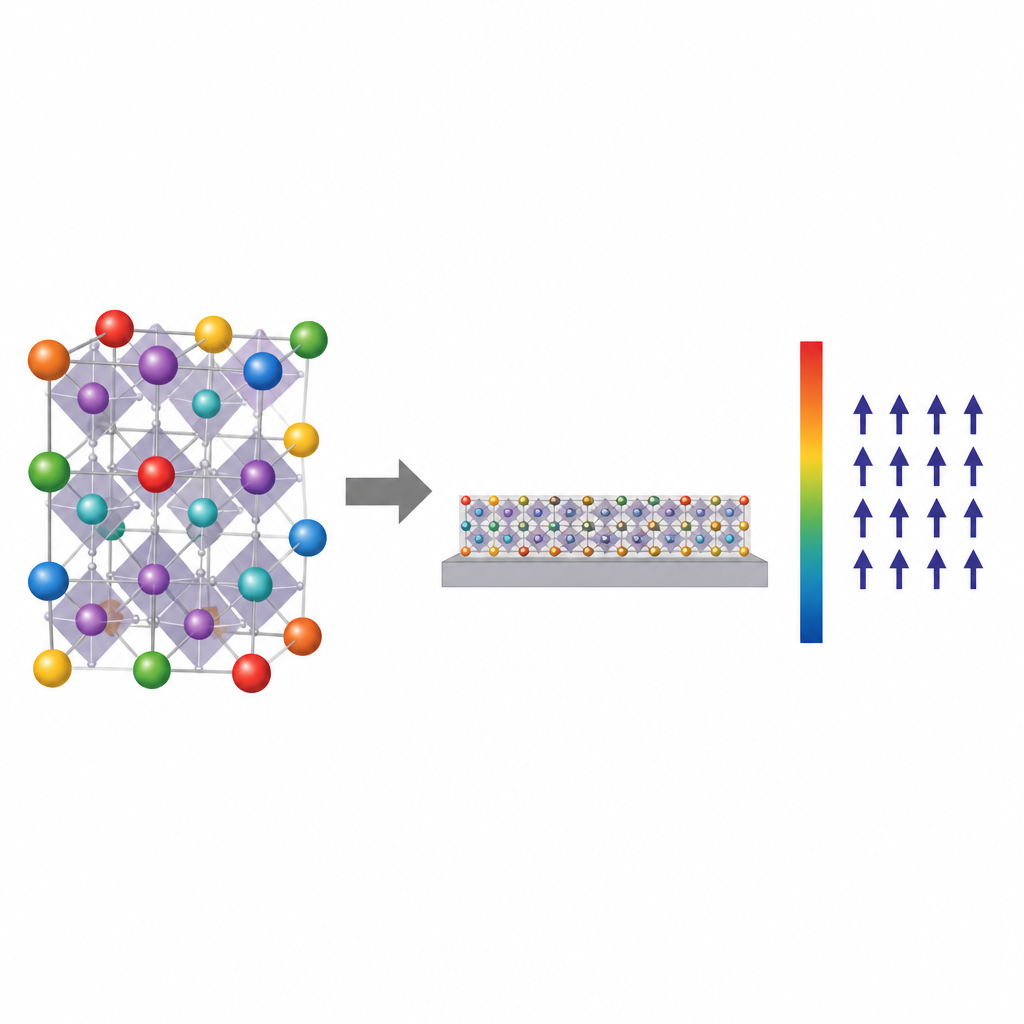
Strong magnetism from an average view
Despite the heavy mixing of rare earth atoms, the films display robust ferromagnetism: below about 150 kelvin the magnetic moments line up in the same direction. This transition temperature closely matches that of a simpler cousin compound containing samarium, suggesting that what matters most is the average size of the rare earth ions, which controls the bond angles between nickel, oxygen and manganese. Magnetic susceptibility data fit a standard mean field model, where each magnetic moment feels only an average internal field from its neighbors, and the fitted Curie Weiss temperature nearly equals the observed transition point. X ray absorption measurements confirmed that nickel and manganese sit in their expected charge states, so the main ferromagnetic interaction between Ni2+ and Mn4+ remains intact even in this chemically complex setting.
Vibrations reveal hidden magnetic order
To probe how magnetism couples to the crystal lattice, the team turned to Raman spectroscopy, which tracks tiny shifts in the frequencies of lattice vibrations. A key stretching mode of the nickel and manganese oxygen octahedra normally follows a smooth, anharmonic temperature trend. In the new film, that mode abruptly softens below the magnetic transition temperature, deviating from the purely vibrational model. This softening mirrors the square of the magnetization, as expected from a mean field description where spin spin correlations modify the restoring forces on the atoms. The close match shows that a simple average field picture captures not only the transition temperature but also how magnetic order feeds back onto the lattice vibrations in the ferromagnetic phase.
When order gives way to frustration
At lower temperatures the story changes. Around 35 kelvin, subtle anomalies appear in the magnetization curves, and the mean field description no longer works. Memory experiments, in which the sample is cooled with a low magnetic field, held for a while at a fixed temperature and then reheated, reveal a telltale dip in magnetization exactly at the halt temperature. This kind of magnetic memory is a classic sign of a spin glass state, where competing interactions freeze the magnetic moments in a disordered pattern. The authors trace this frustration to two main ingredients: antisite disorder that locally swaps nickel and manganese neighbors, and the complex couplings between the different magnetic rare earth ions and the nickel manganese network. Importantly, the temperature scale of the glass like behavior matches that of rare earth interactions, hinting that disorder among these ions plays a leading role. 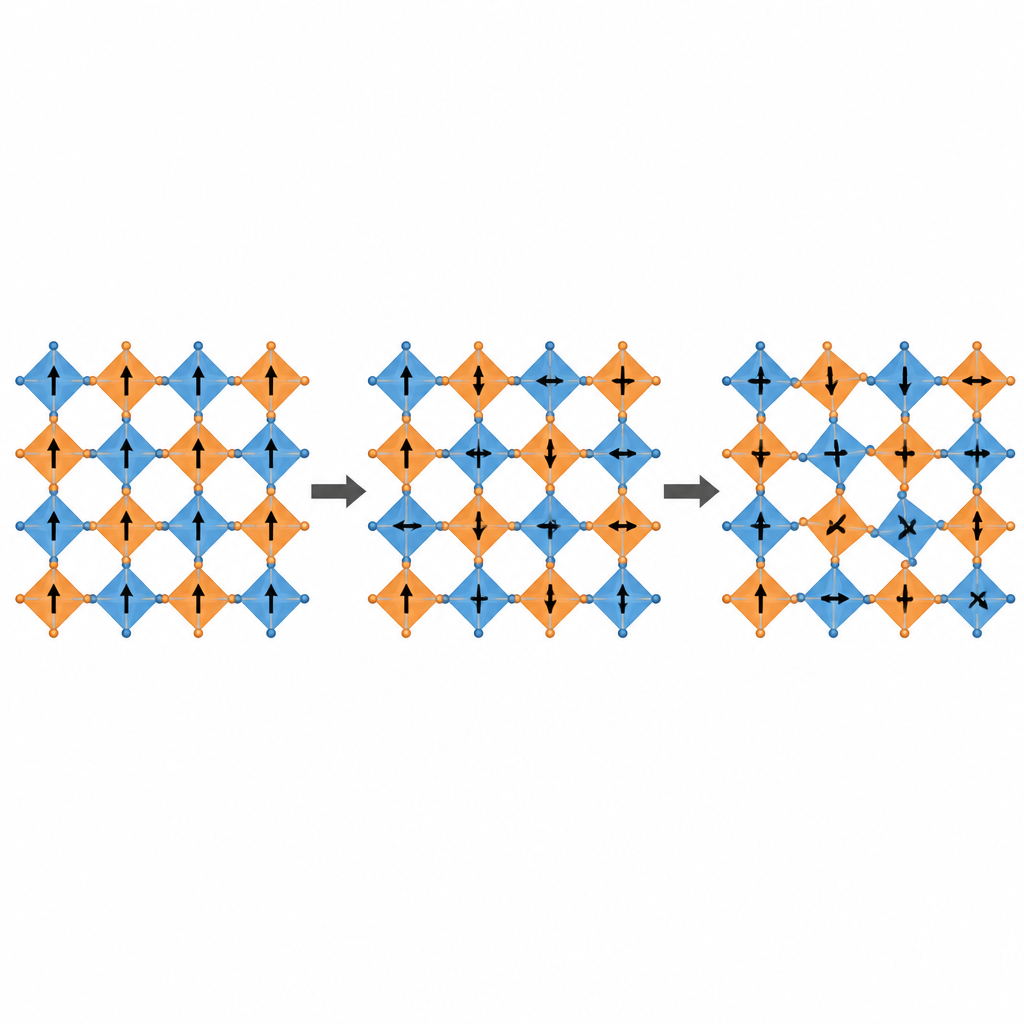
Designing future complex magnets
The results show that long range ferromagnetic order can remain surprisingly robust even in a highly mixed, high variance oxide, with its transition temperature largely set by simple averages of ionic size. At the same time, microscopic details of how individual atoms interact become crucial at low temperatures, where they can generate frustrated, glass like magnetism. For a lay reader, the key message is that chemical disorder does not just destroy magnetic order: used carefully, it becomes a powerful design tool to tune when and how a material becomes magnetic, and even to engineer more exotic phases that could be useful in future spin based electronics and multifunctional devices.
Citation: Bhattacharya, N., Dokala, R.K., Chowdhury, S. et al. Mean field magnetism and spin frustration in a double perovskite oxide with compositional complexity. Commun Mater 7, 130 (2026). https://doi.org/10.1038/s43246-026-01135-8
Keywords: high entropy oxides, double perovskite magnetism, spin glass, spin phonon coupling, ferromagnetic insulator