Clear Sky Science · en
Template-Derived Masks for 4D-STEM
Seeing Atoms in Four Dimensions
Modern batteries and smart materials work because of what happens at the scale of individual atoms, but actually seeing those atoms is surprisingly hard. This study introduces a new way to pull clearer, more informative pictures out of a powerful microscope technique called 4D-STEM, helping scientists pick out even the lightest atoms inside complex crystals and batteries.
Why Regular Images Miss Important Atoms
Scanning transmission electron microscopes build images by firing electrons through a thin slice of material and catching how they scatter. Traditional detectors turn all those scattered electrons into a single brightness value for each point, which works well for heavy atoms like iron or lead. Lighter atoms such as lithium or oxygen, however, can be nearly invisible, especially in thicker samples, so details that matter for battery performance or electric behavior are easily lost.
What Makes 4D-STEM Different
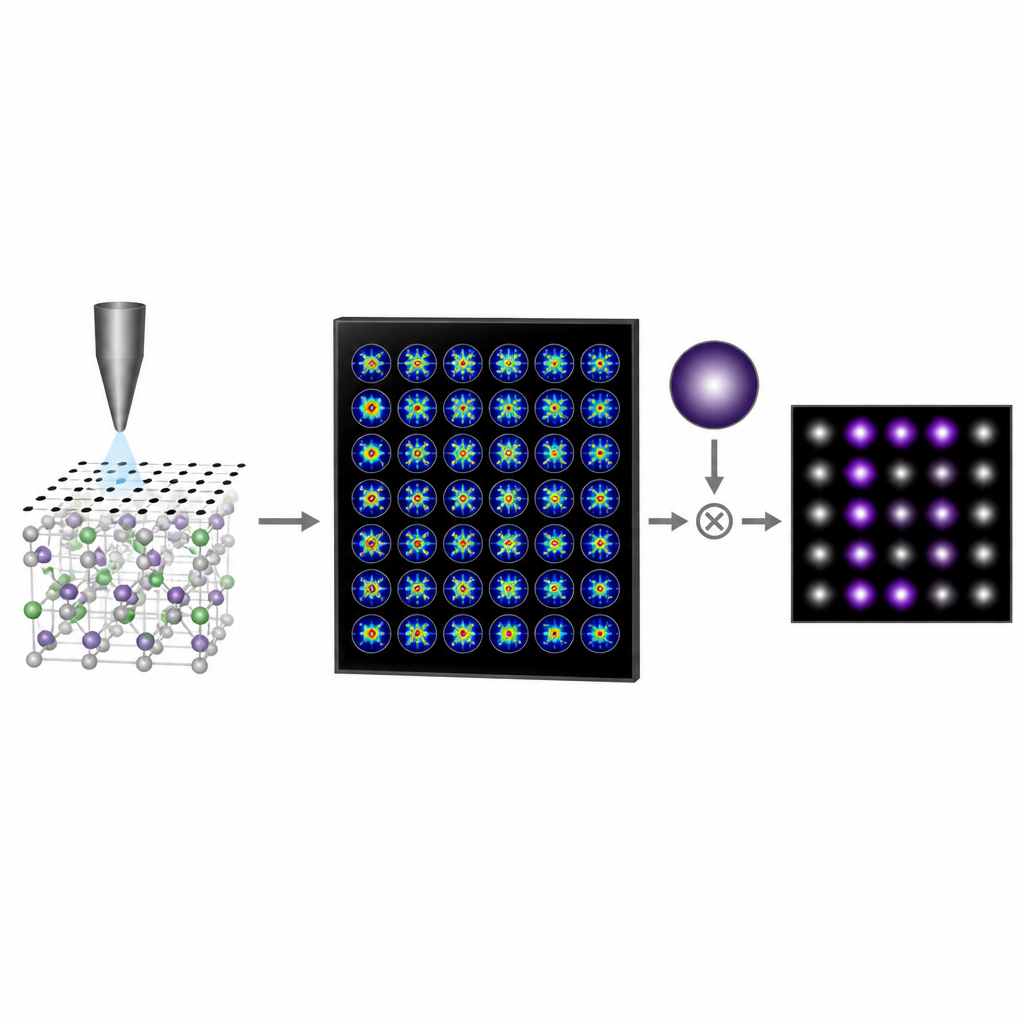
New fast detectors can record a full diffraction pattern at every probe position as the beam scans across the specimen. The result is a four-dimensional dataset: for each point in the image, there is a two-dimensional pattern showing where electrons went in the detector. Each recorded intensity belongs both to a location in real space and a spot in diffraction space. The challenge is no longer collecting enough information but deciding how to combine all these tiny measurements into a clear, meaningful image.
Letting a Template Guide the Data
The authors propose a simple but powerful strategy: start with a rough picture of what you care about, then let the data tell you which parts of the diffraction patterns matter most. First, they create a template in real space, for example a map marking where oxygen or lithium columns sit in an initial STEM image. They then calculate how strongly each detector pixel’s signal across the scan matches that template, using a standard measure of correlation. The result is a weighted mask in diffraction space that brightens pixels carrying useful information and dims those dominated by noise or unrelated scattering.
Picking Out Specific Atoms in Real Materials
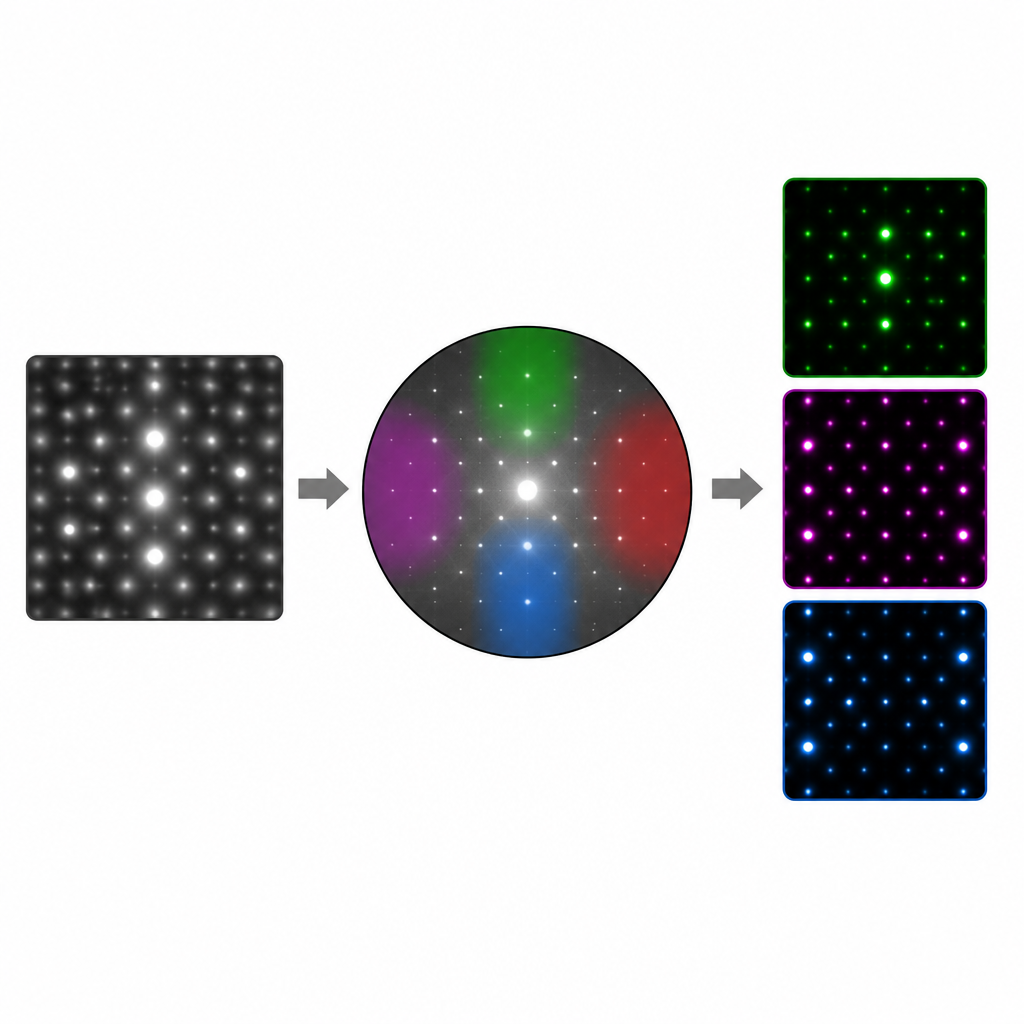
When this template-derived mask is applied back to the 4D-STEM data, it produces a new image that is highly sensitive to the chosen atoms. In lithium iron phosphate, a common battery cathode, the method cleanly separates images of iron, phosphorus, oxygen, and even tiny lithium columns in a sample about 70 nanometers thick, where other advanced techniques struggle. The same idea works in a more complex case: a boundary between two domains in lead titanate, a ferroelectric crystal. By building templates from just a small, well-behaved region, the team recovers oxygen positions and subtle atomic shifts across the whole domain wall, revealing how local distortions relate to electric polarization.
Why This Matters for Future Studies
To a non-specialist, the key point is that the microscope already collects rich information; the trick is learning how to ask for the right picture. This work shows that by using an informed guess of where certain atoms should be as a guide, scientists can automatically design the best way to process 4D-STEM data. The approach is computationally modest, works well for samples that are too thick for some rival methods, and can be tuned to highlight specific atom types or defects. In practical terms, it offers a clearer window into how atoms are arranged in working battery materials and functional oxides, helping connect atomic structure with real-world performance.
Citation: Xie, Y., Moynihan, E., Alexe, M. et al. Template-Derived Masks for 4D-STEM. Commun Mater 7, 124 (2026). https://doi.org/10.1038/s43246-026-01134-9
Keywords: 4D-STEM, electron microscopy, lithium batteries, atom imaging, crystal defects