Clear Sky Science · en
Enhancing performance and stability of methylammonium lead iodide-based perovskite solar cells using single-crystal precursors
Turning Light into Power, Indoors and Out
Solar panels are already common on rooftops, but a newer class of materials called perovskites promises even higher efficiency and cheaper production. One of the earliest and simplest perovskites, known as MAPbI3, has a reputation for falling apart too quickly, especially under light and heat. This study revisits that assumption and shows that a clever change in how the material is made can greatly boost both its power output and its long-term stability, opening doors for reliable solar power not just outdoors, but also under indoor lighting for small electronic devices.
Why These Solar Materials Matter
Perovskite solar cells are attractive because they absorb sunlight very efficiently and can be processed from liquid solutions at relatively low temperatures. MAPbI3, in particular, is easy to make and has well-balanced properties, but many earlier reports labeled it as too fragile for real-world use. That conclusion was based largely on films made from a typical recipe that mixes two starting salts in a solvent and lets them react on a surface. In these conventional films, tiny leftovers of one salt, lead iodide, almost always remain. Those leftovers were long treated as either a minor flaw or even a helpful feature, which may have obscured MAPbI3’s true potential.
A New Way to Build the Light-Absorbing Layer
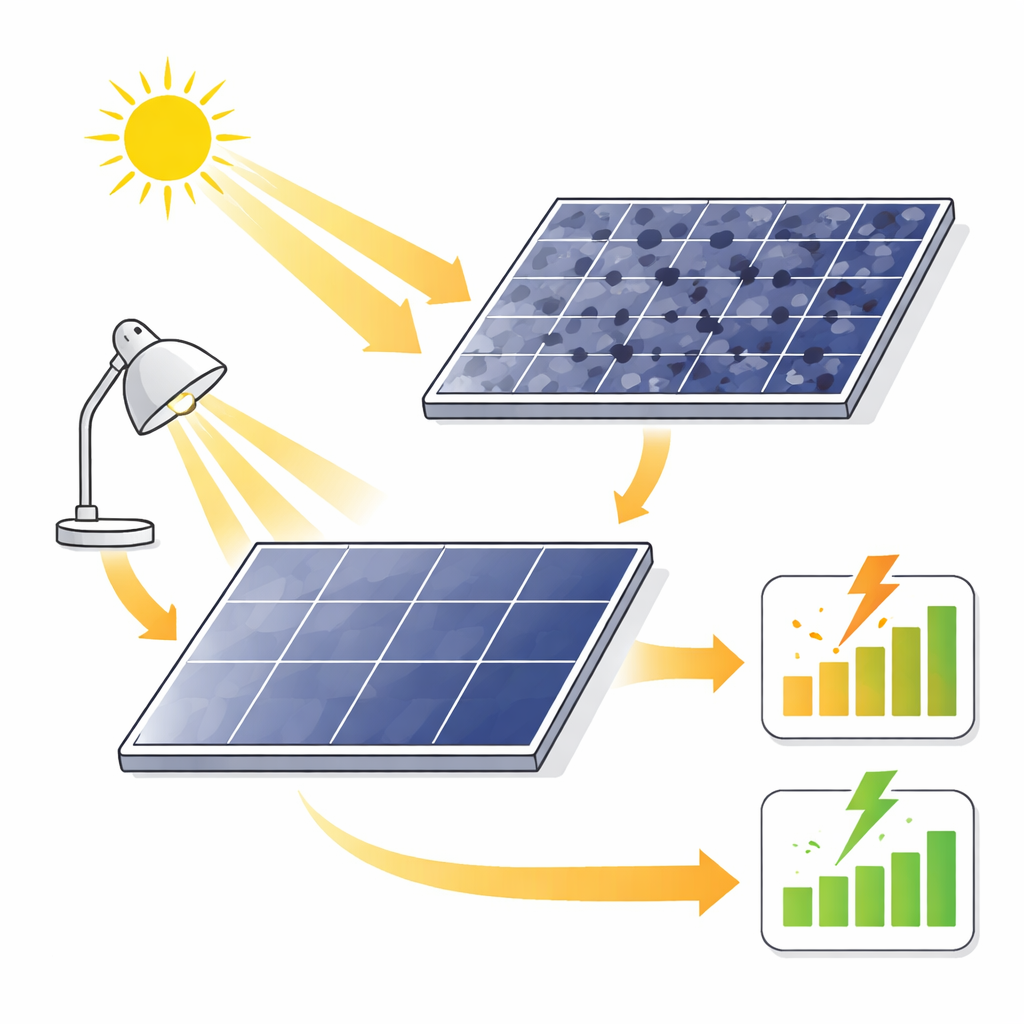
The researchers tackled the problem at its source: the liquid “ink” from which the perovskite layer is coated. Instead of mixing separate ingredients that might never fully react, they first grew large, pure single crystals of MAPbI3 and then dissolved these crystals to make the coating solution. Because the crystals already have the exact right balance of components, the resulting films are essentially free of leftover lead iodide and other unwanted by-products. When these single-crystal-based films were used in standard solar cell structures, the devices reached a power conversion efficiency of 21.55%, compared with 18.61% for cells made from conventional solutions—a substantial gain achieved mainly through higher voltage and a more favorable current–voltage curve.
Cleaner Films, Fewer Hidden Flaws
Detailed measurements revealed why the single-crystal route works so well. Microscopy showed that conventional films contain many small bright specks concentrated at the boundaries between grains; these match the signature of lead iodide residues. In contrast, the new films form dense, smooth layers with uniform grains and no obvious impurity clusters. Electrical tests designed to count internal defects found that the improved films have a much lower density of electronic traps where charges can get stuck and lost. Other measurements showed stronger internal electric fields and reduced unwanted leakage currents. Together, these features lead to more efficient separation and transport of the charges created when light hits the solar cell.
Stability and the Hidden Role of Residual Salts
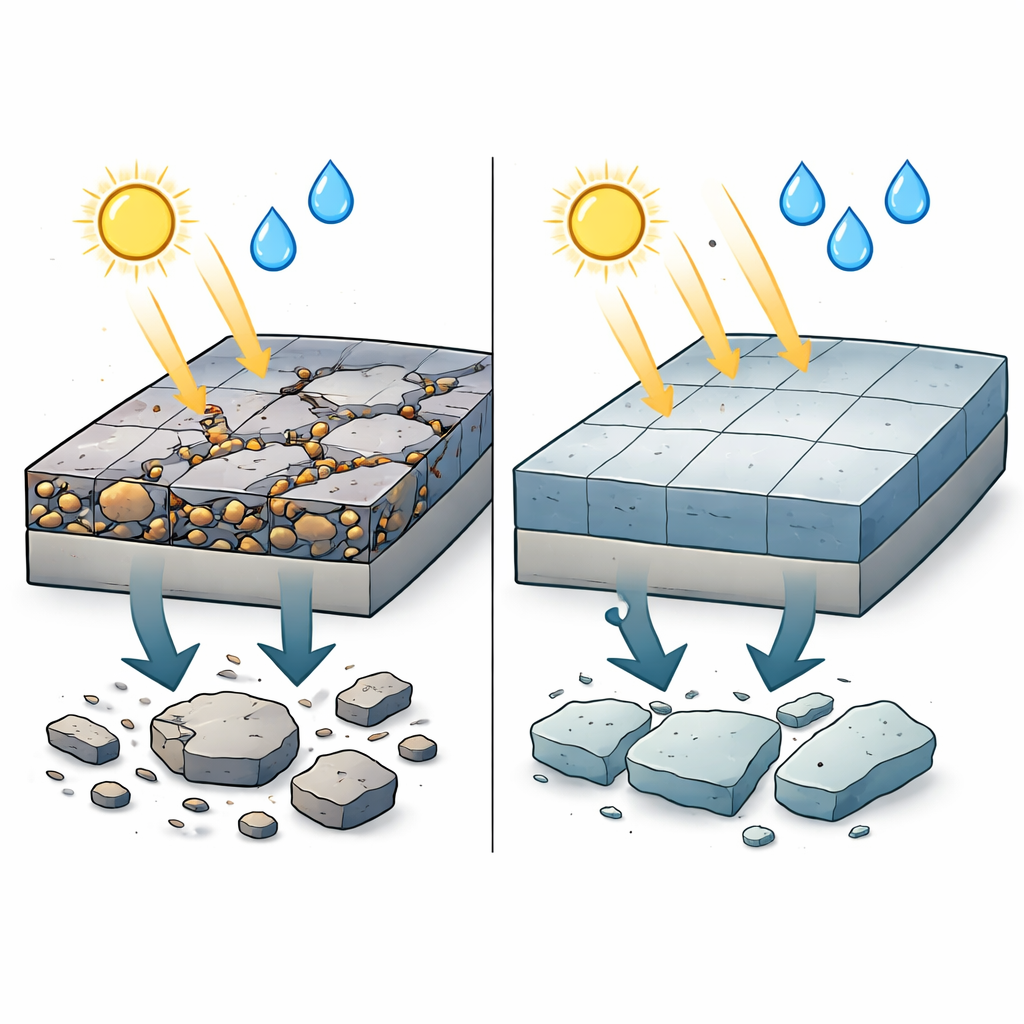
The biggest surprise came from how the two types of films aged over time. Unprotected cells made from conventional solutions quickly lost performance, dropping below half their original efficiency. Those built from single-crystal-derived films retained 98% of their initial output even after about six weeks in room air. By tracking changes in crystal structure and surface chemistry, the team traced this difference to cycles of chemical reactions driven by moisture and light. Residual lead iodide can react with water to form new compounds and a reactive acid, which then attacks the perovskite itself. Under illumination, the same residue can break down further to metallic lead and iodine species that act like catalysts, speeding the material’s decay and carving out voids in the film. When the starting film contains almost no such residue, these destructive cycles are largely suppressed.
From Lab Devices to Practical Mini-Modules
To show that the method scales beyond tiny test cells, the researchers fabricated 5-by-5-centimeter mini-modules, more similar to real products. Using the single-crystal approach, these larger devices reached nearly 20% efficiency under bright sun and close to 40% under typical indoor LED lighting, outperforming modules made by the conventional route. Because the new films are both chemically and structurally more uniform, they lend themselves well to large-area manufacturing methods while keeping performance high.
What This Means for Everyday Technology
By starting from pre-formed, ultra-pure perovskite crystals instead of raw ingredients, this work shows that MAPbI3 is not as inherently unstable as once feared. Much of its bad reputation stems from residual lead iodide created during standard processing, which silently seeds a web of moisture- and light-driven reactions that erode the solar layer over time. Remove that residue, and the same simple compound can deliver high, long-lasting efficiency in both small cells and larger modules. This makes MAPbI3 a strong candidate for powering indoor sensors, wireless gadgets, and other electronics that need dependable, low-light energy harvesting without complicated material recipes.
Citation: Kunnathumpeedika, S., Kattoor, V. & Wei, TC. Enhancing performance and stability of methylammonium lead iodide-based perovskite solar cells using single-crystal precursors. Commun Mater 7, 117 (2026). https://doi.org/10.1038/s43246-026-01123-y
Keywords: perovskite solar cells, indoor photovoltaics, material stability, single-crystal precursors, lead iodide impurities