Clear Sky Science · en
EGaIn tube memristors offering reliable switching on a biological time scale
Liquid circuits that think like our brains
Computers and brains speak very different electrical languages. Silicon chips are fast but rigid, while nerve cells in our bodies rely on slow, fluid chemistry. This paper introduces a new type of electronic element—built from a liquid metal in a tiny tube—that behaves more like a biological synapse than a traditional transistor, switching on and off in just the right time window to talk directly to living tissue or support brain-inspired computing.
Why a new kind of memory switch is needed
Engineers have long sought “memristors,” electronic components whose resistance remembers past signals, to build fast, low-energy computers that learn from data. Most existing versions are solid-state devices that work by forming and dissolving nanoscale metal filaments inside a solid material. Because these filaments are only a few atoms wide and grow in a random way, the devices often behave inconsistently from one use to the next and from chip to chip, limiting their reliability for large-scale applications.
A metal droplet inside a tube
To escape the randomness of solid filaments, the authors turn to a liquid system based on eutectic gallium–indium (EGaIn), a room-temperature liquid metal, and a sodium hydroxide (NaOH) solution. They place two small EGaIn regions inside a millimeter-scale plastic tube and separate them with the liquid electrolyte. Copper or gold-plated electrodes contact each metal region from the outside. When a modest voltage (well below 1 volt) is applied along the tube, the resistance between the electrodes can jump between a low and a high state in a highly repeatable way, giving the device the key property of a memristor. Because the active region is a smooth liquid interface rather than a fragile filament, many atoms act together, averaging out random variations and producing stable behavior over thousands of switching cycles. 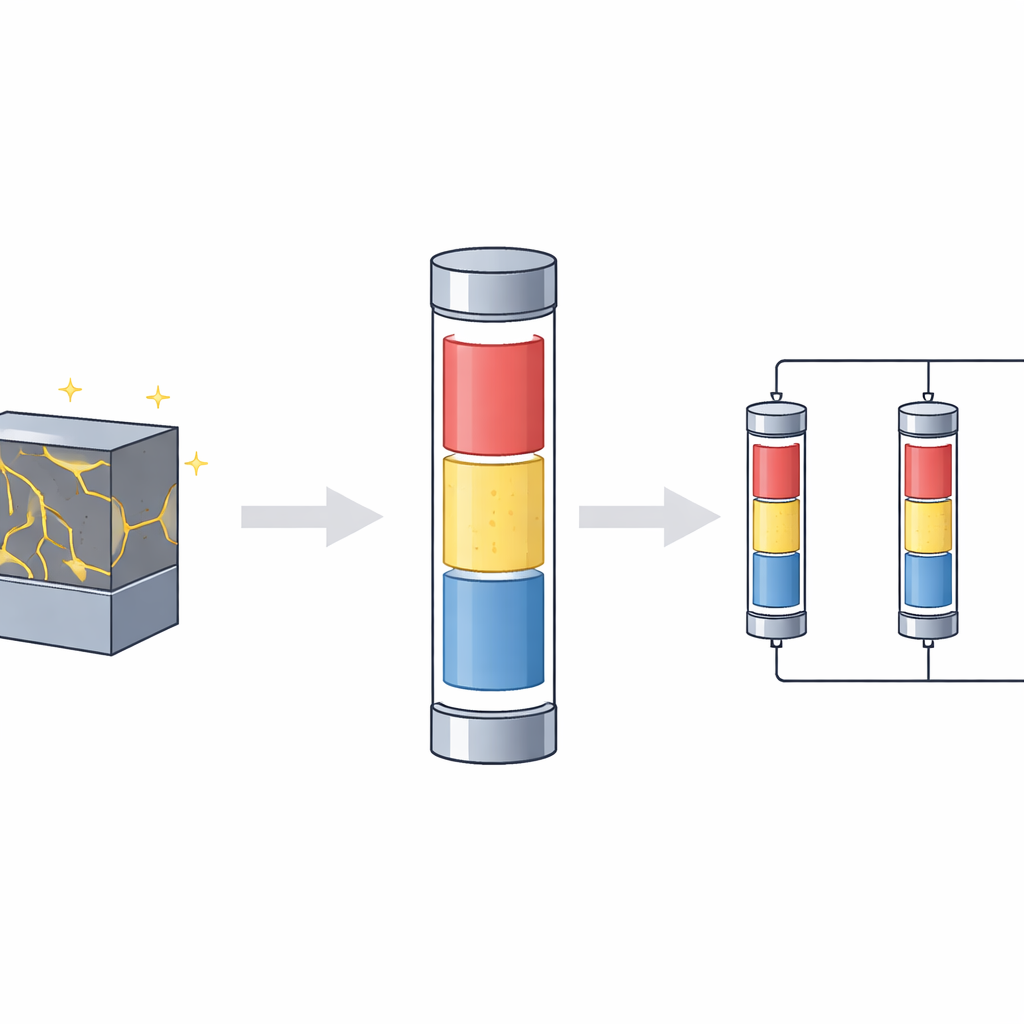
How a growing skin controls the current
The switching comes from a reversible “skin” that forms on the surface of the liquid metal. In a basic solution, gallium atoms at the EGaIn surface can be oxidized to form an oxide and related compounds that act like a thin insulating film. By carefully studying a single metal–electrolyte interface, the team shows that increasing voltage first speeds up oxidation, then reaches a point where the growing film blocks further reaction and sharply increases resistance. When the voltage is reduced or reversed, the film dissolves and the metal surface returns to a more conductive state. In the full tube device there are two such interfaces in series; as the voltage swings positive or negative, one side oxidizes while the other reduces, leading to a symmetric, hysteretic current–voltage curve with well-defined “turn-off” and “turn-on” thresholds.
Switching at the speed of biology
Beyond the basic on–off behavior, the authors probe how fast these liquid switches respond. Using short voltage pulses and circuit measurements, they find that the device can turn off in roughly 20–25 milliseconds and turn back on in about 150 milliseconds—comparable to the timing of many neural and sensory processes in living systems. Impedance spectroscopy reveals that, in addition to changing resistance, the device also shows memory-like capacitive behavior, hinting at richer dynamics similar to those seen in biological membranes. Importantly, the devices keep working reliably for many days, with only small drift in their switching voltages.
Logic inside the memory itself
To demonstrate practical use, the researchers wire two of these tube devices together and show that they can perform basic logical operations while simultaneously storing the result. By treating the low-resistance state as a logical “1” and the high-resistance state as a “0,” and by applying carefully chosen voltage pulses, they build simple AND and OR gates. In these circuits, the final state of one memristor directly encodes the outcome of the logical operation, an example of “in-memory computing” where data are processed and stored in the same physical element rather than shuttled back and forth between separate logic and memory units. 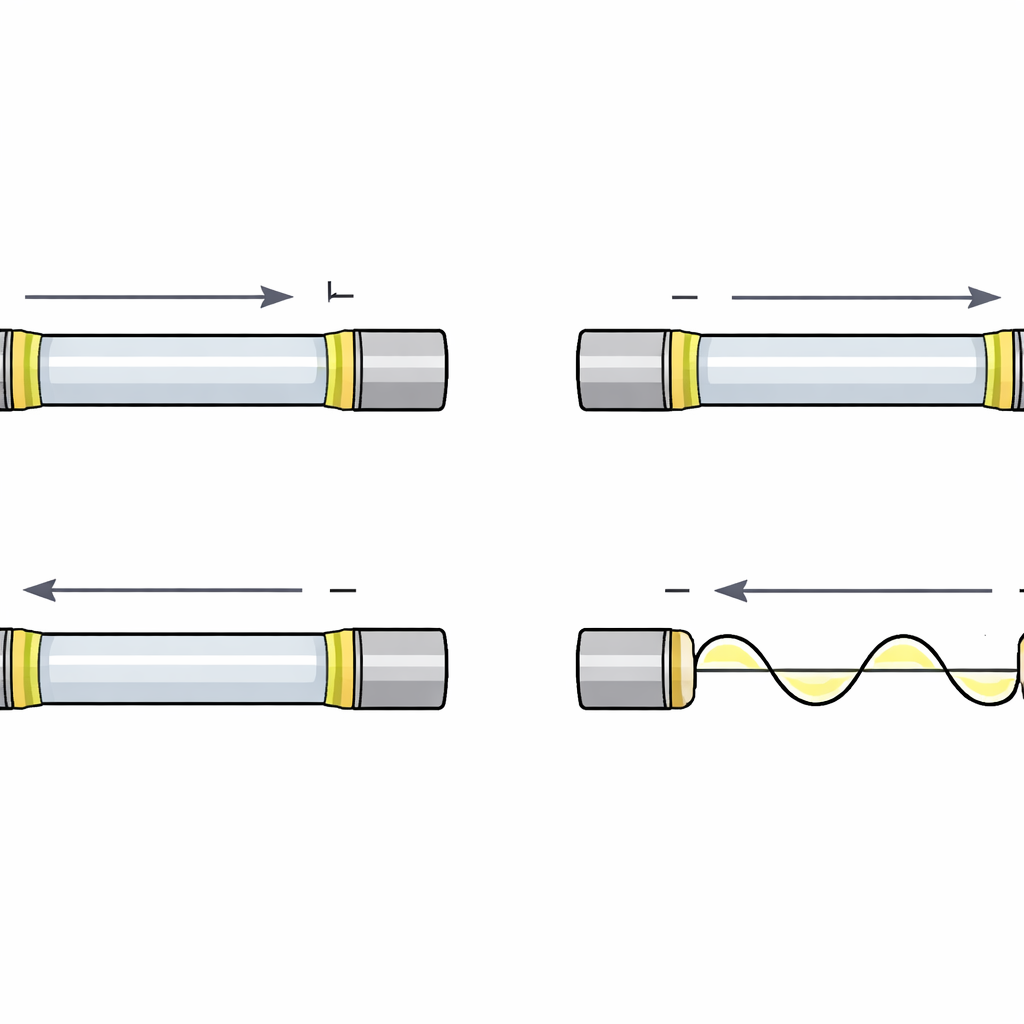
What this could mean for future devices
The work shows that a simple tube filled with liquid metal and electrolyte can serve as a highly reliable, low-voltage memristor whose switching speed is naturally tuned to biological time scales. Because the active region is liquid and smooth, the devices avoid many of the randomness issues that plague solid-state designs, while still operating at voltages comparable to existing memory technologies. With further miniaturization and materials optimization, such liquid memristors could lower power use and be integrated into soft, flexible electronics. Their similarity to the timing and physics of neural tissue suggests potential roles in neuroprosthetics, brain–computer interfaces, and adaptive signal-processing hardware that can learn and respond in real time.
Citation: Pershin, Y.V., Patel, L., Bera, B. et al. EGaIn tube memristors offering reliable switching on a biological time scale. Commun Mater 7, 104 (2026). https://doi.org/10.1038/s43246-026-01113-0
Keywords: liquid metal memristor, neuromorphic computing, in-memory logic, brain-computer interface, oxide-based switching