Clear Sky Science · en
A generative artificial intelligence approach for peptide antibiotic optimization
Why new approaches to antibiotics matter
Drug resistant infections are spreading faster than our ability to treat them, and some of the last line antibiotics are starting to fail. This study explores how a new form of artificial intelligence can help redesign natural protein fragments, called peptides, into more powerful antibiotics, using guidance from both computer models and animal tests.
Turning ancient molecules into modern drugs
The work builds on an intriguing idea: mining the genomes of extinct animals to find hidden antimicrobial peptides. Earlier research had already uncovered such molecules in the DNA of species like the woolly mammoth and giant ground sloth, but many of these natural peptides were only modestly active against bacteria. The question here is whether an AI system can take these rough starting points and quickly suggest small sequence changes that turn them into stronger, safer antibiotics, without the usual slow trial and error in the lab.
How the AI design loop works
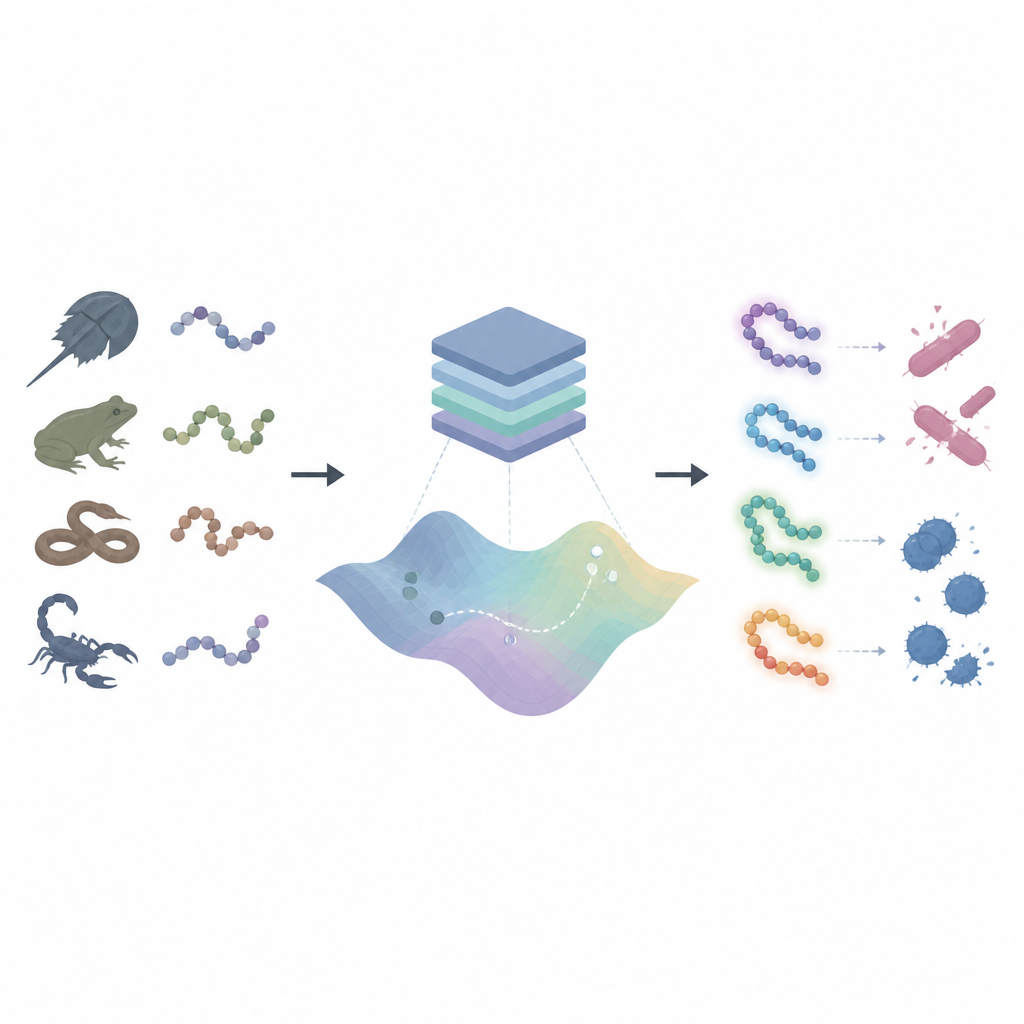
The authors created ApexGO, a design framework that pairs a deep learning model with a search strategy. A transformer based "translator" first converts each peptide sequence into a position in a smooth mathematical space, where similar sequences sit close together. A second model, called APEX, predicts how much of each peptide is needed to stop the growth of several problem bacteria. A Bayesian search algorithm then explores the smooth space, proposing new peptide variants that are likely to be more potent while still staying at least three quarters similar to the original template and manufacturable in practice.
From computer suggestions to real molecules
Using ten different extinct peptides as templates, ApexGO generated many candidate sequences and selected 100 for chemical synthesis. These were tested in the lab against eleven clinically important bacteria, including several that shrug off standard drugs. Eighty six of the 100 designed peptides showed measurable activity, and about two thirds were clearly better than their starting templates, with even higher success against Gram negative bacteria that are often hardest to treat. The team also compared ApexGO with other AI generators and found that those older systems struggled when forced to stay close to a given template, whereas ApexGO reliably produced improved variants under those constraints.
What the lab and animal tests revealed
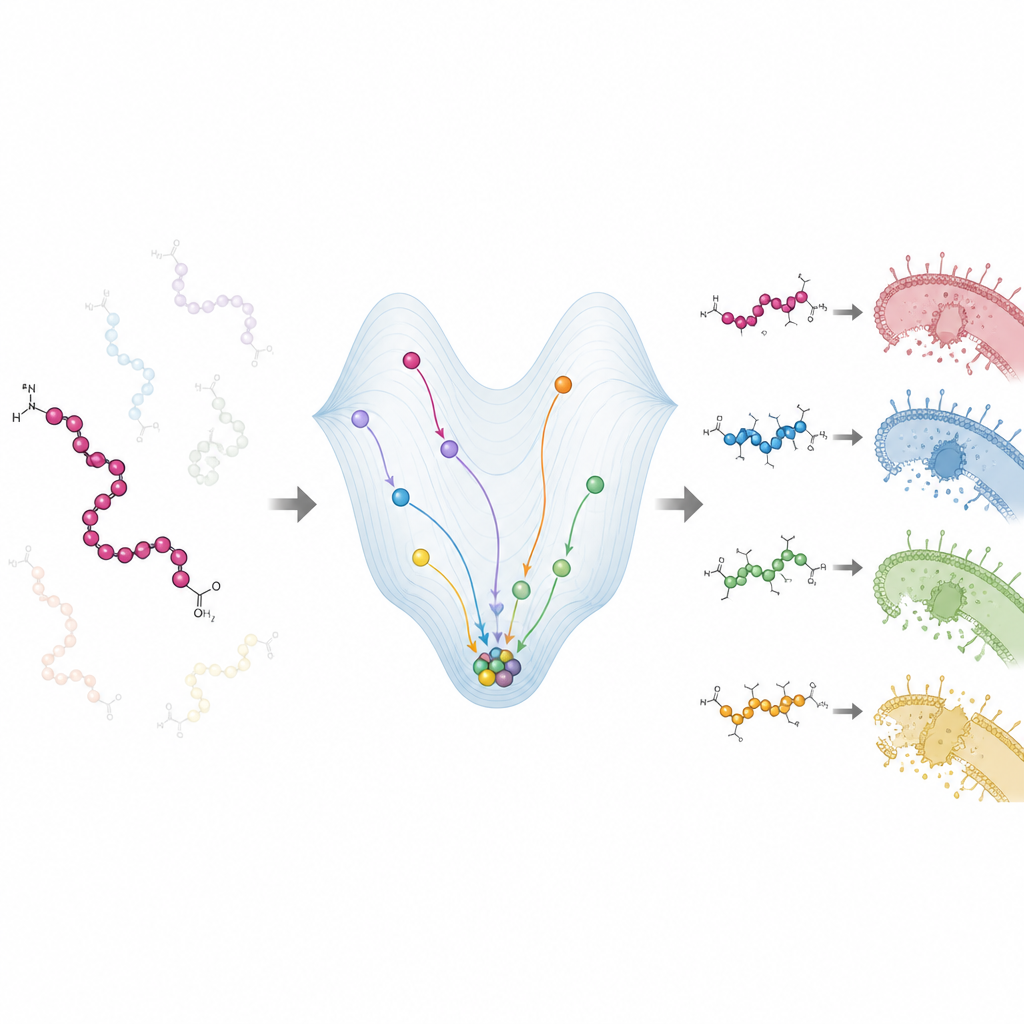
The researchers dug deeper into how the optimized peptides behave. They measured how the molecules fold, how they disturb bacterial membranes, and whether they harm human kidney cells in culture. The new peptides spanned many shapes, from loose chains to helices, and no single structure guaranteed strong activity, suggesting that the AI can exploit several physical routes to killing bacteria. Most of the designed peptides were not toxic at the doses tested. In mouse models of skin and deep muscle infection with the dangerous bacterium Acinetobacter baumannii, selected optimized peptides cut bacterial counts by three to four orders of magnitude. In some cases they matched or even outperformed last resort antibiotics such as polymyxin B, all without obvious side effects in the animals.
What this means for the future of antibiotics
The study shows that an AI guided optimization loop can reliably sharpen the performance of existing peptide antibiotics, even when starting from only moderately active natural sequences. Rather than blindly searching the huge space of possible peptides, ApexGO learns from each round of predictions and experiments, homing in on variants that are both powerful and relatively safe. While much more work is needed to address issues such as stability in the body and dosing in humans, this approach points toward a faster, more targeted way of building new antibiotics at a time when they are badly needed.
Citation: Torres, M.D.T., Zeng, Y., Wan, F. et al. A generative artificial intelligence approach for peptide antibiotic optimization. Nat Mach Intell 8, 841–856 (2026). https://doi.org/10.1038/s42256-026-01237-5
Keywords: antimicrobial resistance, peptide antibiotics, generative AI, Bayesian optimization, drug discovery