Clear Sky Science · en
Immunotherapy drug target identification using machine learning and patient-derived tumour explant validation
Why this matters for cancer patients
Immunotherapy has transformed cancer care, yet most patients still do not benefit from these powerful drugs. This study presents a new way to sift through enormous amounts of biological data to find fresh drug targets that may help the immune system attack tumors more effectively. By combining advanced machine learning with tests in real patient tumor samples, the work offers a blueprint for discovering next-generation immunotherapy strategies.
A smart map to find new weak spots in cancer
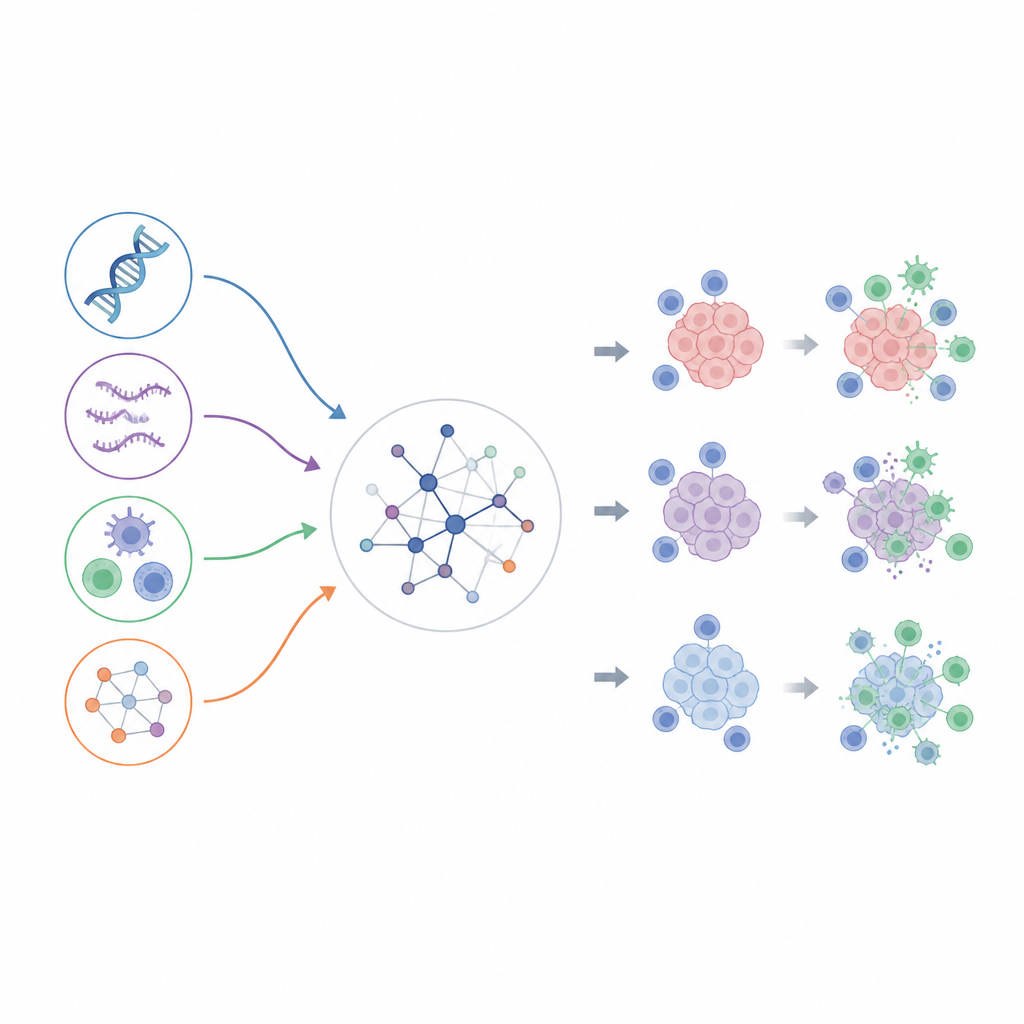
The researchers built a system called MIDAS that treats the human body as a complex network of interacting genes and cells. Instead of looking at one type of data at a time, MIDAS pulls together many layers of information: tumor DNA changes, gene activity, how immune cells behave inside tumors, which protein fragments appear on cell surfaces, and how genetic variants influence disease. These different clues are woven into a single gene–gene interaction map, on which a graph neural network learns patterns that distinguish known immunotherapy targets from other genes.
How the learning engine is tested
To check whether MIDAS was genuinely useful for drug discovery, the team designed several stress tests. First, they asked whether genes that entered immunotherapy clinical trials after 2019 were ranked highly by a model trained only on data available up to that year. MIDAS did just that, giving higher scores to these “future” targets than to random genes. Second, the system tended to score already approved immunotherapy targets higher than those still in early clinical testing, even though it had not been told which genes had made it that far. Third, when challenged with new patient datasets not used in training, MIDAS recovered many genes whose activity levels differ between responders and non-responders to checkpoint inhibitor drugs, suggesting it captures real features of tumor–immune interaction.
What the model learns about the immune system
Peering under the hood, the authors found that MIDAS focuses strongly on pathways already known to be crucial for immune responses against cancer, such as signals that tell T cells to activate or to rest. Features reflecting how genes regulate other genes, along with links to autoimmune diseases, stood out as especially informative. This makes biological sense: genes that can over-activate the immune system in autoimmune conditions might, when carefully targeted, help unleash immune attacks on tumors. The web of interactions between genes also proved essential; when the connections in the network were randomly scrambled, model performance dropped sharply, showing that the structure of the biological map itself is a key ingredient.
From computer predictions to real tumor tissue
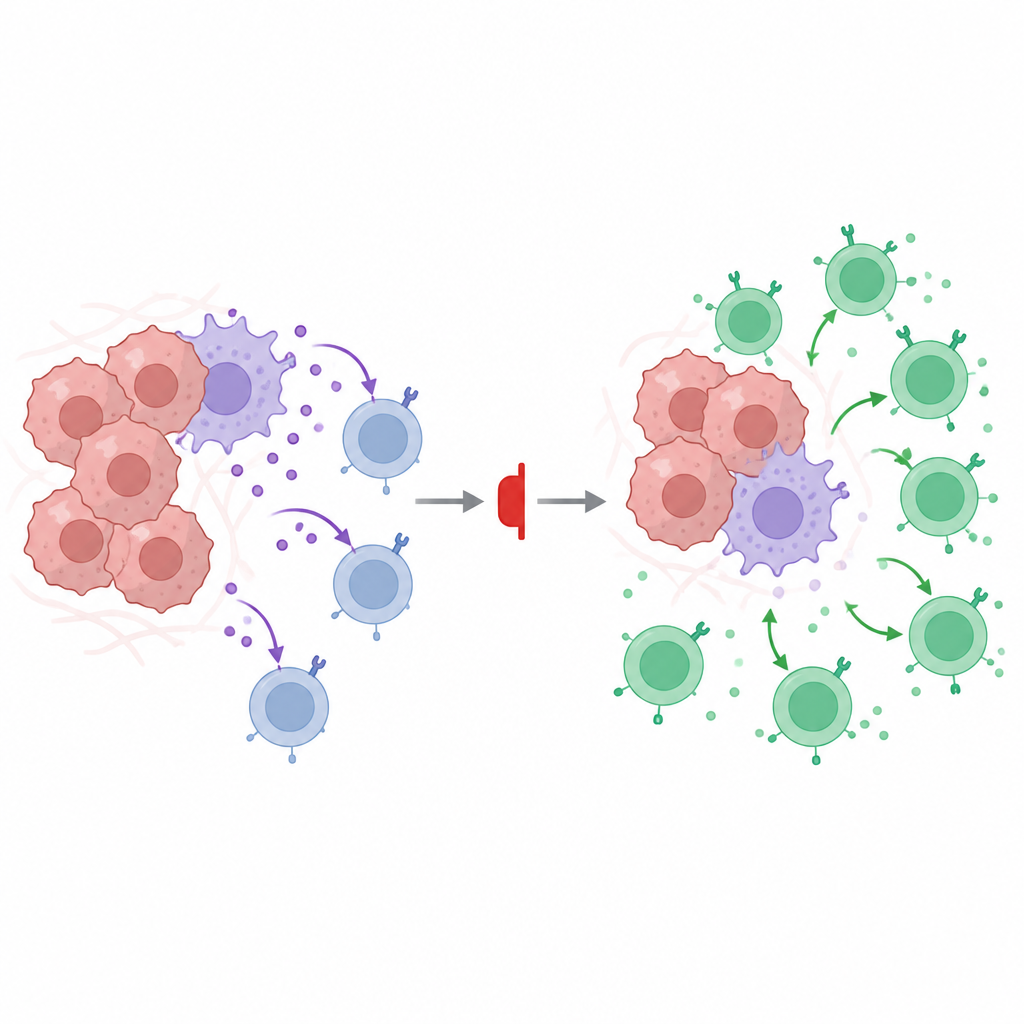
Using its priority list of candidates, MIDAS highlighted a signaling pair called oncostatin M (OSM) and its receptor OSMR, as well as a regulatory enzyme PTPN22. Earlier animal work hinted that OSM–OSMR could foster tumor-friendly environments, but it had not been thoroughly explored in human cancer tissue. The team tested these targets using patient-derived tumor explants, small pieces of melanoma grown briefly outside the body that preserve the original mix of cancer and immune cells. Blocking OSM–OSMR signaling in these explants led to fewer so-called dysfunctional CD8 T cells, a state linked to better immunotherapy responses, and lowered levels of the molecule CCL4, which is associated with tumor-promoting macrophages. In contrast, inhibiting PTPN22 produced subtler shifts in T cell behavior that did not reach clear statistical significance in this small series.
What this means for future cancer treatment
Overall, the study shows that MIDAS can mine complex data to flag drug targets that matter in real human tumors, not just in cell lines or simple lab models. The work supports the idea that OSM–OSMR signaling helps shape an immune-suppressive tumor microenvironment and that blocking this pathway could be a promising immunotherapy strategy worth further testing in oncology. More broadly, the approach demonstrates how combining rich patient data, network-based artificial intelligence and functional tests in patient-derived tissue can make the search for new cancer immunotherapy targets more efficient and better grounded in human biology.
Citation: Augustine, M., Nene, N.R., Fu, H. et al. Immunotherapy drug target identification using machine learning and patient-derived tumour explant validation. Nat Mach Intell 8, 670–689 (2026). https://doi.org/10.1038/s42256-026-01201-3
Keywords: cancer immunotherapy, drug target discovery, graph neural networks, tumor microenvironment, machine learning in oncology