Clear Sky Science · en
A general model for frictional contacts in colloidal systems
Why tiny grains and their rubbing matter
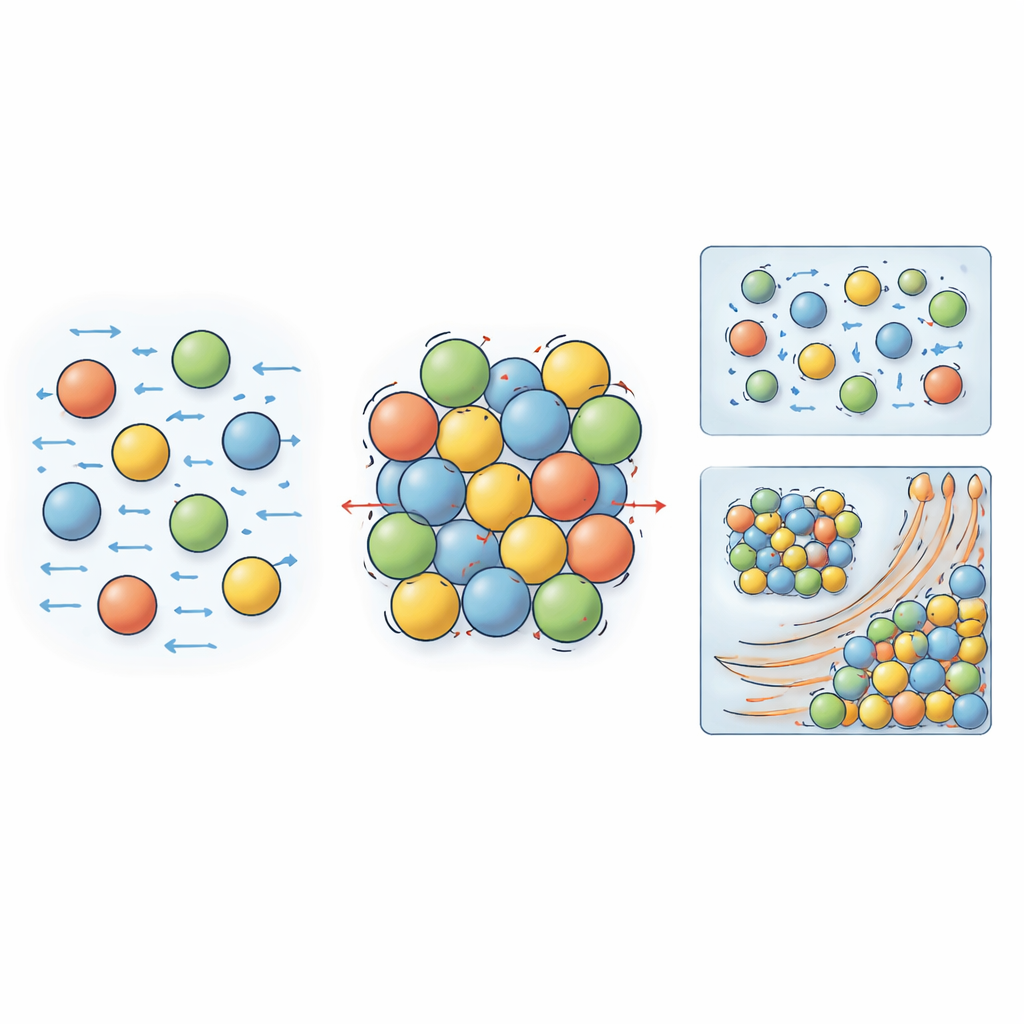
Many everyday materials, from printer ink to toothpaste and liquid foundations, are made of tiny particles suspended in a fluid. These particles constantly bump and rub against each other. Until recently, computer models of such systems mostly ignored the detailed friction that occurs when particles touch. This study shows that this seemingly small omission can lead to incorrect predictions about how these materials flow, thicken, or even spontaneously separate into dense clumps and dilute regions—and it offers a general, thermodynamically sound way to fix the problem.
How particles slide, roll, and spin
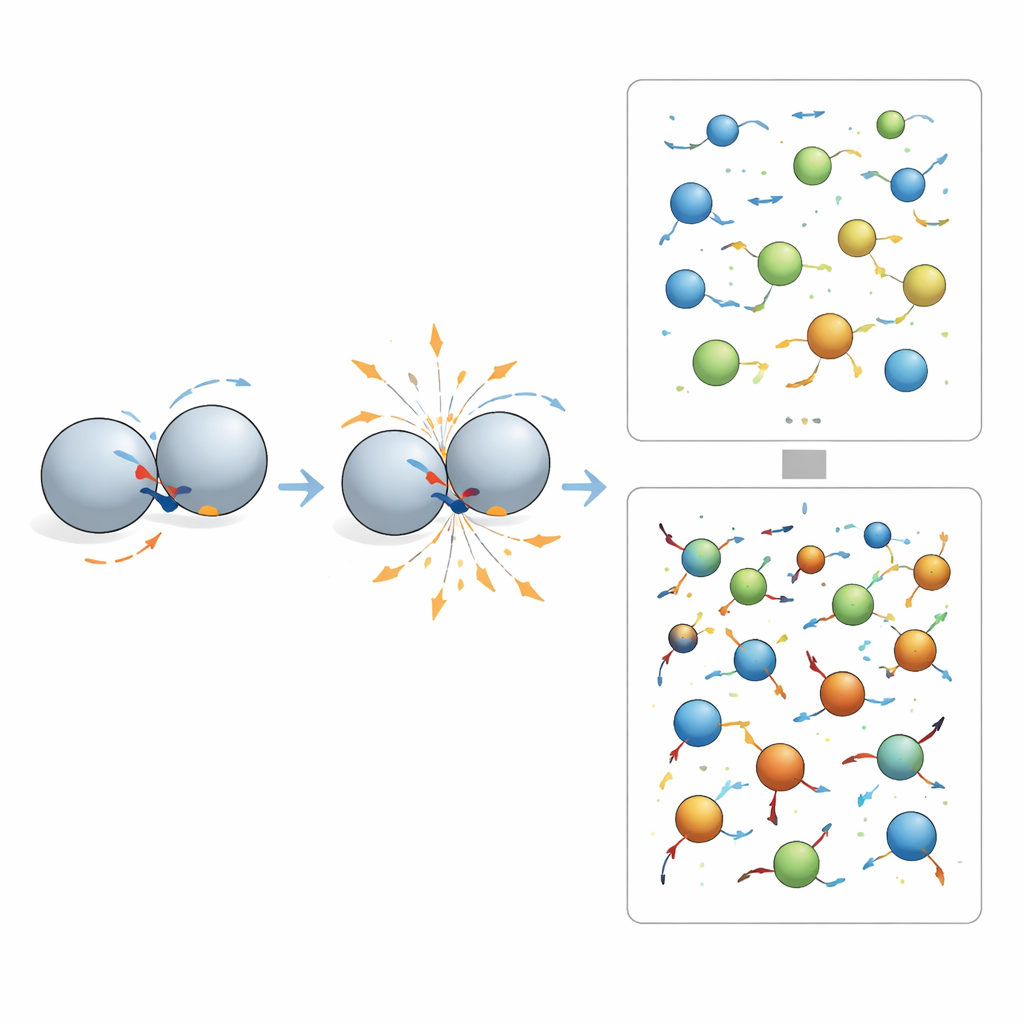
When two spherical particles collide in a liquid, they can do more than just bounce: they can slide and roll against each other. That sliding produces tangential friction, which couples how a particle moves through space to how it spins. Traditional models for large grains, like sand, already include such friction. But in the world of colloids—submicrometer to micrometer-sized particles—the random jostling from the surrounding fluid (thermal noise) is strong and cannot be ignored. The authors set out to build a model in which frictional contacts and this ever-present random motion are treated together in a way that respects the basic rules of thermodynamics.
Marrying friction with thermal jitter
The key insight is that whenever friction drains energy from the system, random forces from the thermal environment must feed energy back in, so that the particles settle to the correct temperature of the surrounding fluid. Using the mathematical framework of Fokker–Planck equations, the authors derive the precise form that these random forces and torques must take when particles experience tangential friction at contact. Crucially, the random kicks must be linked to both translation and rotation in the same structured way as the friction itself. Depending on how one interprets stochastic calculus in time (Itô, Stratonovich, or Hänggi–Klimontovich schemes), the noise takes slightly different but fully specified forms, and can be either simple or more complex “multiplicative” noise that depends on how fast particles move.
What goes wrong if friction noise is incomplete
With their general model in hand, the researchers used large-scale simulations to test its consequences. First, they examined passive colloidal fluids with various friction laws and showed that including only deterministic friction, while leaving out its corresponding random part, leads to severe inconsistencies. The simulated particles no longer follow the familiar Maxwell–Boltzmann distribution of speeds, and their translational motion and rotation appear to have different effective temperatures, both of which differ from that of the solvent. When the properly constructed random forces and torques are added, these artifacts disappear: the speed and spin distributions match theoretical expectations and the kinetic temperature coincides with the bath temperature.
Friction reshapes flow and phase separation
The team then explored how frictional contacts affect more complex behaviors. In pressure-driven flow through a slit channel, particles roll and slide along rough walls. Friction couples shear (velocity gradients) to particle rotation and influences how easily the fluid slips at the walls. Interestingly, the overall viscosity is only mildly changed at moderate densities, but the surface slip length is strongly reduced as friction grows, while rolling motion still prevents truly no-slip conditions. Turning to active matter—self-propelled particles that continuously consume energy—the authors studied motility-induced phase separation, where active particles spontaneously form dense clusters. Frictional contacts enlarge the range of conditions under which this clustering occurs. Yet, if the associated random noise is neglected, the predicted phase diagram changes qualitatively: simulations may show phase separation where a thermodynamically consistent model does not, or vice versa. This highlights how sensitive nonequilibrium collective behavior is to getting friction and noise right.
What this means for modeling real soft materials
In everyday terms, the study provides a missing piece for virtual laboratories that aim to predict how dense suspensions and active particle systems behave under flow or self-propulsion. The authors show that one cannot simply bolt on frictional forces from granular models while leaving thermal noise untouched; the random kicks must be carefully matched to the friction for the model to obey basic energy-balance principles. Their general recipe applies to a wide class of friction laws and simulation schemes, and can be used in popular molecular dynamics packages. This opens the door to more reliable simulations of phenomena such as shear thickening, flow along textured surfaces, and pattern formation in active, spinning, or chiral colloids, bringing theory a step closer to the complex behavior observed in real-world soft materials.
Citation: Hofmann, K., Dormann, KR., Liebchen, B. et al. A general model for frictional contacts in colloidal systems. Commun Phys 9, 139 (2026). https://doi.org/10.1038/s42005-026-02624-5
Keywords: colloidal friction, thermal noise, shear thickening, active matter, phase separation