Clear Sky Science · en
Linking critical temperature with electron localization for cavity-enhanced superconductivity
Why this matters for future technologies
Superconductors—materials that carry electric current with zero resistance—could revolutionize power grids, medical imaging, and quantum computers. But finding or designing better superconductors is slow and computationally expensive. This study explores a new shortcut: instead of simulating every microscopic interaction in detail, the authors ask whether a simple measure of how tightly electrons huddle or spread out in a material can predict how its superconducting temperature changes when it is placed inside a special light-trapping structure called an optical cavity.
Using light without shining a beam
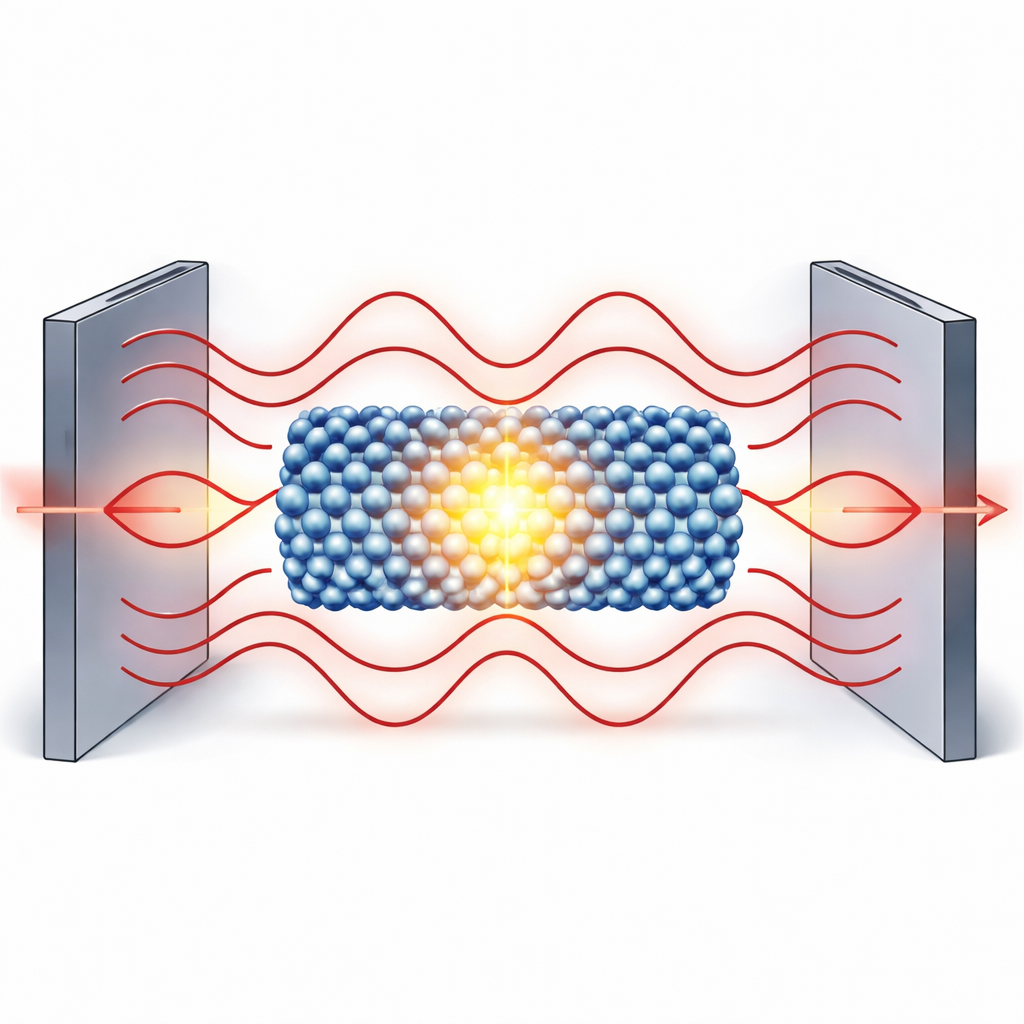
Optical cavities are tiny mirrored enclosures that trap light and amplify its quantum fluctuations—the restless energy of the “empty” electromagnetic vacuum. Even without any laser shining, these vacuum ripples can subtly reshape how electrons and atoms move in a solid. The authors study three well-known superconductors—lead, niobium, and magnesium diboride (MgB2)—when they are embedded in such cavities. Instead of driving the materials far from equilibrium, they stay in an equilibrium-like regime where only the vacuum field is active, offering a gentler but powerful way to engineer material properties from within.
A simpler fingerprint of electron behavior
Fully predicting the critical temperature, the point where a material becomes superconducting, normally requires heavy-duty calculations that track how electrons interact with lattice vibrations (phonons). Here the researchers test a cheaper quantity: the electron localization function, or ELF. ELF does not count how much charge is present, but how concentrated or spread out the electrons are in space, on a scale from fully localized to fully delocalized. By combining state-of-the-art electronic-structure tools with a quantum treatment of light inside the cavity, they compute both the detailed superconducting properties and the ELF for each material, with and without the cavity, and then directly compare how both change.
How the cavity reshapes vibrations and electrons
For all three materials, the cavity tends to “soften” the phonons, meaning the atoms vibrate at slightly lower energies. This softening typically strengthens the interaction between electrons and vibrations, which is essential for conventional superconductivity. In MgB2, the key vibrational mode that glues electrons into pairs becomes noticeably softer, and the overall electron–phonon coupling grows, especially when the cavity’s electric field lies within the boron planes of the crystal. At the same time, the ELF reveals that electrons along certain bonds become more delocalized in regions between atoms, where they can better screen electric forces and help lower the energy cost of atomic motion, reinforcing the phonon softening.
Different materials, different responses
The three superconductors respond in distinct ways. In MgB2, the critical temperature rises dramatically—from 39 kelvin in free space to about 58 kelvin for one cavity orientation and up to roughly 71 kelvin for another. Here, the increase in critical temperature tracks well with increased electron delocalization in specific regions of the crystal, suggesting that ELF can serve as a practical indicator for how cavity conditions will affect superconductivity. Niobium shows a strong but non-monotonic enhancement: its critical temperature first grows and then slightly falls at very strong coupling, while ELF still captures a general trend toward more delocalized electrons as the coupling increases. Lead changes the least: its vibrational spectrum is reshuffled, and the critical temperature dips slightly before recovering, with only a modest and more complex relationship to ELF.
What this means for designing new materials
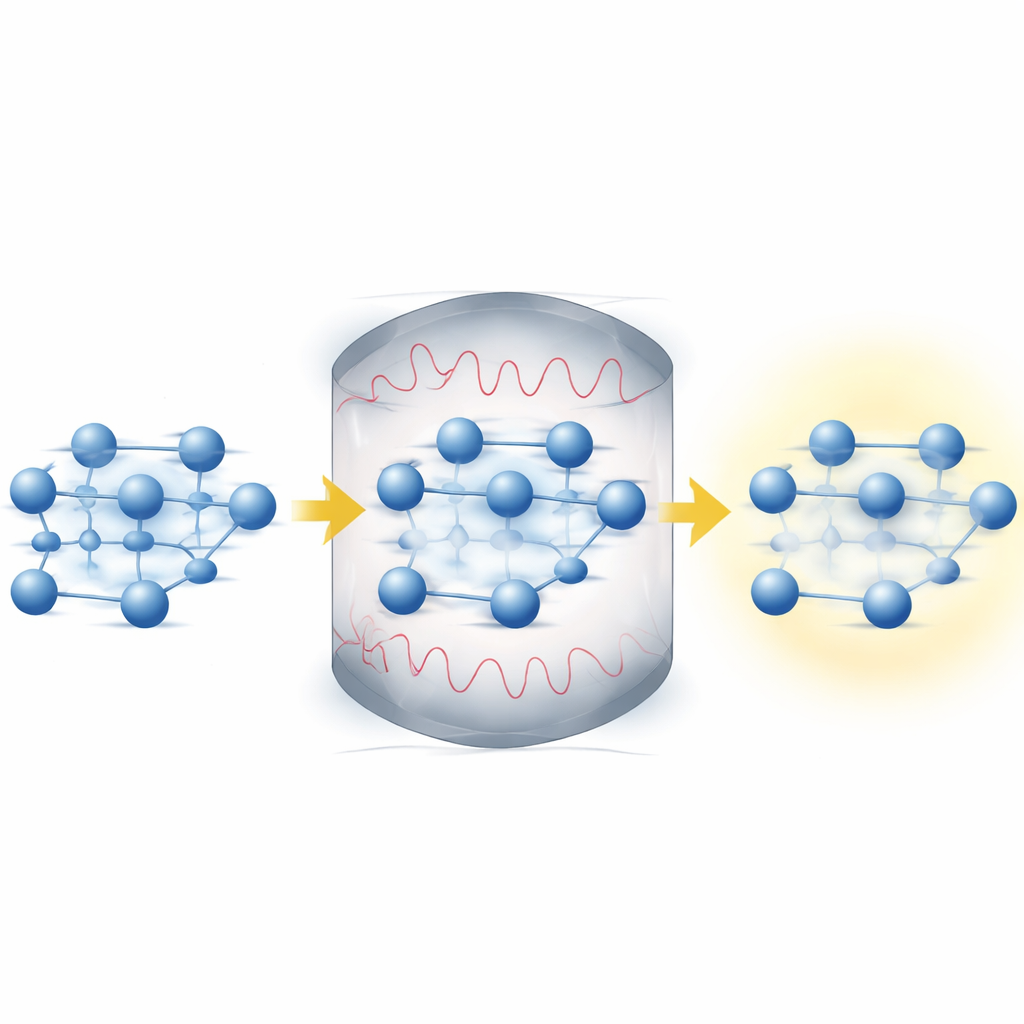
Overall, the study shows that simply confining a superconductor inside an optical cavity—without shining light on it—can substantially alter its superconducting properties through quantum vacuum fluctuations alone. In several key cases, a relatively inexpensive measure of electron localization mirrors the trends in the critical temperature, especially when electron delocalization between atoms grows. For researchers and technologists, this suggests that ELF could act as a fast screening tool to identify promising materials and cavity setups before committing to far more demanding simulations or experiments. In the long run, such descriptors may help guide the rational design of superconductors and other quantum materials tailored to work hand in hand with engineered light fields.
Citation: Nourmofidi, O., Hübener, H., Gross, E.K.U. et al. Linking critical temperature with electron localization for cavity-enhanced superconductivity. Commun Phys 9, 134 (2026). https://doi.org/10.1038/s42005-026-02604-9
Keywords: superconductivity, optical cavities, electron localization, quantum materials, light–matter interaction