Clear Sky Science · en
Dual-mode superconducting diode effect enabled by in-plane and out-of-plane magnetic field
Why one way superconductors matter
Electronics depends on diodes that let current flow more easily one way than the other. In normal devices this always wastes energy as heat. Superconductors, by contrast, can carry current with almost no loss, but usually treat both directions the same. This study explores a new kind of "superconducting diode" that works in two distinct modes, promising ultra efficient, direction sensitive elements for future low power and quantum circuits.
A special sandwich of ultra thin crystals
The researchers built their diodes from a stacked pair of layered crystals known as 2H NbSe2 and 2H NbS2. Each material is a superconducting sheet that can be peeled into flakes only tens of nanometers thick. By placing flakes of similar thickness on top of each other, they formed a vertical junction where pairs of electrons can tunnel across the interface without resistance. Crucially, this sandwich structure subtly breaks the spatial symmetries that would otherwise force current to behave the same in both directions, setting the stage for diode like action once time reversal symmetry is also disturbed by a magnetic field. 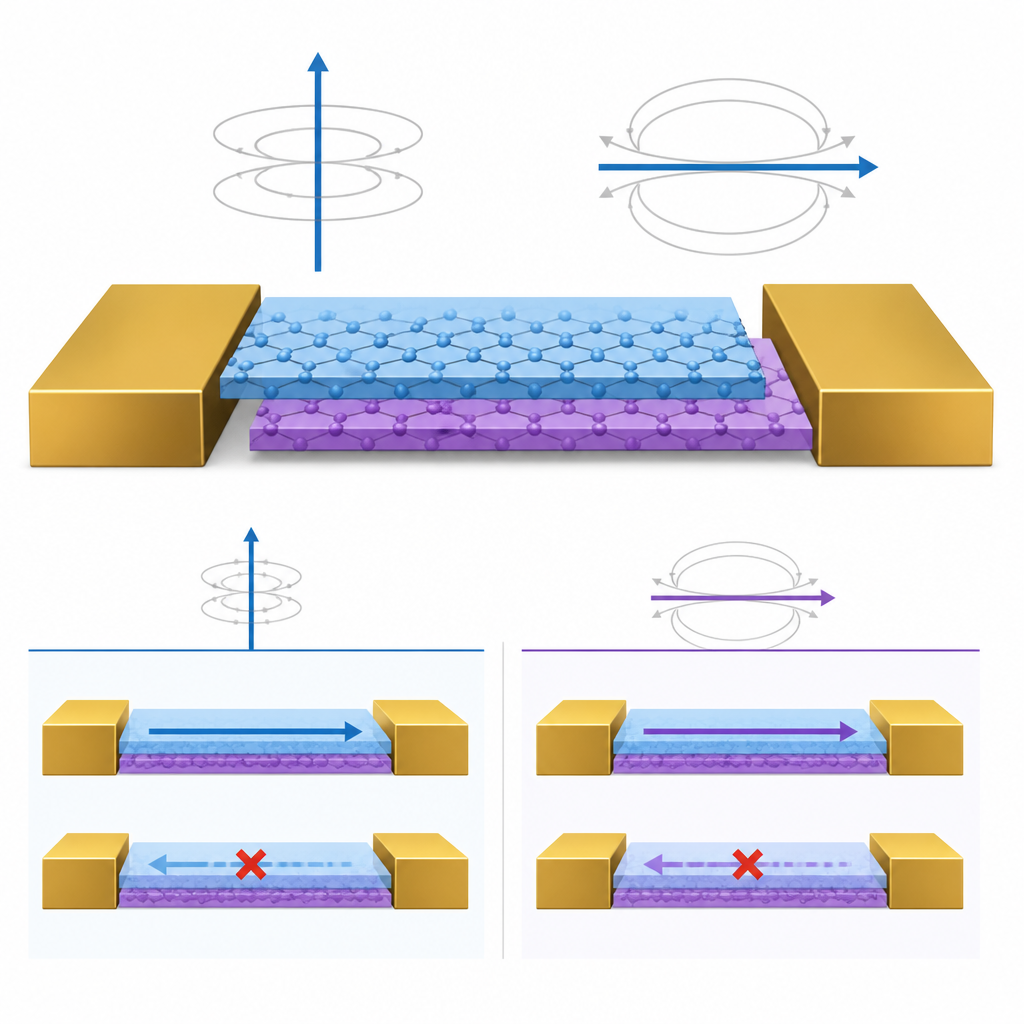
Two independent ways to turn on one way flow
Most previously reported superconducting diodes work in a single mode: they need a magnetic field in one special direction, either straight through the device or along its plane. In this work, both orientations independently activate strong diode behavior in the same junction. When the magnetic field points out of the plane, with strengths of only about one thousandth of a tesla, the device supports a larger critical supercurrent in one direction than in the opposite one. Rotating the field into the plane, and increasing its strength by about a hundredfold, again creates a one way supercurrent, with a similar efficiency of more than ten percent difference between directions.
Fingerprints of two distinct modes
By mounting the device on a rotatable stage, the team could smoothly change the angle between the flakes and the magnetic field. They measured how the maximum lossless current in each direction varied with field strength and direction, and summarized the asymmetry in a "diode efficiency". Out of plane fields produced narrow peaks in efficiency at very small fields, while in plane fields gave a broader, almost sinusoidal pattern at larger fields. At intermediate tilt angles, both patterns appeared at once, proving that the two modes coexist rather than being artifacts of slight misalignment. The temperature dependence also differed: the out of plane mode followed a square root like trend expected from certain superconducting theories, while the in plane mode changed more linearly as the device warmed toward its critical temperature. 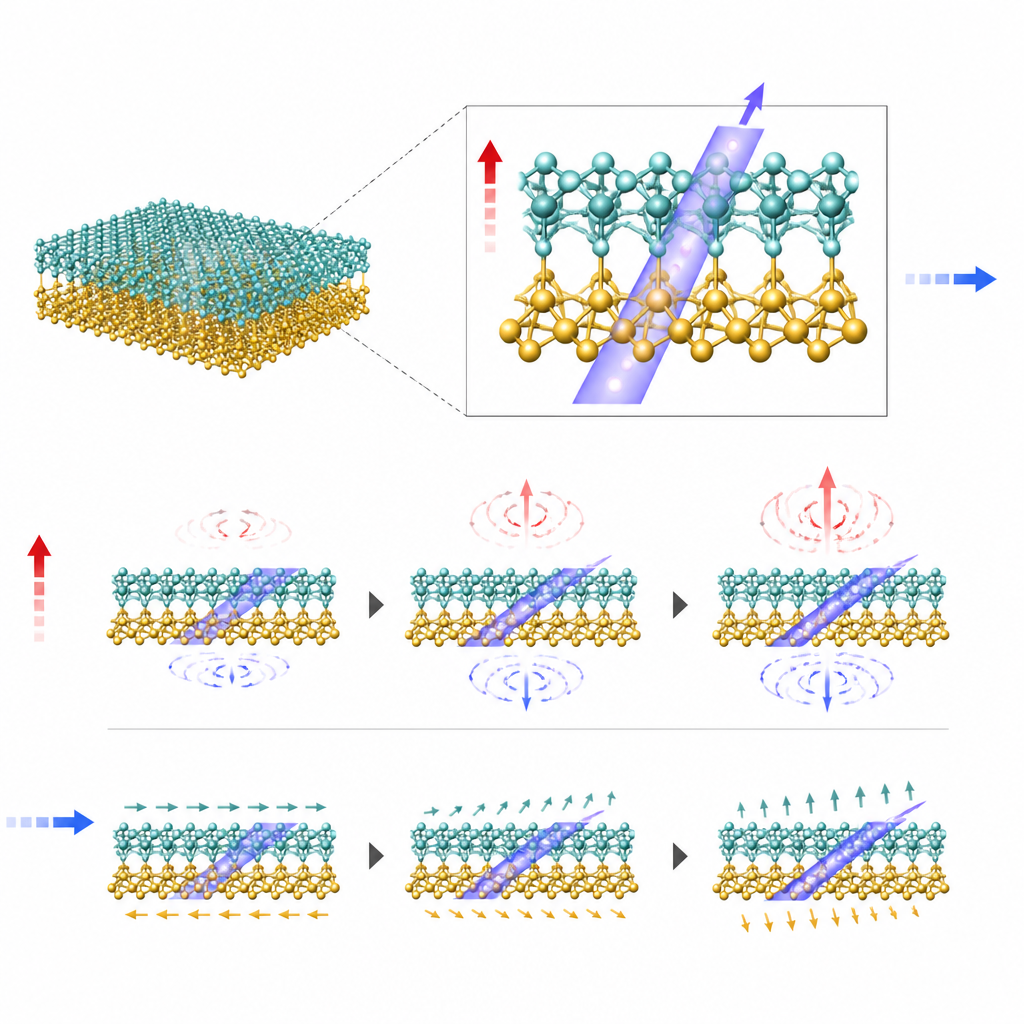
How broken symmetry and spin effects help
To understand the origin of this dual behavior, the authors modeled the interface as two superconducting layers with different kinds of spin orbit coupling, an interaction that ties an electron’s spin to its motion. In this picture, stacking NbSe2 and NbS2 lowers the symmetry at the interface and allows two spin orbit effects, often called Ising and Rashba types, to work together. If the current through the junction is slightly tilted rather than perfectly vertical, both out of plane and in plane magnetic fields can shift the momentum of paired electrons in a way that favors one direction of flow. Calculations within this simplified model reproduce key features of the experiment, including comparable diode strength for both field directions and the need for much larger in plane fields.
From fast switches to stable logic elements
Having two independently addressable modes in the same superconducting diode opens new design options. The out of plane mode responds to extremely small fields, which could be provided locally by tiny on chip nanomagnets that switch polarity at high speed. This suggests a fast "polarity flipping" element whose preferred current direction can be changed on demand. The in plane mode, in contrast, needs a much stronger field and turns out to be relatively insensitive to small stray fields, making it attractive for high fidelity operations in complex superconducting circuits where stability is crucial. Together, these results show that carefully engineered crystal stacks can host flexible, low loss components that go beyond what single mode superconducting diodes can offer.
Citation: Guan, H., Yan, C., Zhang, Z. et al. Dual-mode superconducting diode effect enabled by in-plane and out-of-plane magnetic field. Commun Phys 9, 180 (2026). https://doi.org/10.1038/s42005-026-02598-4
Keywords: superconducting diode, NbSe2 NbS2 heterostructure, spin orbit coupling, magnetic field control, superconducting electronics