Clear Sky Science · en
Distances in weighted higher-order networks
Why measuring distance in networks matters
From social media to scientific research, much of modern life can be described as networks of connections. But many real situations involve groups rather than simple pairs: a research paper links several fields, an email goes to many recipients, a drug combines multiple ingredients. In these higher-order networks, even defining how "far apart" two items are becomes tricky. This article introduces a new way to measure distance in such complex, group-based systems so that we can better map how ideas, people, or components relate to one another.
From simple links to rich group connections
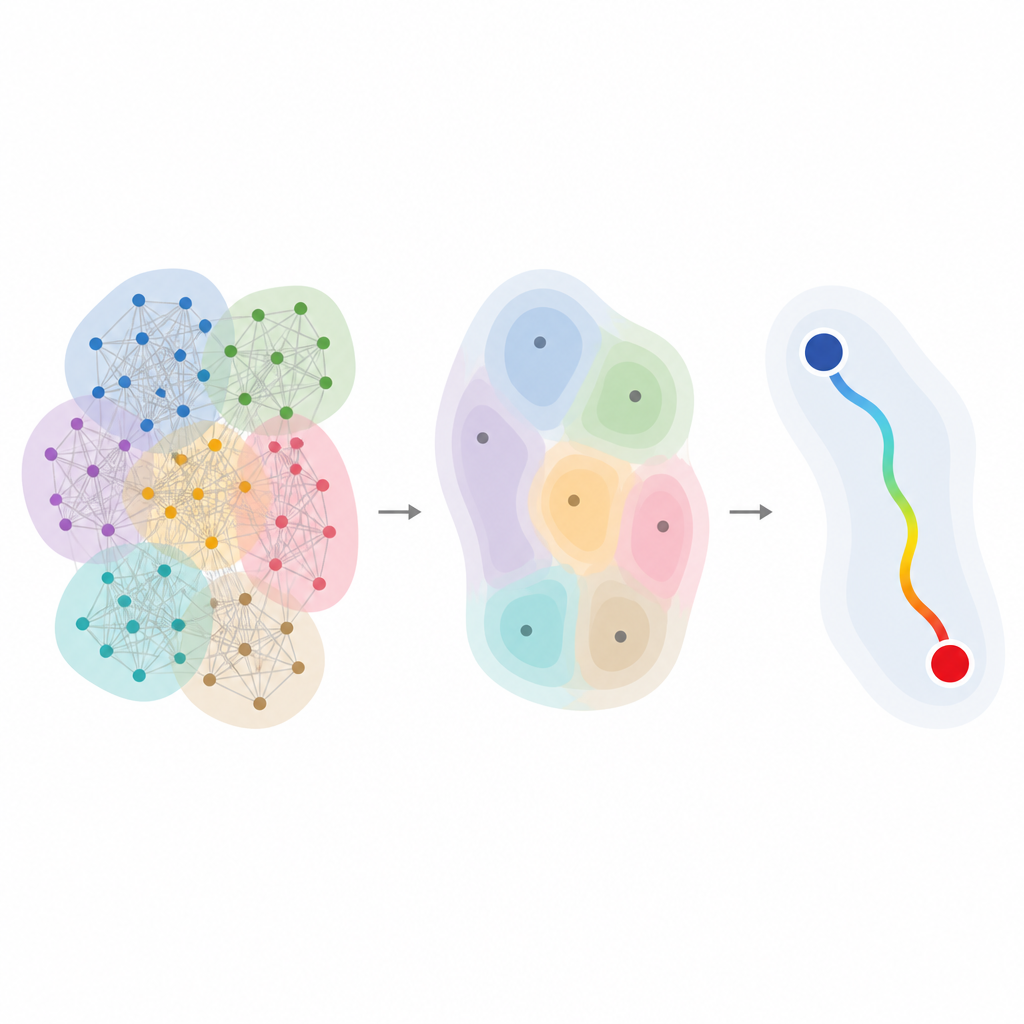
In ordinary networks, distance is straightforward: it is the length of the shortest path from one node to another. This works well when each link connects exactly two nodes. However, many real data sets are better described by hypergraphs, where a single connection can join three, four, or many more nodes at once. A common shortcut is to break each group into many pairwise links, a process called clique projection. While convenient, this shortcut discards important information about how large the groups are and how they overlap, and can therefore distort distances between nodes.
Building a distance that respects higher-order structure
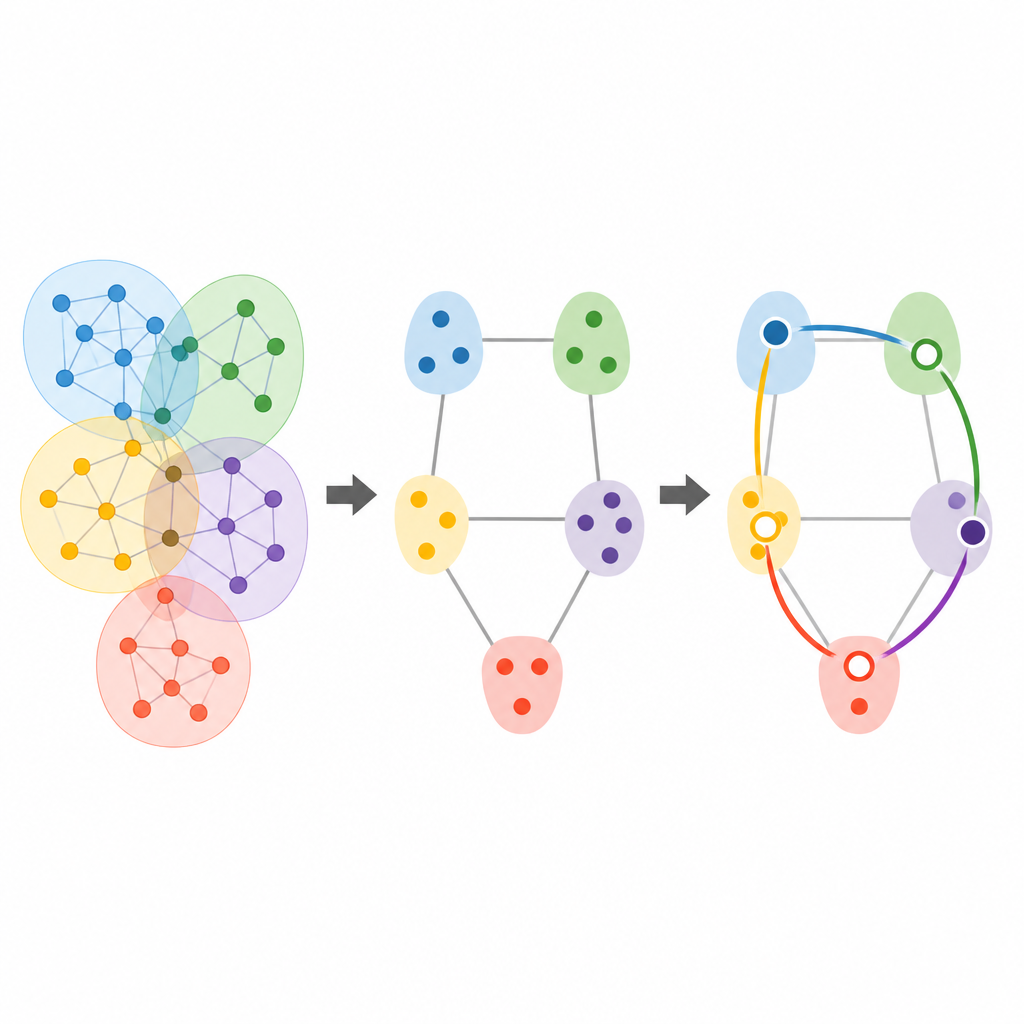
The authors propose a distance measure designed specifically for weighted hypergraphs, where each group also carries a strength or frequency. Their construction relies on transforming the hypergraph into a companion structure in which each group becomes a node and overlaps between groups become links. Distances between original nodes are then derived from paths that run through this "network of groups," taking into account both how large the groups are and how strongly they are weighted. The resulting distance obeys all the standard rules we expect of a metric, such as always being non-negative and satisfying the triangle inequality, and it reduces to the familiar graph distance when connections are purely pairwise.
How weights and overlaps shape separation
By exploring simple examples, the study illustrates why higher-order effects matter. When a single group contains many nodes, any two members of that large group are treated as farther apart than members of a tiny group, reflecting the idea that sharing a crowded context gives weaker direct affinity. Likewise, if two groups overlap heavily, nodes in different groups but within the shared core are effectively closer. When weights are added, frequent or strong group interactions shorten distances, but in a way that depends on both group size and how groups intersect. This richer picture contrasts with clique projection, where the same underlying hypergraph can produce identical pairwise distances even when higher-order structure is very different.
Testing the method on real-world data
The researchers apply their distance to several real datasets, including the arXiv preprint repository, school contact patterns, emails in a company, drug compositions, and United States Senate committees. In the arXiv case, each scientific field is a node, each paper forms a group of fields, and group weights track how often a particular combination appears. The new distance is used to study "cognitive distance" between fields, that is, how conceptually far disciplines are from one another. When they compare their hypergraph-based distances with those obtained from clique projections, they find that some pairs of fields can move from being relatively close to relatively far, or vice versa, depending on the method. These shifts show that projections can mask meaningful structure, especially when many papers span more than two fields.
What this means for mapping complex systems
Across all datasets, the authors find that pairwise projections work reasonably well only when most interactions involve two nodes, as in typical classroom contacts. In systems where larger groups are common and carry diverse weights, the projection approach can significantly underestimate or mis-rank distances. The new measure preserves the full higher-order information while remaining computationally manageable, and it naturally includes ordinary graph distance as a special case. For non-specialists, the key message is that when we try to chart how far apart ideas, people, or components are in complex group settings, we need tools that see beyond simple pairwise links. This hypergraph-based notion of distance offers a more faithful map of separation in the many-layered networks that underlie modern science and society.
Citation: del Genio, C.I., Vasilyeva, E., Tupikina, L. et al. Distances in weighted higher-order networks. Commun Phys 9, 178 (2026). https://doi.org/10.1038/s42005-026-02592-w
Keywords: hypergraph distance, higher order networks, cognitive distance, network metrics, arXiv data