Clear Sky Science · en
Generation of vacuum ultraviolet vortex beams via near-threshold harmonics in argon gas driven by infrared Laguerre-Gaussian lasers
Light With a Twist
Light is not just a stream of energy; it can also carry a kind of “twist” that makes its wavefront spiral like a corkscrew. In the vacuum‑ultraviolet (VUV) range, such twisted, or vortex, light could let scientists watch electrons move inside materials on extremely short time scales and at very small length scales. This study shows how to create these exotic beams using a compact table‑top setup instead of huge facilities, opening the door to more accessible tools for ultrafast materials science and chemistry.
Why Twisted VUV Light Matters
Vortex light beams have a hole in the middle and a ring of brightness around it, like a glowing doughnut. Because their wavefronts spiral, they carry orbital angular momentum, a kind of rotational “kick” that can be imprinted on matter. At shorter wavelengths in the VUV range, this twisted light can probe electronic transitions in solids, reveal how electrons move between energy bands, and sense chiral (handed) structures in molecules. Until now, generating such beams at these wavelengths typically required large, expensive installations like synchrotrons or free‑electron lasers, or complicated schemes with limited flexibility. A simple, tunable source that fits on a lab bench is therefore highly attractive for many areas of research and technology.
A Table‑Top Route to Vortex VUV Beams
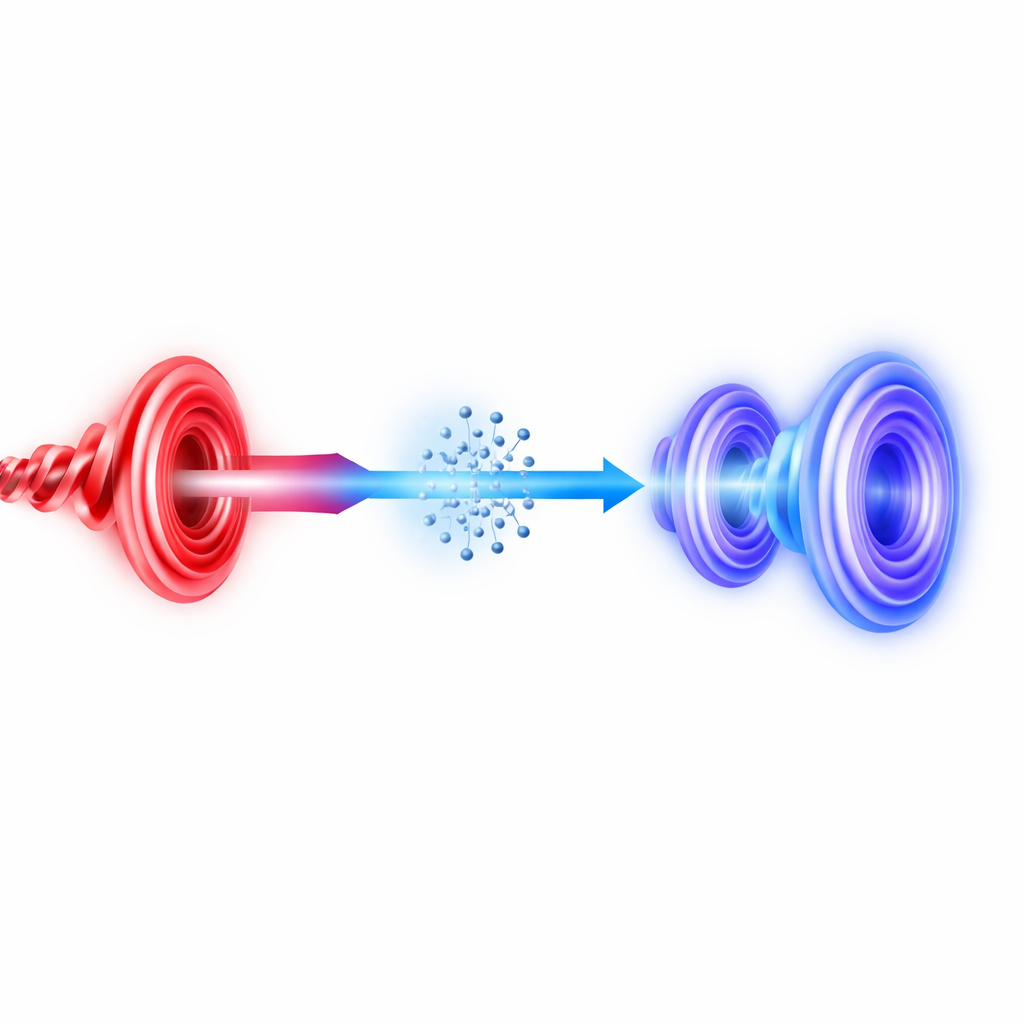
The authors explore a method that starts from an intense infrared laser beam already shaped into a vortex, with its energy wrapped into a ring and its phase twisting as it propagates. This beam is focused into a short jet of argon gas, where it drives electrons in the atoms so strongly that they give off light at new, much higher frequencies. These new colors arise through harmonic generation: the emitted light oscillates several times faster than the original laser. The work concentrates on “near‑threshold” harmonics, whose photon energies sit just around the point where argon atoms would ionize. In this regime, the emitted VUV light naturally falls into the range useful for studying solids and molecules, and crucially, it inherits the twisting character of the driving infrared vortex beam.
Two Competing Routes to New Light
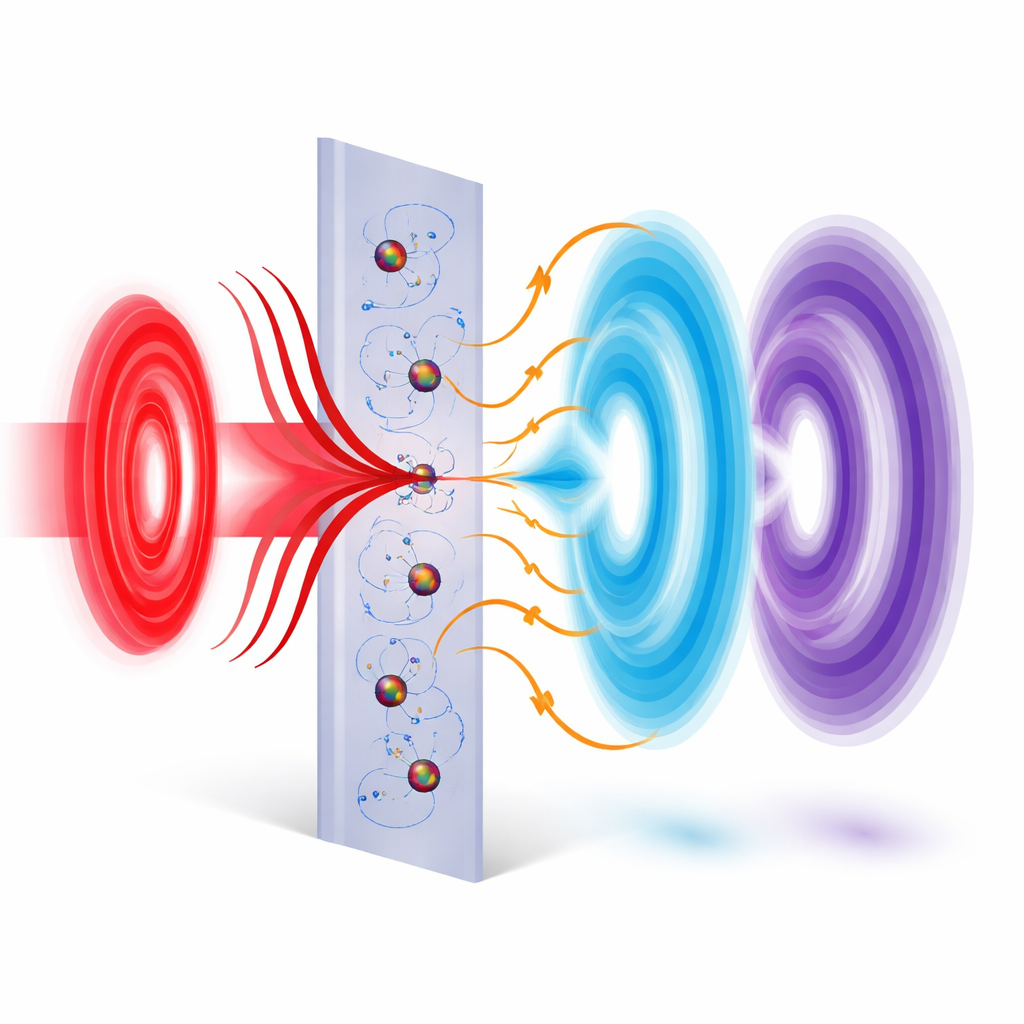
Inside each argon atom, the infrared field can create VUV light in more than one way. Sometimes the atom effectively absorbs several photons at once in a multiphoton step, nudging an electron into an excited state without fully freeing it. In other cases, the field rips the electron away and then drives it back to collide with its parent ion, a process that can release a burst of higher‑energy light. The simulations in this paper track these processes in time and frequency and show that different harmonic orders are dominated by different mixtures of these routes. Lower near‑threshold harmonics around the seventh and ninth orders are especially sensitive: they emerge from a delicate interference between multiphoton and recollision pathways, which makes their spectra broad and somewhat fuzzy. Slightly higher harmonics, such as the eleventh, are mostly produced by clean, well‑defined recollision events and look much more like conventional high‑order harmonics.
Shaping Doughnut Beams in Space
Beyond the internal mechanism, the researchers ask how these vortex harmonics look in space as they leave the gas jet and propagate. The simulations reveal rich ring patterns in the intensity: some harmonics show a single bright ring, others multiple concentric rings. Moving the gas jet before, at, or after the laser focus changes how different parts of the beam add up, because the phase of the emitted light and the focusing conditions shift together. Interestingly, the overall strength and basic spectral shape of the near‑threshold harmonics barely change with gas‑jet position, unlike higher‑order harmonics at much higher energies. However, their spatial profiles do change: the seventh harmonic tends to keep a single‑ring structure, the eleventh remains a robust clean ring at all positions, while the ninth is highly sensitive, switching between one and multiple rings as conditions vary. These patterns are traced back to differences in how well different parts of the gas support constructive buildup of each harmonic along the beam path.
Toward Practical Twisted VUV Sources
By connecting the microscopic routes inside atoms with the macroscopic shape of the emerging beam, the study builds a detailed picture of how near‑threshold vortex harmonics form and propagate. In simple terms, the authors show that a twisted infrared beam can reliably imprint its twist onto VUV light in a compact gas‑jet setup, and that the resulting doughnut‑shaped beams can be tuned and understood in detail. This lays the groundwork for practical, table‑top VUV vortex sources that laboratories can use to watch electrons move, probe chiral matter, and explore ultrafast processes in atoms, molecules, and solids without relying on giant light facilities.
Citation: Han, J., Wang, B., Tang, X. et al. Generation of vacuum ultraviolet vortex beams via near-threshold harmonics in argon gas driven by infrared Laguerre-Gaussian lasers. Commun Phys 9, 145 (2026). https://doi.org/10.1038/s42005-026-02579-7
Keywords: vortex light, vacuum ultraviolet, high-order harmonics, orbital angular momentum, ultrafast electron dynamics