Clear Sky Science · en
Discrete time quasi-crystals in Rydberg atomic chain
Time Patterns Beyond Simple Repetition
We are used to patterns in space—like the regular arrangement of atoms in a crystal—but matter can also form patterns in time. This paper explores an especially exotic kind of temporal order called a “discrete time quasi-crystal,” realized not in a solid block of material, but in a carefully controlled line of ultra-cold atoms. For readers interested in quantum technologies and new phases of matter, this work shows how engineers can sculpt the rhythm of a many-particle quantum system into intricate, almost-but-not-quite repeating patterns in time.
From Ordinary Crystals to Clocks Made of Matter
Ordinary crystals break spatial symmetry: shift them by less than one lattice spacing and they no longer look the same. Time crystals are the temporal counterpart. When a quantum system is driven by a regular series of pulses, it can respond with its own rhythm that is locked to, but different from, the driving period—much like a dancer who reliably steps on every second beat of the music. These “discrete time crystals” have been seen in several platforms, including trapped ions and solid-state spins. They are non-equilibrium phases: instead of settling into stillness or randomness, they sustain long-lived, organized motion in time.
Quasi-Crystals in Time: Not Quite Periodic
Quasi-crystals in space, famously discovered in metallic alloys, display sharp diffraction patterns despite lacking a simple repeating unit cell. A discrete time quasi-crystal is the temporal analogue: the system exhibits robust oscillations, but the pattern never exactly repeats, even over long times. This happens when the drive includes two frequencies whose ratio is incommensurate—based on an irrational number such as the golden ratio—so no common period exists. The authors ask whether such time quasi-crystals can be engineered in a particularly versatile quantum simulator: an array of Rydberg atoms, whose strong, tunable interactions have already been used to realize programmable spin models and discrete time crystals. 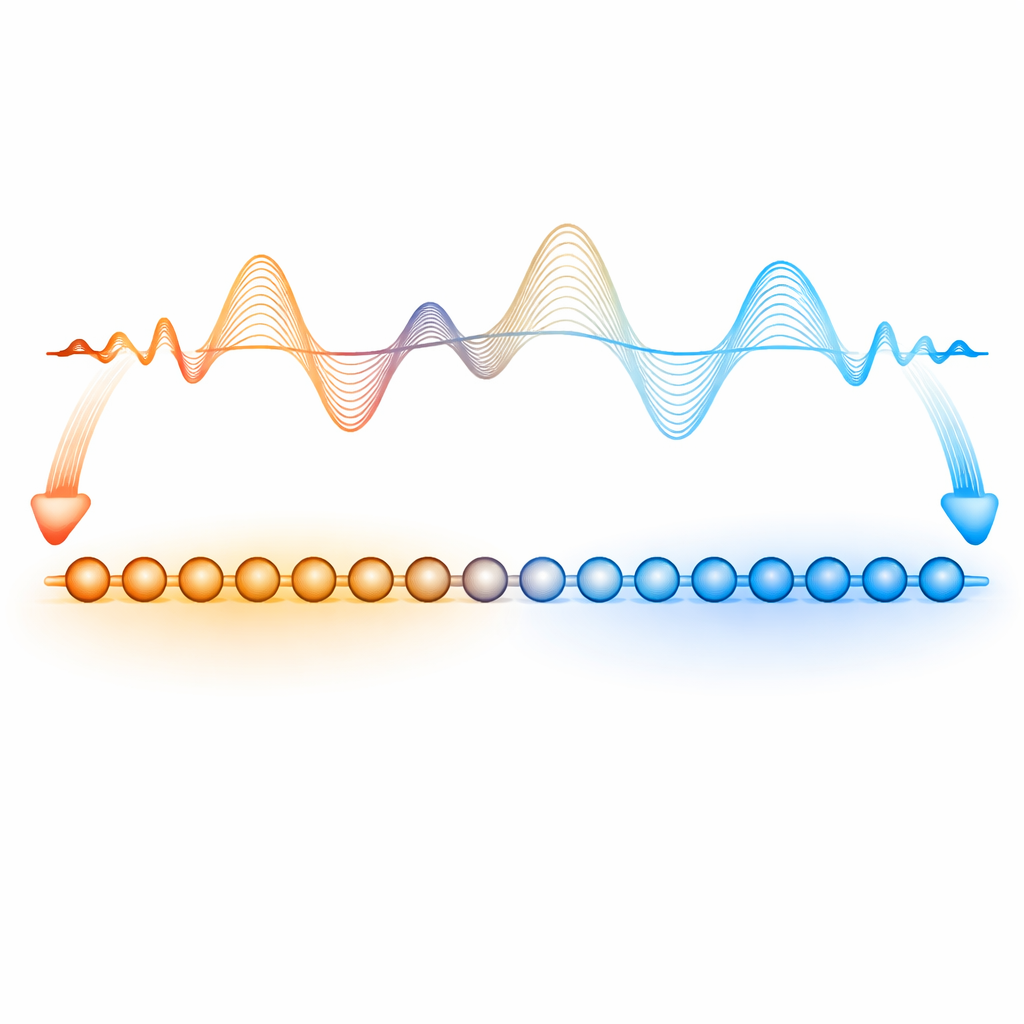
Building a Quantum Chain with Two Rhythms
The team proposes a one-dimensional chain of atoms split into a left and a right segment. In each segment, lasers excite atoms to high-lying Rydberg states, with a strong “blockade” that prevents neighboring atoms from being excited simultaneously. This constraint gives rise to special non-thermal “scar” states that naturally oscillate. Using periodic laser pulses, each half-chain is individually tuned into a discrete time crystal that flips between two antiferromagnetic patterns—alternating excited and unexcited atoms. Crucially, the two halves are driven at different frequencies whose ratio is chosen to be maximally incommensurate (close to the golden ratio). The same interaction that enforces the blockade at the boundary also couples the two halves, causing their distinct time-crystal rhythms to interfere.
Diagnosing the New Temporal Order
To recognize a time quasi-crystal, the authors track several quantities as the chain evolves. One is an antiferromagnetic order parameter that measures how strongly atoms alternate along the chain; another is the fidelity, which records how often the system returns close to its initial pattern. A third is the entanglement entropy between the left and right halves, which quantifies how strongly their quantum states are linked. When the driving frequencies and pulse strengths are tuned just right, the order parameter shows stable oscillations that never settle into a simple period, and its frequency spectrum contains sharp peaks at combinations of half the two drive frequencies. The fidelity and entanglement signals echo this structure: they display clear, long-lived components built from sums and differences of the underlying drives, indicating a robust quasi-periodic temporal order shared by the whole chain. 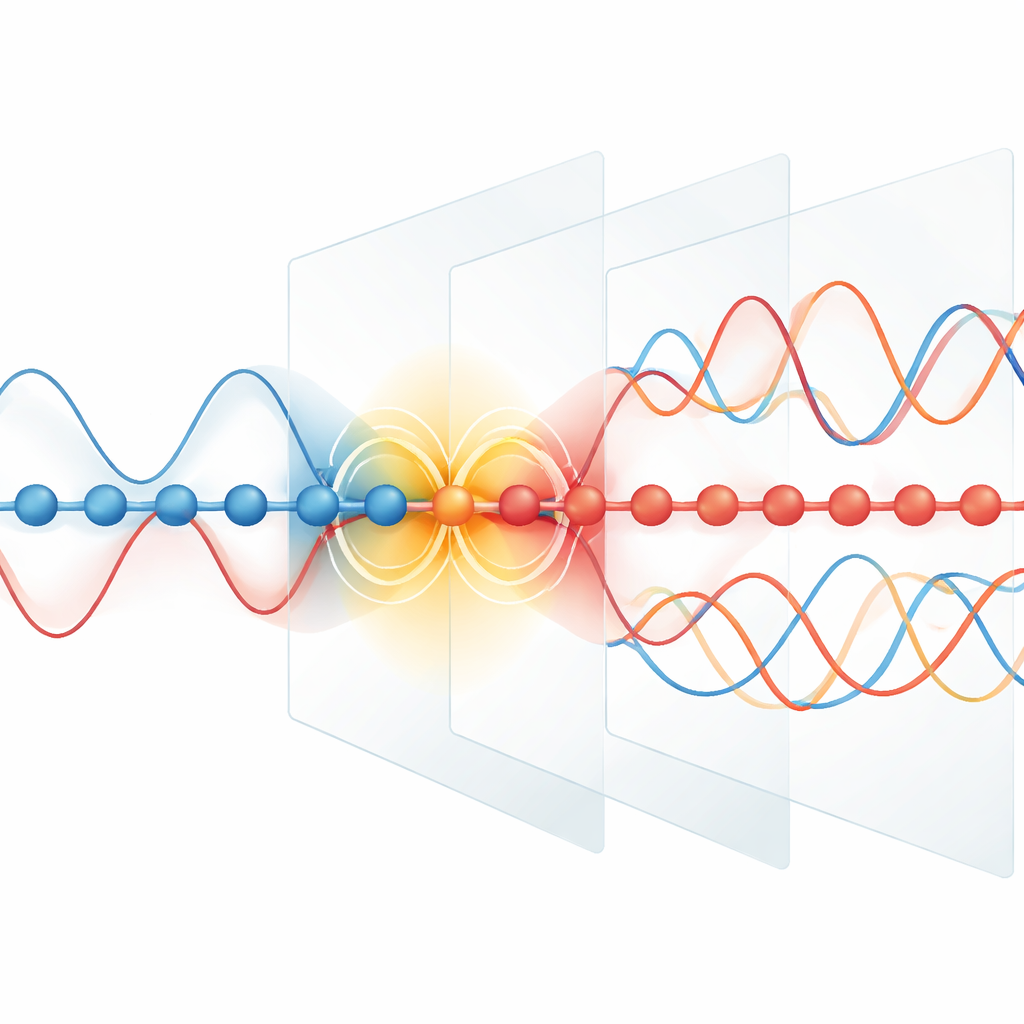
Windows Between Calm and Chaos
The authors map out how this behavior depends on the drive strength and frequency. At low drive frequencies, many competing oscillations appear and the signal becomes irregular, approaching chaotic behavior rather than forming a clean time quasi-crystal. At very high frequencies, the two halves effectively decouple, each acting as an independent time crystal with little mutual influence; the entanglement between them becomes small. Only in an intermediate “sweet spot” does the system display both clear incommensurate frequencies and a modest but steady level of entanglement across the boundary. A simple picture of two coupled oscillators with slightly different natural frequencies helps explain why: if their rhythms are too different, they fail to lock in a structured way; if they are too similar or too strongly driven, one behavior dominates.
Why This Matters for Quantum Technology
In summary, the paper shows that by coupling two distinct time crystals in a Rydberg atom chain and driving them with carefully chosen, incommensurate frequencies, one can engineer a discrete time quasi-crystal: a quantum many-body system that displays long-lived, quasi-periodic motion in time. For non-specialists, the key takeaway is that quantum matter can be made to “tick” in surprisingly complex and controllable ways. Because such states naturally encode multiple sharp frequencies at once, they may be useful for storing high-dimensional quantum information or sensing several signals simultaneously. This work thus positions time quasi-crystals as a promising bridge between orderly oscillations and chaos, and as a new resource for future quantum devices.
Citation: Luo, X., Zhou, Y., Xu, Z. et al. Discrete time quasi-crystals in Rydberg atomic chain. Commun Phys 9, 141 (2026). https://doi.org/10.1038/s42005-026-02572-0
Keywords: time crystals, Rydberg atoms, quantum simulation, quasicrystals, entanglement