Clear Sky Science · en
Exploring nontrivial topology at quantum criticality on a superconducting processor
Why quantum fluctuations matter to future technology
Everyday materials like magnets and superconductors owe their strange behaviors to countless tiny quantum particles acting in concert. Physicists have long used this collective behavior to classify different “phases” of matter, such as solids and liquids, or more exotic states that conduct electricity only on their edges. This article explores an especially subtle kind of quantum phase that sits right at a tipping point between two forms of order. Using a large superconducting quantum processor, the researchers show that even at this delicate balancing point, hidden patterns of organization survive and could be harnessed as a resource for quantum technologies.
A new kind of order at the tipping point
Traditionally, phases of matter are distinguished by whether some symmetry of the system is broken—for example, when a magnet picks a preferred direction. More recently, scientists discovered “topological” phases, where the crucial information is stored not in any local pattern but in global features of the quantum state and its entanglement. These phases are usually thought to rely on an energy gap that protects them from disturbances. The work described in this paper challenges that intuition by focusing on a model that is gapless at a special quantum critical point, where the system is poised between an ordinary magnetically ordered phase and a topological phase. Theory predicts that, despite the lack of a gap, this critical point retains robust edge features that distinguish it from a more conventional critical system.

Building a 100-qubit quantum spin ring
To probe these delicate effects, the team uses a flip-chip superconducting processor containing 125 qubits, of which 100 are configured into a one-dimensional ring. Each qubit can be individually controlled and read out, while pairs of neighbors are linked by tunable couplers that implement precise entangling gates. Instead of directly engineering the full many-body interactions of the target model, the researchers adopt a variational strategy: they design a compact sequence of quantum gates whose adjustable rotation angles are optimized on a classical computer for small systems. Exploiting the uniform structure of the model, they then extrapolate this recipe to much larger rings, preparing low-energy quantum states that closely approximate the ground state and first excited state at the critical point without having to fine-tune a 100-qubit circuit on the device itself.
Reading out hidden patterns of entanglement
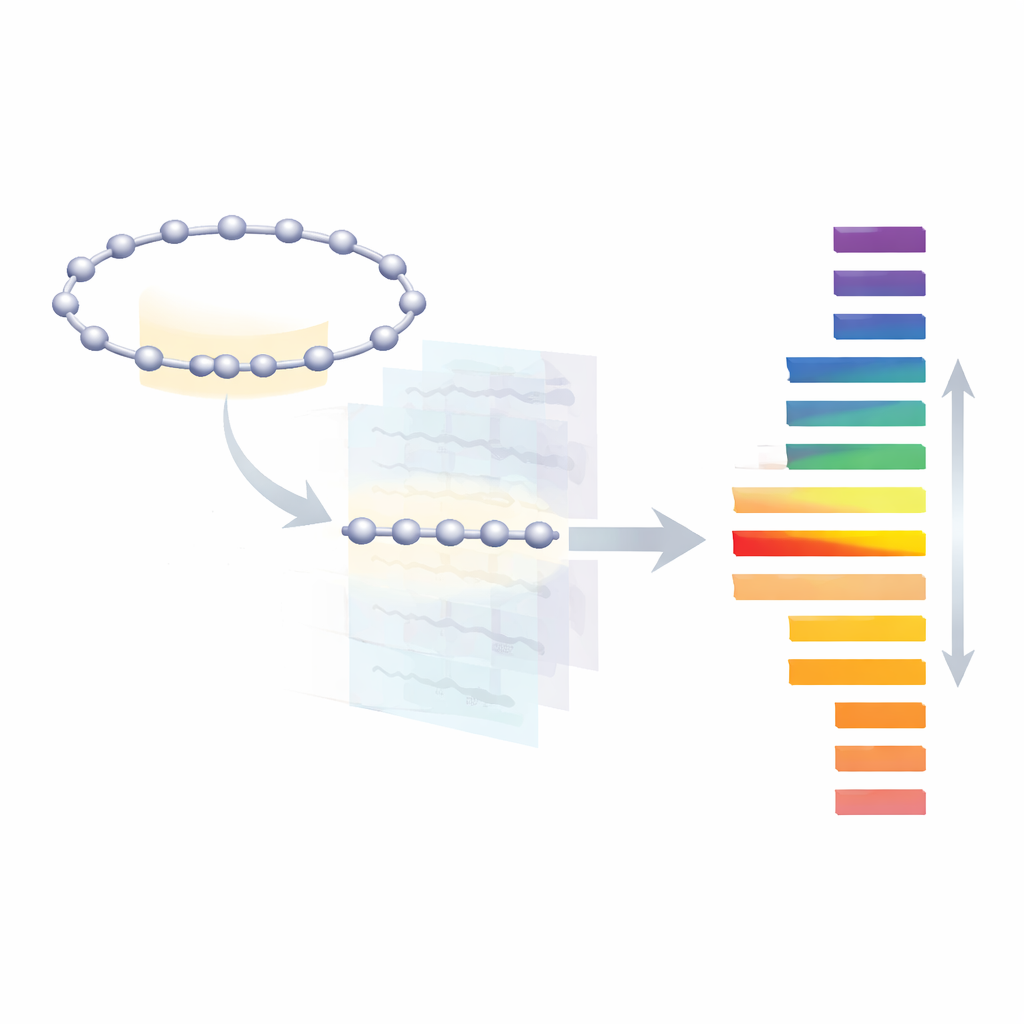
Although these prepared states are very low in energy, they do not perfectly display all the subtle long-range features of an ideal infinite system. To reveal the underlying structure, the authors turn to a technique called entanglement Hamiltonian tomography. They repeatedly measure different segments of the 100-qubit ring in many carefully chosen ways, then use classical optimization to reconstruct an effective “entanglement Hamiltonian” that captures how each segment is quantumly linked to the rest of the system. From this reconstructed object they can compute standard fingerprints of critical behavior, such as how correlations between spins decay with distance and how the entanglement entropy of a block grows with its size. The extracted numbers match theoretical expectations for the same universality class as the well-known Ising model, confirming that the experiment has indeed reached the intended quantum critical regime.
Uncovering edge-like modes without real edges
The most striking results come from examining the entanglement spectrum, which is a refined view of how the quantum information in a subsystem is organized. Theory predicts that, for this particular critical model, the entanglement spectrum should display a robust two-fold degeneracy associated with emergent edge modes, even though the physical system is a closed ring with no actual boundaries. Using their reconstructed density matrices, the researchers calculate this spectrum for segments of various lengths and observe the expected pairwise structure in the lowest levels across the board. As the segments grow, the pattern sharpens into a tower-like arrangement characteristic of conformal field theories, revealing a deep connection between bulk critical behavior and boundary-like features encoded in entanglement alone.
What this means for quantum matter and quantum machines
In plain terms, the study shows that certain kinds of topological order can survive right at the brink of a phase transition, in systems without the usual protective energy gap. By cleverly preparing accessible low-lying states on a noisy but programmable quantum processor, and then using entanglement-based reconstruction to “see through” experimental imperfections, the authors provide experimental evidence that these critical states host hidden, edge-like quantum modes. This suggests that future quantum simulators do not always need to reach pristine ground states to reveal rich physics: carefully chosen low-energy states, combined with smart analysis tools, may already encode the essential universal information about exotic quantum phases and their transitions.
Citation: Tan, Z., Wang, K., Yang, S. et al. Exploring nontrivial topology at quantum criticality on a superconducting processor. Commun Phys 9, 136 (2026). https://doi.org/10.1038/s42005-026-02569-9
Keywords: quantum phase transitions, topological order, entanglement spectrum, superconducting qubits, quantum simulation