Clear Sky Science · en
Synchronization transitions and spike dynamics in a higher-order Kuramoto model with Lévy noise
Why sudden bursts of harmony matter
From the beating of heart cells to the rise and fall of electric demand on a power grid, many systems work because countless individual parts manage to move in step. Yet in the real world these systems are constantly jostled by irregular disturbances, including rare but very large shocks. This study explores how such shocks reshape collective rhythm: when they help many units fall into line, when they tear order apart, and how they produce sudden, short-lived bursts of near-perfect coordination that resemble extreme events such as epileptic seizures or market surges. 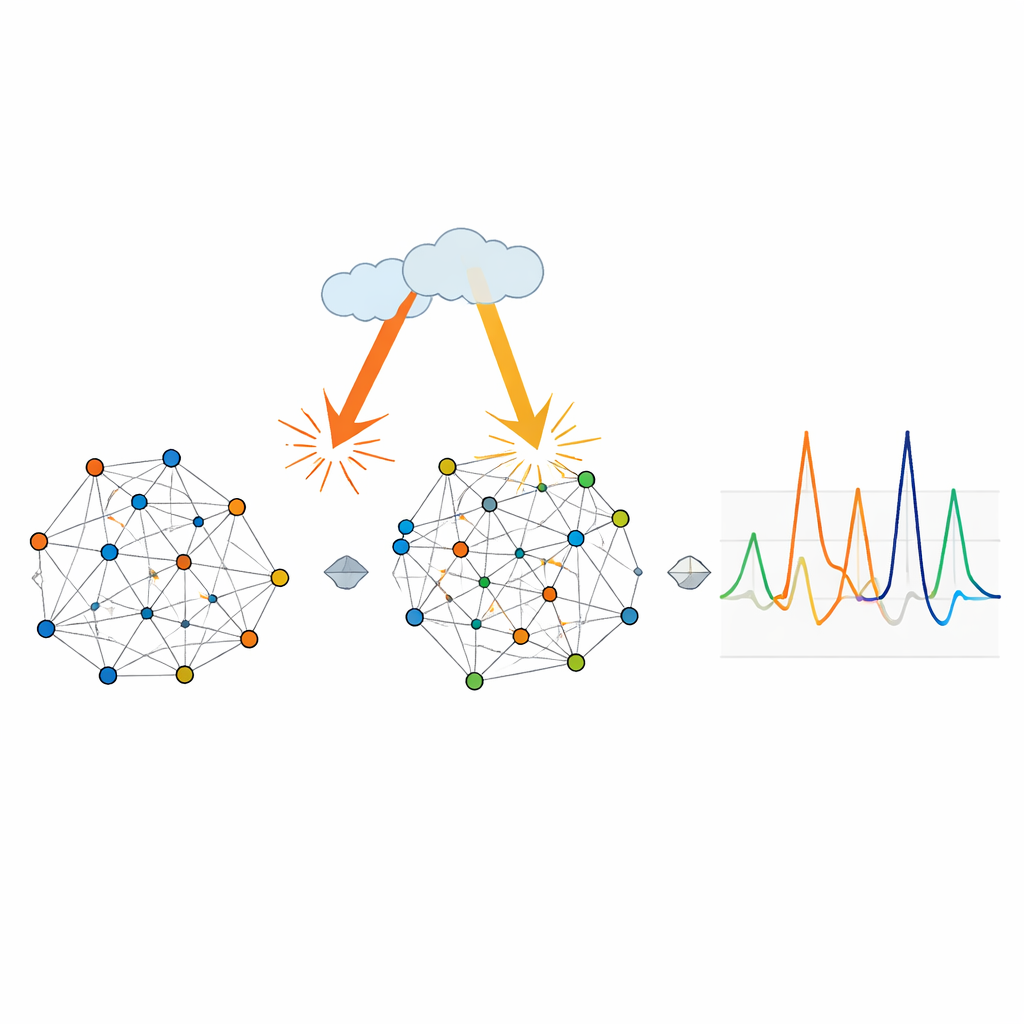
Many voices trying to keep the beat
The authors use a mathematical framework known as the Kuramoto model to represent a crowd of simple rhythmic units, or oscillators. Each oscillator has its own natural pace, but they are connected so that they tend to adjust toward one another. Unlike classic versions of the model that only link pairs, this work also includes three-way interactions, where triplets of units can influence each other together. This added layer mimics real systems in which groups, not just pairs, matter—such as clusters of neurons in the brain, or triads of devices in a power grid or communication network.
When random shocks are gentle or wild
To mimic the unpredictability of the outside world, the model is driven by noise. Standard studies often assume “Gaussian” noise, made of many small nudges. Here, the focus is on Lévy noise, a type of disturbance dominated by rare but powerful jumps. The authors tune two features of this noise: one that sets how heavy its tails are (how extreme its extremes can be) and another that controls its overall strength. By tracking an order parameter that measures how tightly the oscillators move together, they show that as the noise becomes wilder, lasting synchronization weakens and may vanish entirely beyond a critical strength. Even when the network’s connections are strong enough to support a synchronized state in the absence of noise, heavy-tailed shocks can keep it trapped in a mostly disordered regime.
Borders between order and disorder
To map out where the system tends to settle, the authors combine several measures: the average level of order, the typical time it takes to cross into a synchronized state, and the fraction of starting conditions that eventually synchronize. Together, these reveal a region of parameter space where the system can either remain incoherent or lock into a coherent state, depending on details of initial conditions and noise. As the noise tails grow heavier or its scale increases, the domain where synchronization is common shrinks and shifts: stronger coupling between oscillators is required to reach and maintain order, and sharp transitions become smoother crossovers. 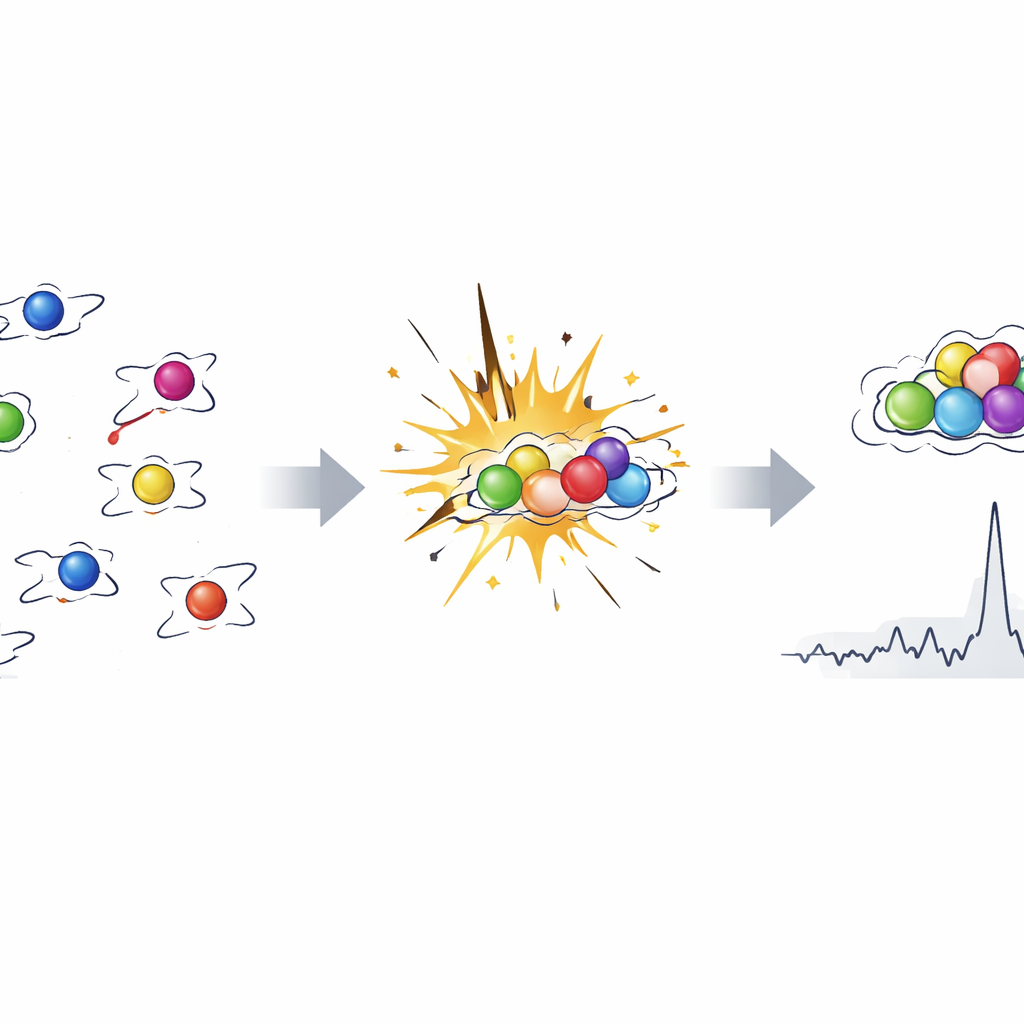
Short bursts of collective action
Beyond whether the system is mostly ordered or disordered, the authors pay special attention to spikes—brief episodes when the order parameter suddenly shoots above a threshold and then falls back. These spikes mark extreme bouts of temporary coherence. The study shows that they are most frequent and largest in size when the noise strength is modest but not overwhelming: strong enough to kick the system into alignment now and then, yet not so strong that it instantly tears the alignment apart. By counting spikes and measuring their heights across many runs, the authors find that their abundance drops sharply as noise becomes too strong or too heavy-tailed. A more detailed analysis of spike timing patterns, using a specialized “edit distance” method, reveals long-range correlations and power-law signatures, indicating that these extreme events are not just random blips but reflect an underlying, structured switching process.
Why these findings could matter in real life
In accessible terms, the work shows that rare, powerful jolts can play a dual role: they can both prevent a system from settling into a dangerously rigid synchronized state and, at the same time, trigger brief but intense bursts of collective behavior. This balance may be crucial in settings from brain dynamics, where it could help explain how the brain avoids runaway synchronization yet still produces localized events, to social and technological networks exposed to shocks like crises or outages. By clarifying how higher-order connections and nonstandard noise shape the borders between order, disorder, and extreme episodes, the study offers new insight into how to manage, predict, or harness sudden bursts of collective activity in complex systems.
Citation: Zhao, D., Kurths, J., Marwan, N. et al. Synchronization transitions and spike dynamics in a higher-order Kuramoto model with Lévy noise. Commun Phys 9, 129 (2026). https://doi.org/10.1038/s42005-026-02560-4
Keywords: synchronization, complex networks, Lévy noise, extreme events, oscillator models