Clear Sky Science · en
Geometry-adaptive formulation of non-Bloch bands in arbitrary dimensions and spectral instability
Why the Shape of a Lattice Matters
Many of today’s cutting-edge devices—from photonic chips that guide light to electrical circuits that sense tiny signals—can be described by “non-Hermitian” physics, where energy can leak, be amplified, or dissipate. In such systems, waves can mysteriously pile up at the edges, a phenomenon called the non-Hermitian skin effect. Until now, this behavior was well understood only in one dimension, such as a chain of sites. This article explains how to predict and control such edge piling in two and three dimensions, where the very shape of the device turns out to reshape its allowed energies in surprising and important ways. 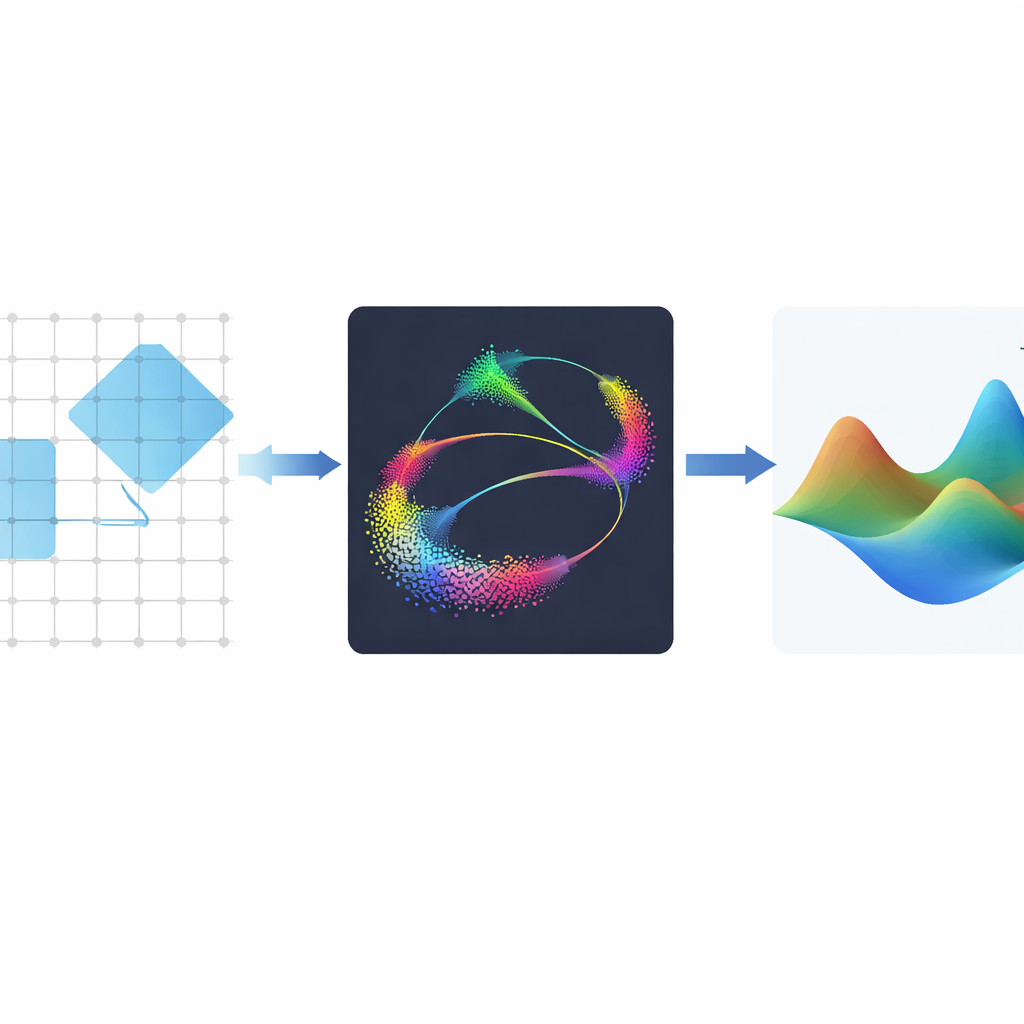
Waves That Creep to the Edges
In ordinary, lossless materials, the standard Bloch band theory tells us how waves spread through a repeating pattern, filling the material more or less evenly. But in non-Hermitian systems, where some regions may lose or gain energy, the usual theory breaks down. Instead of spreading, many wave patterns concentrate dramatically at the boundaries. This is the non-Hermitian skin effect: a macroscopic number of modes migrate to the edges, making the energy spectrum extremely sensitive to how the system is terminated. In one-dimensional chains, a refined “non-Bloch” band theory has been developed to handle this edge-focused behavior, but extending it to higher dimensions has been difficult because there are many more ways to cut and shape a lattice.
Letting Geometry Enter the Rules
The authors introduce a geometry-adaptive non-Bloch band theory that works in any number of dimensions. Their key idea is to encode information about the sample’s shape—essentially, the directions along which it is cut—directly into the mathematical description of momentum. They then reinterpret the full set of energies under open boundaries as charges generating an “electrostatic” potential spread over the complex energy plane. By systematically building this potential from simpler one-dimensional slices, they derive a function whose curvature reveals where the energy levels cluster. Crucially, this potential depends on the chosen geometry, so different shapes, such as squares and diamonds, yield different continuous energy spectra even when the underlying lattice and couplings are the same.
When Corners and Edges Take Over
To illustrate this geometric dependence, the authors study a simple two-dimensional lattice model cut into a square and into a rhombus (diamond). In both cases, many modes become localized at specific corners, but their exact positions and the detailed distribution of energies shift with the shape. The calculated spectral density from the new theory matches large-scale numerical simulations, confirming that the method correctly predicts how geometry sculpts the non-Bloch spectrum. Alongside the spectra, the theory also determines a generalized Brillouin zone, a higher-dimensional analogue of the usual momentum space, which captures how strongly and in which directions the modes hug the boundaries.
Critical Modes and Fragile Spectra
Beyond sharply corner-localized states, the authors uncover a more subtle class of “critical” skin modes that live along extended edges. These modes do not have a fixed decay length into the bulk; instead, their width grows in proportion to the system size. As a result, the energy levels fail to settle into a well-defined continuum as the lattice becomes larger, and they depend sensitively on the aspect ratio between different sides. In such cases, the geometry-adaptive theory loses its predictive power because the underlying assumption of convergence no longer holds. The spectra also become strikingly unstable: even weak disorder in the bulk can dramatically reshape the energy distribution, nudging it toward a more universal, geometry-independent set of energies related to earlier “Amoeba” formulations. 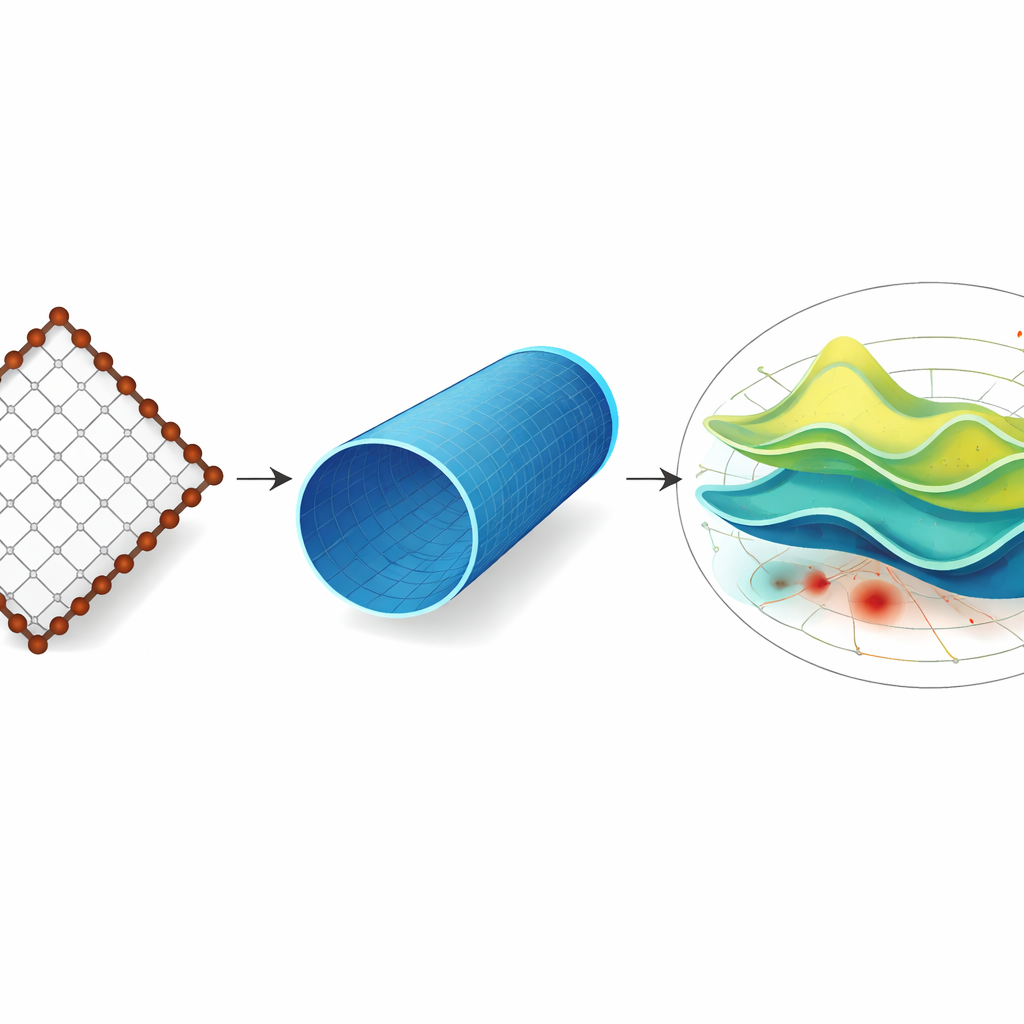
What This Means for Future Devices
Overall, the article establishes a unified framework for predicting how lattice shape, boundary cuts, and dimensionality jointly determine where energy levels lie and where modes accumulate in non-Hermitian systems. For regular shapes, the theory provides accurate spectra and localization information, revealing that higher-dimensional devices cannot be understood independently of their geometry. At the same time, the discovery of critical skin modes highlights regimes where spectra are inherently delicate and easily destabilized by imperfections. For experimental platforms in photonics, acoustics, mechanics, and electronics, these results offer both a design tool and a warning: tailoring geometry can be a powerful way to engineer robust edge phenomena, but in certain regimes the very same geometry can make the spectrum extraordinarily fragile.
Citation: Xing, ZY., Xiong, Y. & Hu, H. Geometry-adaptive formulation of non-Bloch bands in arbitrary dimensions and spectral instability. Commun Phys 9, 127 (2026). https://doi.org/10.1038/s42005-026-02546-2
Keywords: non-Hermitian skin effect, non-Bloch bands, lattice geometry, spectral instability, generalized Brillouin zone