Clear Sky Science · en
Connecting phases of matter to the flatness of the loss landscape in analog variational quantum algorithms
Why this matters for future quantum computers
As quantum computers move from laboratory curiosities toward practical tools, a major challenge has emerged: many promising algorithms become impossible to train as devices grow. This paper explores a surprising way to tackle that problem by borrowing ideas from condensed-matter physics. The authors show how different “phases” of quantum matter—ways in which a many-particle system organizes itself—can make variational quantum algorithms either trainable or effectively stuck, and they propose a strategy to keep them trainable on analog quantum hardware.
Quantum learning that works with the hardware
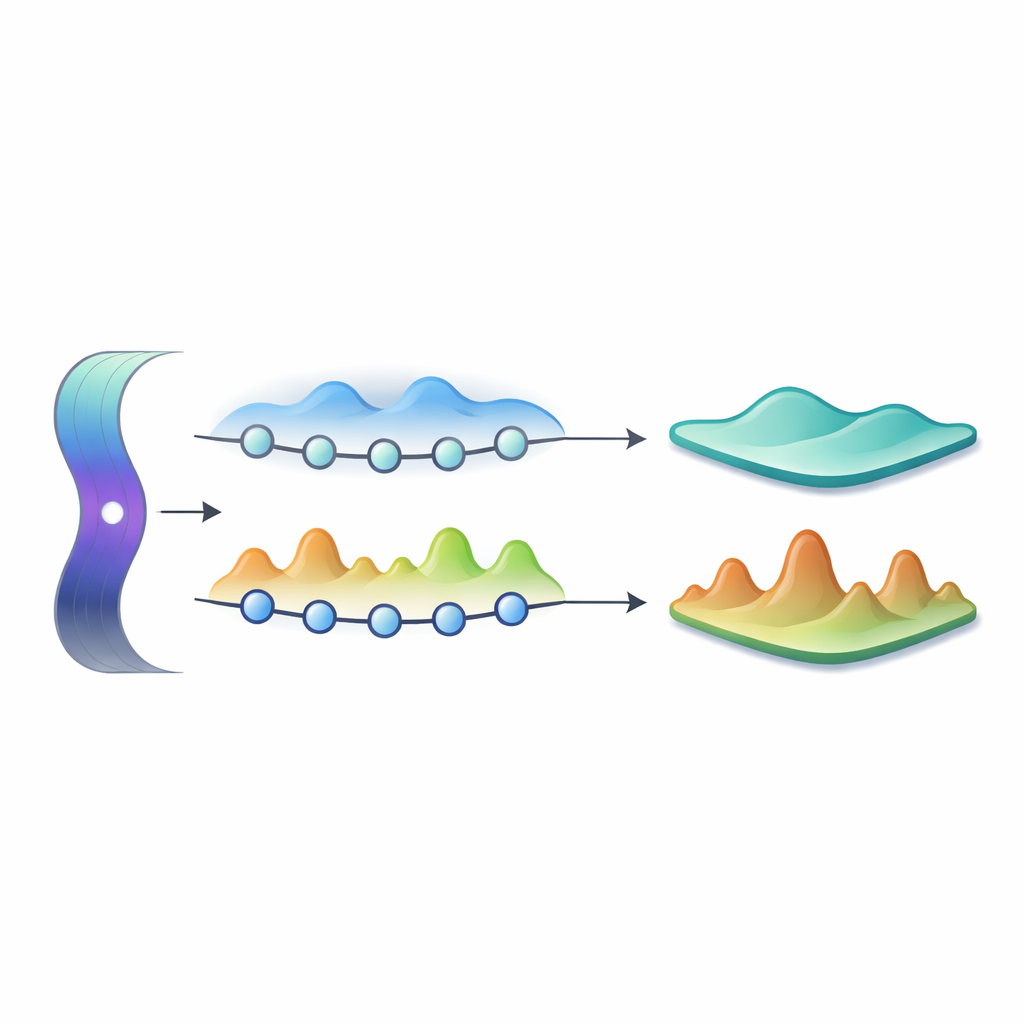
Variational quantum algorithms use a quantum device to prepare a tunable quantum state and a classical computer to adjust the knobs until a target quantity, like energy or cost, is minimized. Most existing designs are “digital”: they build states from long sequences of logic gates. While flexible, these circuits can be too expressive, exploring vast regions of quantum state space that are unnecessary for the task. In large systems this can cause the so-called barren plateau problem, where the loss landscape becomes almost perfectly flat and gradients vanish exponentially with system size. Instead of assembling long gate sequences, the authors study an “analog” approach: let a chain of quantum spins evolve under its natural interactions in a series of sudden changes, or quenches, that are directly implementable on platforms such as trapped ions, Rydberg atoms, and superconducting circuits. By controlling the disorder in the spin chain, they can place each quench into one of two distinct phases of matter, thermalized or many-body localized, and investigate how that choice shapes the algorithm’s behavior.
Two phases, two very different learning landscapes
In the thermalized phase, the system behaves chaotically: interactions and weak disorder quickly spread information and entanglement across all spins, driving the chain toward states that resemble those produced by a fully random quantum process. In the many-body localized (MBL) phase, strong disorder prevents this kind of mixing. Local patterns in the initial state remain visible for very long times, and entanglement grows only slowly. The authors use quantitative measures of how widely the algorithm’s ansatz explores the space of possible quantum evolutions—its expressivity—and relate this to how flat the loss landscape becomes. They find that both phases become maximally expressive if enough quenches are applied, but the thermalized phase reaches that regime much sooner. As it does, the loss function’s variance, and hence the gradients needed for learning, shrinks exponentially with the number of qubits, signaling barren plateaus. In the MBL phase, the same fate eventually occurs, but only after many more quenches.
Linking entanglement growth to trainability
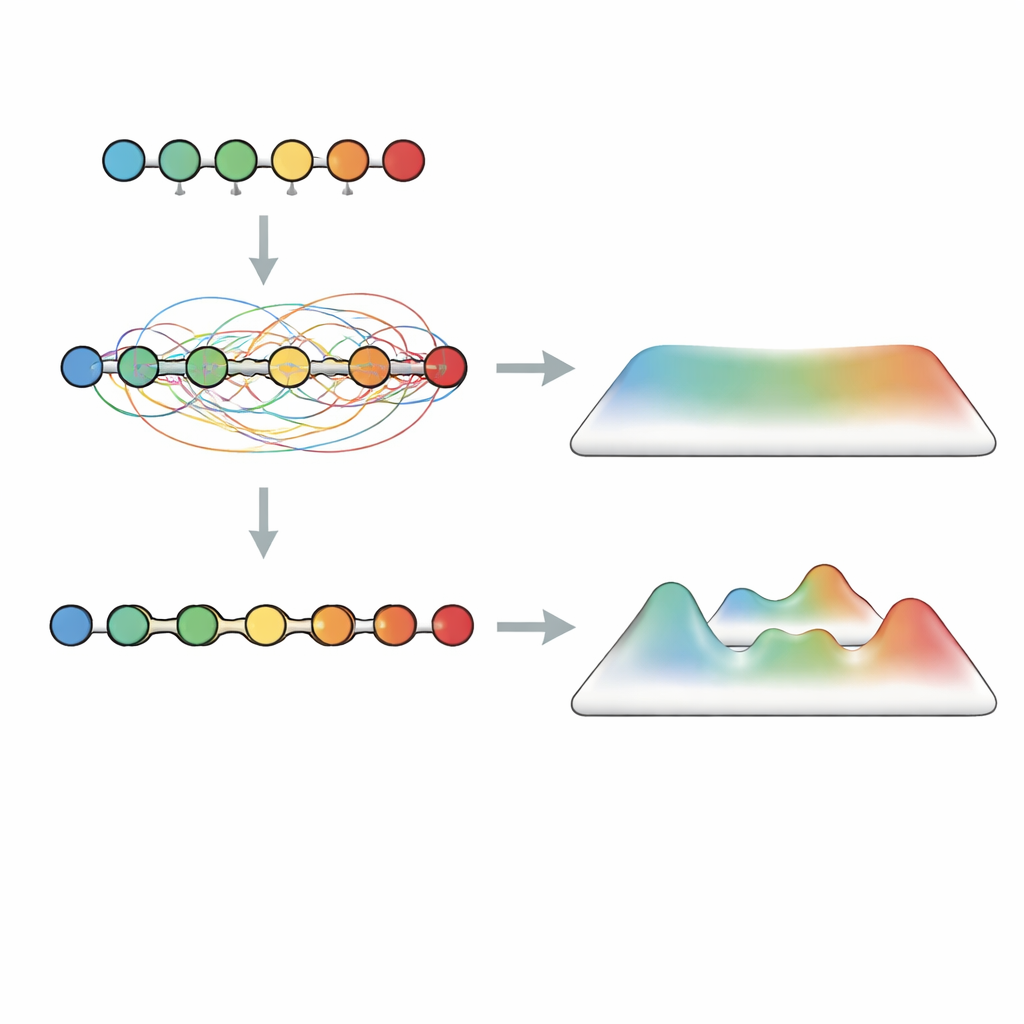
Why does the MBL phase delay the onset of flat landscapes? The authors trace this to how entanglement builds up. In the thermalized regime, each quench produces a large jump in entanglement between parts of the spin chain, and the system quickly mimics fully random states. This rapid scrambling erases the structure of the loss landscape, making gradients extremely small. In contrast, the MBL regime generates entanglement much more slowly and in a more localized fashion. Numerically, the number of quenches required for the loss variance to saturate closely tracks the number needed for the entanglement to saturate, and the gap between the two phases grows roughly linearly with system size. This means there is a broad window where the MBL-based ansatz is already quite expressive but has not yet fallen into a barren plateau, while the thermalized ansatz is already untrainable.
An initialization strategy that avoids early failure
Building on this insight, the authors propose a practical rule for setting up analog variational algorithms. Choose an intermediate number of quenches and initialize the system in the MBL phase: the same depth that would already be too deep and flat in the thermalized phase remains trainable in the MBL phase. During optimization, the control parameters are then free to move away from strict localization if needed, gaining access to higher expressivity without having started in a flat region. Tests on small but nontrivial examples support this picture. For certain problems whose structure closely matches the hardware, a shallow thermalized setup can perform well. But for more generic targets, such as finding the ground state of a Heisenberg chain or solving random Max-Cut instances, MBL-based initialization at intermediate depth delivers significantly better energy accuracy and higher-quality solutions, with more reliable convergence and fewer instances stuck in poor minima.
What this means for scaling up quantum algorithms
The study suggests that the physics of quantum phases is not just an obstacle or curiosity, but a tool for designing better quantum learning architectures. By tuning an analog device into a many-body localized regime for initialization, one can delay the onset of barren plateaus while keeping enough flexibility to approximate complex states later in training. The authors emphasize that this is not a magic cure: barren plateaus and other issues, such as bad local minima, can still arise, and the method is largely problem-agnostic. Nonetheless, it offers concrete, hardware-aware guidelines for building more scalable analog variational quantum algorithms and points toward a broader program where concepts like localization, time crystals, or topological order help shape the learning landscapes of future quantum computers.
Citation: Srimahajariyapong, K., Thanasilp, S. & Chotibut, T. Connecting phases of matter to the flatness of the loss landscape in analog variational quantum algorithms. Commun Phys 9, 111 (2026). https://doi.org/10.1038/s42005-026-02528-4
Keywords: variational quantum algorithms, analog quantum simulation, many-body localization, barren plateaus, quantum machine learning