Clear Sky Science · en
Cannabidiphorol (CBDP) acts as a negative allosteric modulator at two distinct sites of cannabinoid receptor 1
Why a gentler cannabis effect matters
Many people turn to cannabis for pain relief, but the same compound that eases pain, THC, can cloud memory and cause intoxication. This study explores a lesser known cannabis molecule called cannabidiphorol, or CBDP, that may help dial down some of THC’s unwanted mental effects while keeping its ability to reduce pain. Understanding how CBDP works at the brain’s cannabis receptors could guide the design of future treatments that offer relief with fewer side effects.

A new cousin in the cannabis family
Cannabis plants produce more than a hundred related molecules, including THC and CBD. CBDP is a close chemical cousin of CBD, differing mainly in the length of one of its side chains. It occurs naturally in some cannabis varieties, but only in tiny amounts, and its actions in the body have been poorly understood. Earlier work hinted that CBDP might share some of CBD’s benefits, such as acting against inflammation and seizures, and that it could weakly block one of the main cannabis receptors in the brain, called CB1. This raised the possibility that CBDP might regulate CB1 in a subtle way rather than simply switching it on or off.
How CBDP taps the brain’s cannabis switch
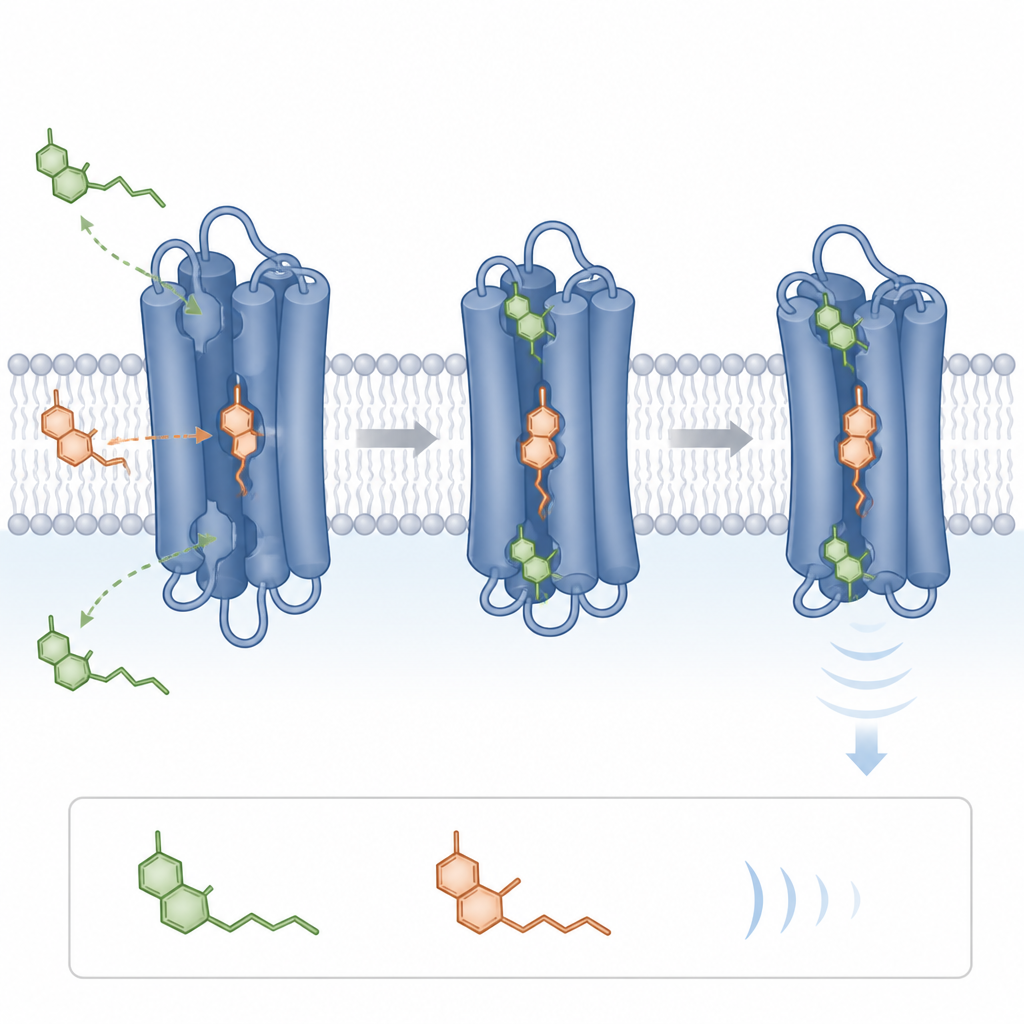
The CB1 receptor sits on nerve cells and responds to the body’s own cannabis like messengers as well as to THC. Instead of competing directly with these messengers at the main docking site, CBDP latches onto separate spots on CB1 known as allosteric sites. Using engineered cells that produce human CB1, the researchers showed that CBDP makes a synthetic CB1 activator less potent and slightly lowers its maximum effect, a hallmark of a "negative allosteric modulator." In simple terms, CBDP nudges CB1 into a less responsive state, trimming back strong signals while leaving basic background activity largely intact.
Two hands on the same receptor
By subtly altering individual building blocks of the CB1 protein, the team mapped where CBDP grips the receptor. Their experiments pointed to two distinct allosteric regions: one on the outer surface of the receptor, overlapping a site used by a known modulator called ORG27569, and another on the inner side of the receptor near where it faces the cell interior. Computer simulations of the receptor in a membrane supported this picture. CBDP settled into both pockets and stayed there stably for hundreds of nanoseconds of simulated time, forming mostly oily, shape-fitting contacts with surrounding protein segments. This dual anchoring suggests CBDP can influence how CB1 moves and signals from both outside and inside the cell.
What CBDP does in live animals
To see whether these allosteric effects matter in a living brain, the researchers gave CBDP, THC, or both to mice and ran standard behavior tests often used to profile cannabis like drugs. On its own, CBDP caused mild slowing of movement but did not alter pain responses or body temperature much. When combined with THC, CBDP did not blunt THC’s pain relief or its drop in body temperature, and it did not clearly change THC’s tendency to reduce activity in an open field test. However, in a memory task where mice must recognize a new object, animals that received both CBDP and THC performed better than those given THC alone, suggesting that CBDP may ease some THC-related disruption of recognition memory.
What this could mean for future medicines
Taken together, the cell, computer, and animal results indicate that CBDP can act as a dual site modulator of the CB1 receptor, gently turning down strong CB1 signals rather than blocking them outright. In mice, this fine tuning left THC’s pain relieving effect largely intact while showing a modest benefit on a memory measure. Although more work is needed to test different doses, timing, and other CB1 activators, CBDP emerges as a useful template for designing next generation cannabis inspired drugs that seek relief from pain and other conditions with a lower risk of unwanted mental effects.
Citation: Pandey, P., Zagzoog, A.H., Zaharia, T. et al. Cannabidiphorol (CBDP) acts as a negative allosteric modulator at two distinct sites of cannabinoid receptor 1. Commun Chem 9, 186 (2026). https://doi.org/10.1038/s42004-026-01990-z
Keywords: CBDP, CB1 receptor, allosteric modulation, THC and memory, cannabinoid pharmacology