Clear Sky Science · en
Dynamic yet well-defined organization of the FUS RGG3 dense phase
How shapeless proteins can still build organized droplets
Inside our cells, some proteins behave less like rigid Lego bricks and more like cooked spaghetti. Yet these floppy chains can gather into tiny droplets that help organize the cell’s chemistry and, in some cases, go awry in disease. This study asks how one such shapeless region of the FUS protein can remain highly mobile while still forming a well-organized dense phase that resembles cellular droplets called biomolecular condensates.
A flexible protein tail with an important job
The researchers focused on a tail segment of the FUS protein, known as RGG3, which is rich in the amino acids arginine and glycine. FUS helps control how genes are read and repaired, and faulty forms of it are linked to neurodegenerative disorders. The RGG3 segment does not fold into a fixed shape, but earlier work suggested it plays a key role in helping FUS molecules gather into droplets inside cells. This study set out to understand, at atomic detail, how many copies of RGG3 behave when they crowd together, and how this crowded “dense phase” differs from a single, isolated RGG3 chain in dilute solution. 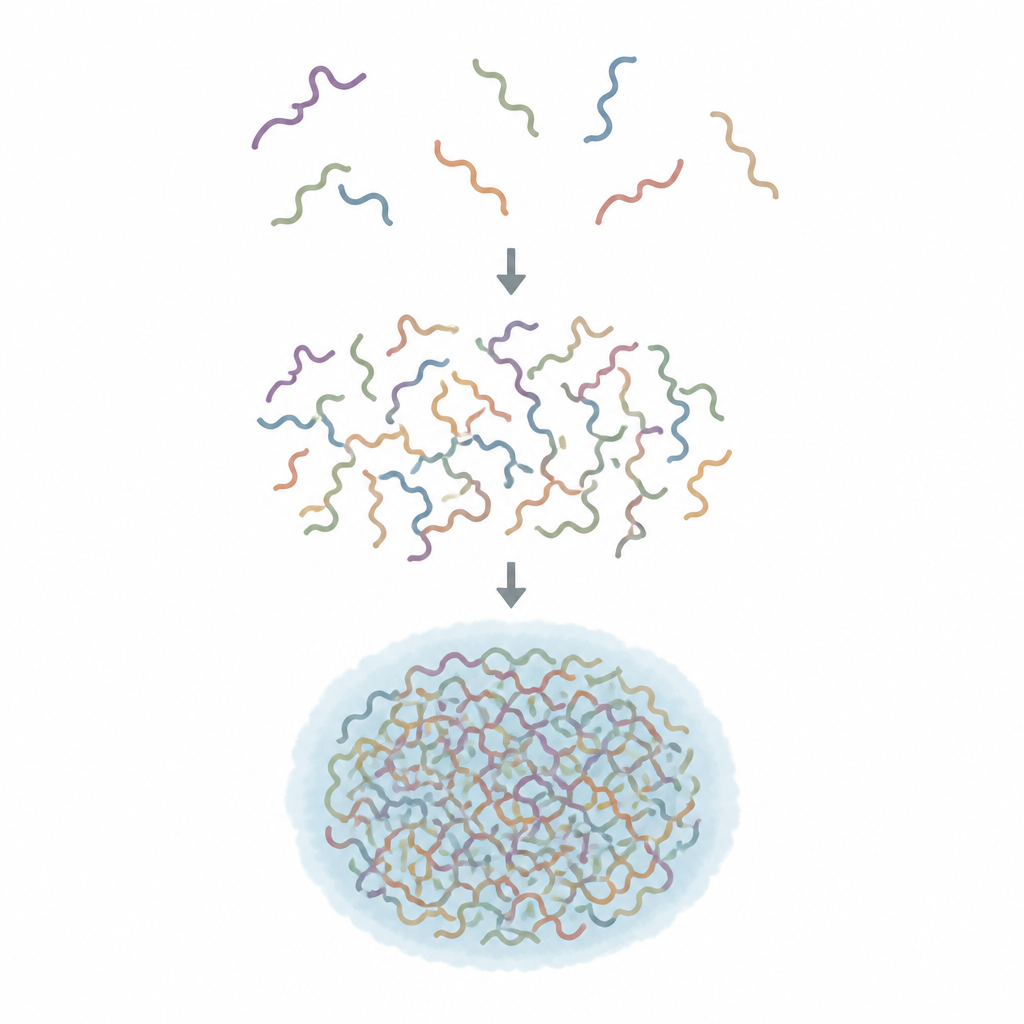
Simulating a crowded droplet at atomic detail
To tackle this question, the authors used long, all-atom molecular dynamics simulations, a technique that calculates how every atom moves over time. They simulated three independent systems, each containing 24 copies of RGG3 in water at a concentration chosen to mimic the interior of a protein-rich droplet, and compared them to simulations of single, isolated RGG3 chains. Over microseconds of simulated time, the 24 chains spontaneously formed a loose network of clusters that merged, broke apart, and reorganized. Despite this busy scene, each chain stayed highly flexible, and its motion slowed only modestly compared with the single-chain case, showing that the dense phase is more like a fluid than a gel.
Sticky spots, spacers, and fast partner swapping
By tracking every contact between chains, the team could map which parts of the sequence most often touched other molecules. Rather than seeing random, featureless stickiness, they discovered recurring “hotspots” along the chain, built around a short motif they describe as a repeating pattern containing arginine, glycine, and aromatic residues such as phenylalanine or tyrosine. These hotspots behave as sticky patches, while the regions in between act as spacers. Yet even these sticky patches remain structurally disordered, and the contacts they form typically last only trillionths of a second. Individual chains constantly swap partners, and most copies end up contacting the majority of their neighbors at least once over the course of the simulations.
Water release and a loose, fractal-like network
Moving from a dilute environment into the dense phase forces each RGG3 chain to give up a small amount of internal freedom, a cost measured as a modest loss in configurational entropy. At the same time, clustering reduces the total protein surface exposed to water and frees up dozens of bound water molecules per chain. This water becomes more disordered, gaining entropy that can help pay the energetic cost of forming the droplet. Using a mathematical framework based on fractals, the authors show that the overall network of proteins in the dense phase has a stable, low-density architecture that looks similar across different length scales, from small clusters to large assemblies. This large-scale structure can be predicted from just two properties of the chains: how compact each one is and how many partners it typically contacts. 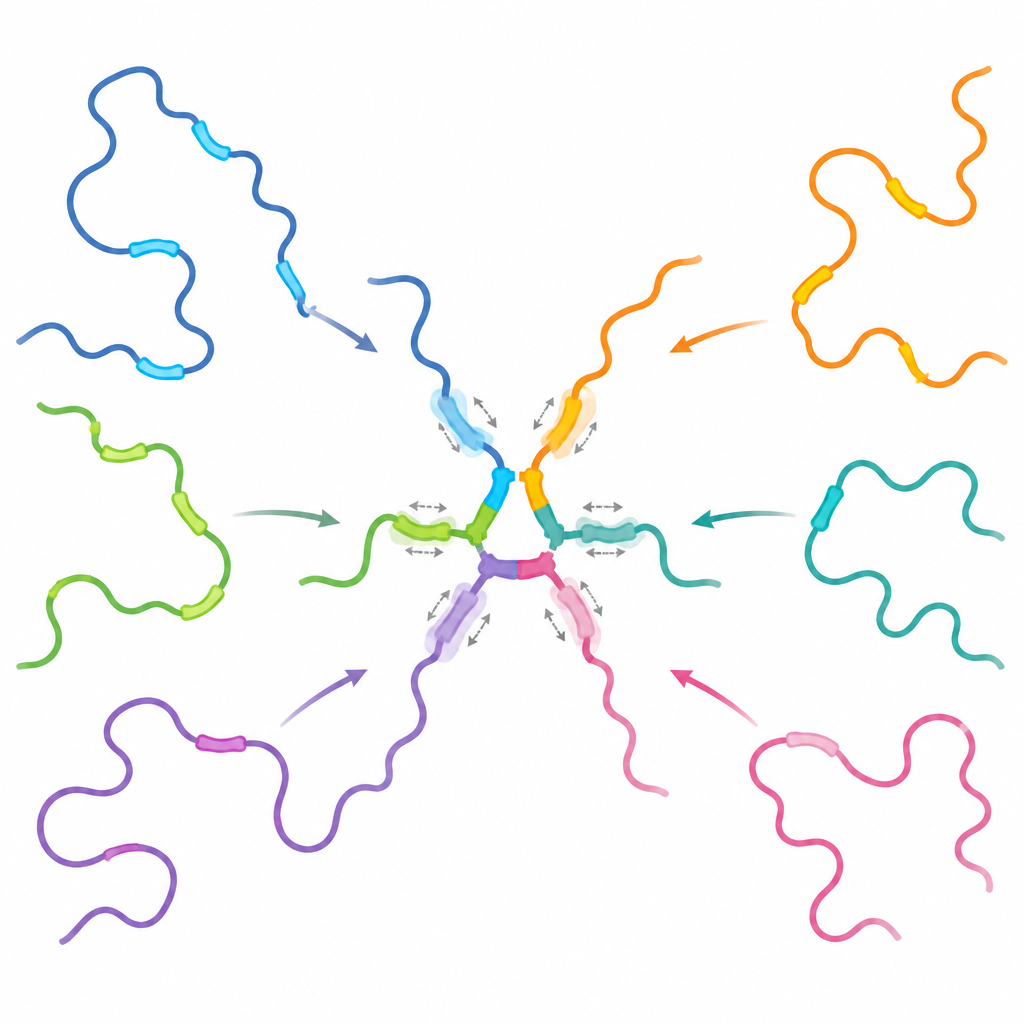
Why this matters for cell biology and disease
Together, these results show how a seemingly shapeless protein segment can form a dynamic yet statistically well-defined dense phase. RGG3 remains highly mobile, its sticky patches form and break contacts rapidly, and the resulting network has a reproducible, scale-spanning organization. Because similar disordered segments and motifs appear throughout the cell, this work helps explain how flexible protein regions can encode instructions for droplet formation directly in their amino acid sequence. It also offers clues to how subtle sequence changes, including disease-linked mutations, might shift a protein’s behavior from forming healthy, fluid condensates toward harmful, more solid-like aggregates.
Citation: Polyansky, A.A., Frühbauer, B. & Žagrović, B. Dynamic yet well-defined organization of the FUS RGG3 dense phase. Commun Chem 9, 177 (2026). https://doi.org/10.1038/s42004-026-01974-z
Keywords: biomolecular condensates, intrinsically disordered proteins, FUS RGG3, molecular dynamics, protein phase separation