Clear Sky Science · en
Robust triboelectric energy harvesters engineered from electrochemically deposited films of HKUST-1 polycrystals
Power from Everyday Motion
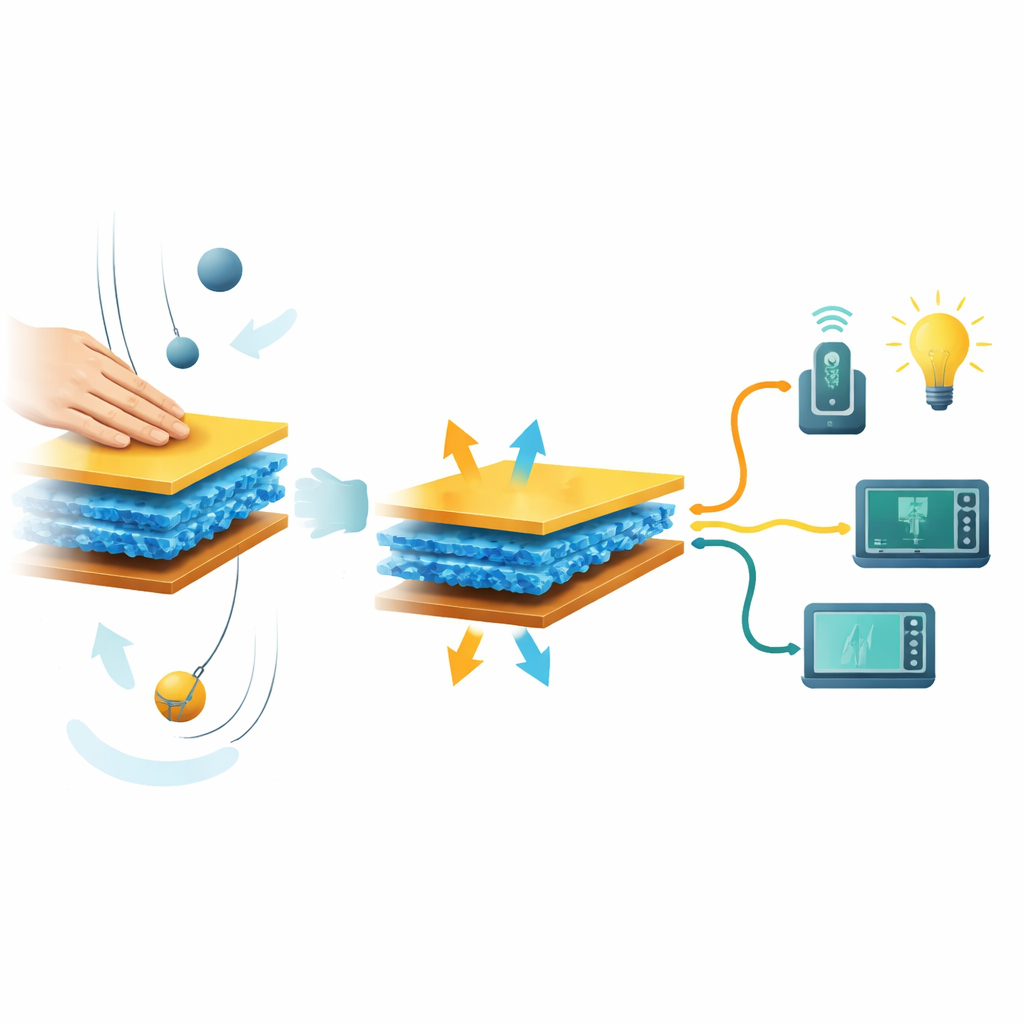
Imagine if the small jolts and vibrations around you—footsteps, typing, the sway of a bus—could quietly power the electronics you carry. This paper explores a new way to turn everyday motion into electricity using a special crystalline coating grown directly on a metal surface. The result is a compact device that can light up dozens of tiny bulbs and keep working reliably, even in damp air, pointing toward self-powered sensors and portable gadgets that might one day need far fewer batteries.
Turning Touch into Electricity
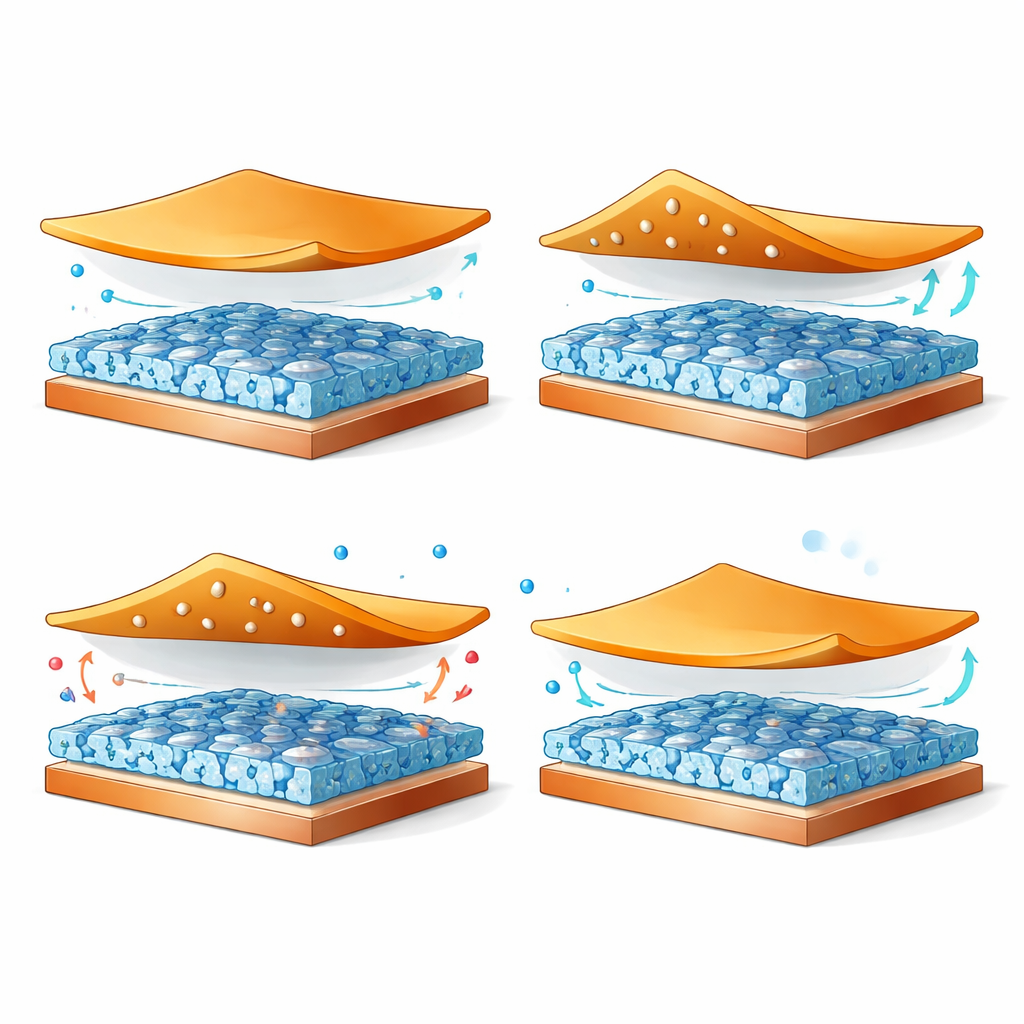
The work centers on triboelectric nanogenerators, devices that make electricity when two surfaces repeatedly touch and separate. When different materials press together, they swap a tiny amount of charge; pulling them apart forces those charges to flow through a circuit. The authors focus on a material called HKUST-1, a porous crystal made from copper and an organic linker. Instead of sprinkling powder onto tape or mixing it into plastic, they grow a thin, firmly attached film of this crystal directly on a copper plate, then pair it with a strip of Kapton plastic. As the two layers are pushed together and pulled apart, the crystal-coated copper becomes the “positive” side and Kapton the “negative,” producing alternating bursts of voltage.
Growing a Tough, Textured Crystal Skin
To make the active layer, the team uses an electrochemical bath: the copper plate slowly dissolves at its surface and reassembles into the HKUST-1 framework under a small applied voltage. By controlling growth time, they tune the film’s thickness, crystal shape, and roughness. Detailed X-ray and electron microscope studies show that after about two hours, the film forms tightly packed, upward-facing crystal facets with a distinctive triangular or hexagonal outline. These facets are mechanically stiff and give the surface a fine, uneven texture. That combination increases the real contact area with the Kapton layer and improves how well the surfaces press together and release, which is crucial for strong charge generation.
Electric Output and Long-Term Strength
When tested in a simple contact–separation setup, the two-hour film outperforms both thinner and thicker versions. It delivers a peak open-circuit voltage of around 99 volts and a maximum power density of about 0.77 watts per square meter—roughly five times higher than a bare copper plate under the same conditions. The generator keeps working through about 97,000 impact cycles (more than 13 hours of continuous operation) with only a minor drop in output. Microscopy after the test shows that while some tiny cracks and slight material transfer occur, the crystal layer remains strongly attached, confirming that growing the film directly on copper creates a robust, mechanically resilient surface.
Handling Humid Air and Real Conditions
Because HKUST-1 is hydrophilic—it likes to take up water—the researchers also probe how humidity affects performance. They cycle the device while reducing relative humidity from about 70 percent down to 10 percent. For the optimised two-hour film, the voltage and current stay high and only change modestly, even in moist air. At higher humidity, water molecules partially fill the crystal’s pores and can help redistribute surface charge, while at lower humidity they leave, exposing more active surface for charge build-up. Computer simulations support this picture, showing how the material’s effective electrical properties and the air gap between layers combine to shape the generated voltage. Overall, the device proves stable and predictable across everyday humidity levels.
Steps Toward Self-Powered Small Devices
In simple demonstrations, the generator charges commercial capacitors within seconds and powers an array of light-emitting diodes, showing that the harvested energy can be stored and used on demand. The authors conclude that their electrochemically grown HKUST-1 film provides a practical, scalable route to strong, durable triboelectric layers. By optimising crystal orientation, nanoscale uniformity, and surface roughness, they achieve high output that remains reliable in ambient and moderately humid environments. For a layperson, the key message is that carefully engineered crystal coatings can turn gentle mechanical motion into usable electricity, moving us closer to small, self-powered electronics that sip energy directly from their surroundings.
Citation: Jin, C., Tan, JC. Robust triboelectric energy harvesters engineered from electrochemically deposited films of HKUST-1 polycrystals. Commun Chem 9, 144 (2026). https://doi.org/10.1038/s42004-026-01949-0
Keywords: triboelectric nanogenerator, metal-organic framework, HKUST-1, energy harvesting, self-powered sensors