Clear Sky Science · en
Beyond traditional strain-promoted azide–alkyne cycloadditions by achieving orthogonality and rapid kinetics with fluoroalkyl azides
Clicking Molecules Together in Living Systems
Chemists dream of reactions that can run inside a living cell without disturbing anything else that is going on. This paper describes a way to make one of these “click” reactions faster and more selective, so scientists can label different molecules at the same time in the same cell. That ability could help researchers watch how proteins move, how drugs bind, or how different parts of a cell behave, all in real time.
Why Special Reactions Are Needed in Biology
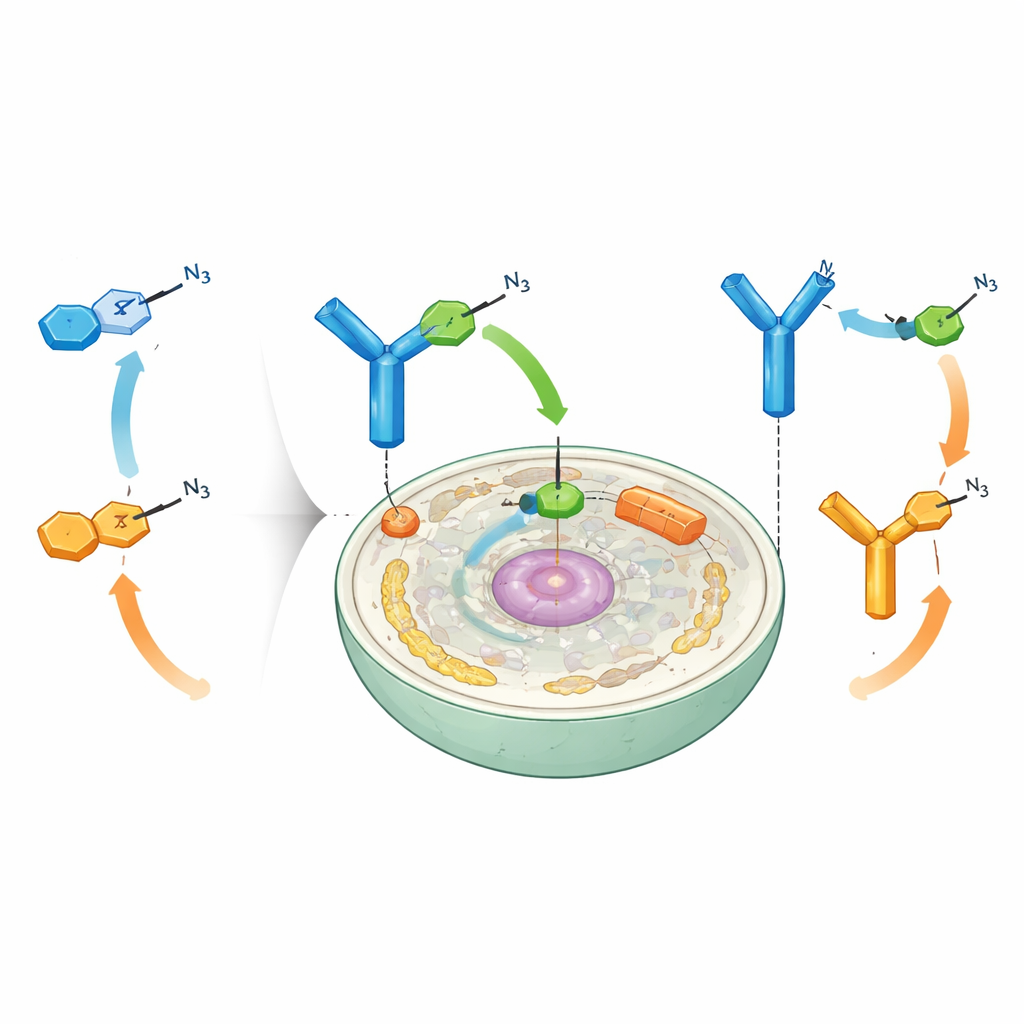
Inside a cell, thousands of different chemical groups are packed into a tiny space. To track just one protein or sugar, chemists use bioorthogonal reactions: pairs of small chemical tags that recognize only each other and ignore everything else. One of the most widely used is the strain‑promoted azide–alkyne cycloaddition, where an azide group clicks together with a highly strained ring‑shaped alkyne to form a stable link. This reaction is gentle and metal‑free, but it is relatively slow and not very selective when more than one tagged molecule is present. That makes it hard to label two different targets independently using the same basic chemistry.
Designing Faster and More Selective Partners
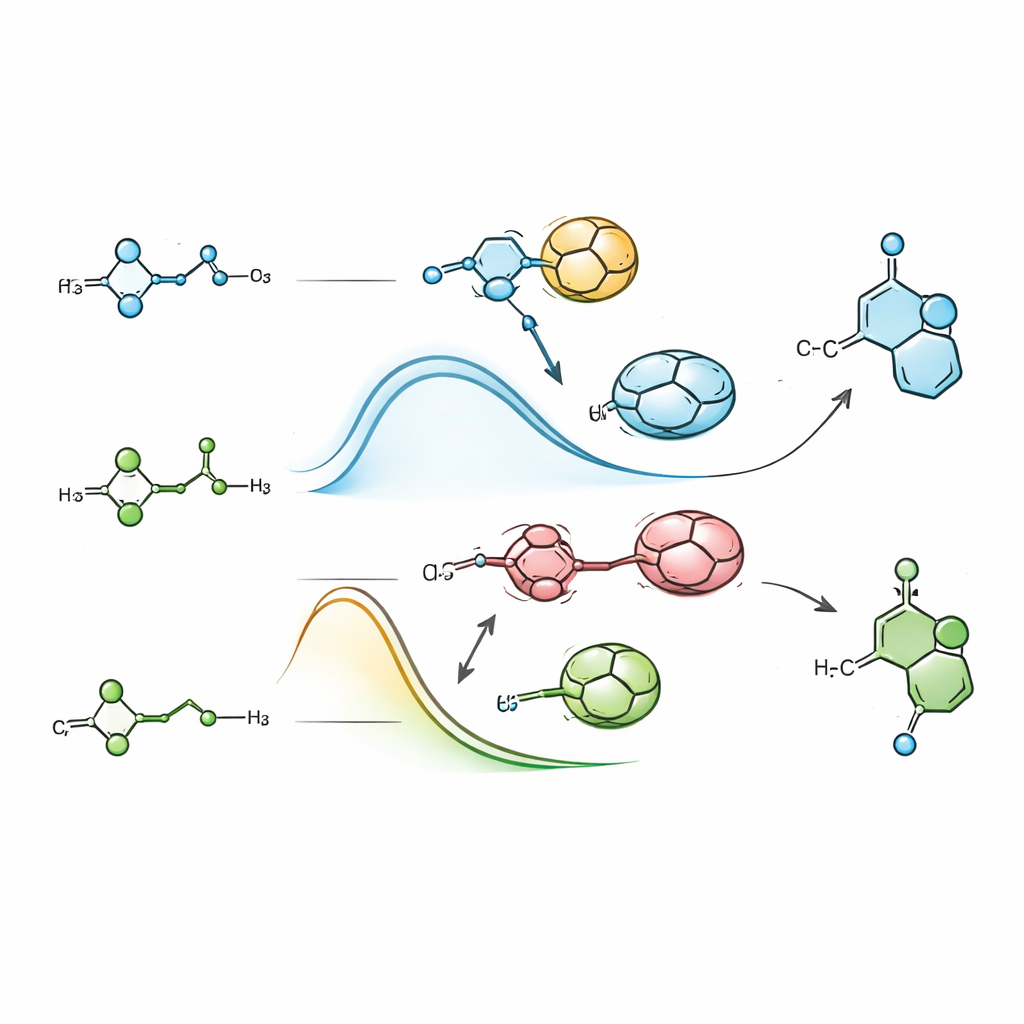
The authors set out to tune this click reaction by modifying the azide partner. They focused on azides that carry fluorine‑rich chains, called fluoroalkyl azides, and compared them with ordinary alkyl azides. Using a set of strained rings known as cyclooctynes, especially two common ones called BCN and DIBAC, they measured how quickly each azide reacted. Infrared spectroscopy allowed them to watch the disappearance of the azide signal over time. They found a striking pattern: the fluoroalkyl azide reacted much faster with the more electron‑rich BCN ring, while the non‑fluorinated azide reacted faster with the more electron‑poor DIBAC ring. For one fluoroalkyl azide, the reaction with BCN was 126 times faster than with DIBAC, revealing a powerful built‑in preference.
Peeking Under the Hood with Theory
To understand why these preferences arise, the team used high‑level quantum‑chemical calculations to estimate the energy barriers for each reaction. The computed transition states supported the experimental trend: pairing the fluoroalkyl azide with BCN required less energy than pairing it with DIBAC, while the reverse was true for the simple alkyl azide. At the same time, the calculations showed that the differences in energy are small, close to the limits of what such methods can predict precisely. That result suggests that no single simple descriptor, like comparing the highest and lowest molecular orbitals, can fully explain the selectivity; instead, subtle combinations of electronic effects, molecular strain, and solvent all matter.
Proving Selectivity in Proteins and Cells
Speed and selectivity only matter if the reaction behaves well in real biological settings. The researchers first confirmed that a model fluoroalkyl azide was stable in water, buffers, cell‑culture medium, and in the presence of amino acids and the antioxidant glutathione, reacting only when a strained ring was present. They then built fluorescent probes containing either a fluoroalkyl azide or a normal alkyl azide and attached BCN or DIBAC handles to two model proteins: the cancer‑targeting antibody trastuzumab and the sugar‑binding protein concanavalin A. Gel experiments showed that BCN‑tagged proteins preferred to react with the fluoroalkyl azide dye, while DIBAC‑tagged proteins preferred the standard azide dye. In living cells, they installed BCN tags in mitochondria and DIBAC tags on the cell surface, then added both dyes. Confocal microscopy revealed that the fluoroalkyl azide highlighted mitochondria, whereas the ordinary azide lit up the cell membrane, confirming that the reactions remain orthogonal inside cells.
What This Means for Future Imaging
This study shows that carefully chosen fluoroalkyl azides can make a classic bioorthogonal reaction both faster and more selective. By pairing a fluoroalkyl azide with BCN and a regular azide with DIBAC, scientists can label two different targets independently using the same click chemistry, even in complex environments such as live cells. For nonspecialists, the key outcome is a new dual‑color, dual‑target labeling strategy that promises clearer images and more precise control in biological experiments, paving the way for advanced diagnostics and smarter drug‑delivery tools.
Citation: Tomčo, M., Šlachtová, V., Vrábel, M. et al. Beyond traditional strain-promoted azide–alkyne cycloadditions by achieving orthogonality and rapid kinetics with fluoroalkyl azides. Commun Chem 9, 171 (2026). https://doi.org/10.1038/s42004-026-01927-6
Keywords: bioorthogonal chemistry, click reactions, live-cell imaging, protein labelling, fluorinated azides