Clear Sky Science · en
Nucleotide-dependent switching and RIPb effector recognition of the barley susceptibility factor RACB
How a fungus turns plant defenses to its advantage
Powdery mildew is a common fungal disease that coats barley leaves in white fuzz and cuts crop yields. This study looks deep inside barley cells to see how a tiny molecular switch, called RACB, can be hijacked so that the fungus finds it easier to punch through the plant’s outer wall. By revealing the exact shapes and motions of this switch and its helper protein RIPb, the researchers show how a natural control system in the plant is repurposed to support infection.
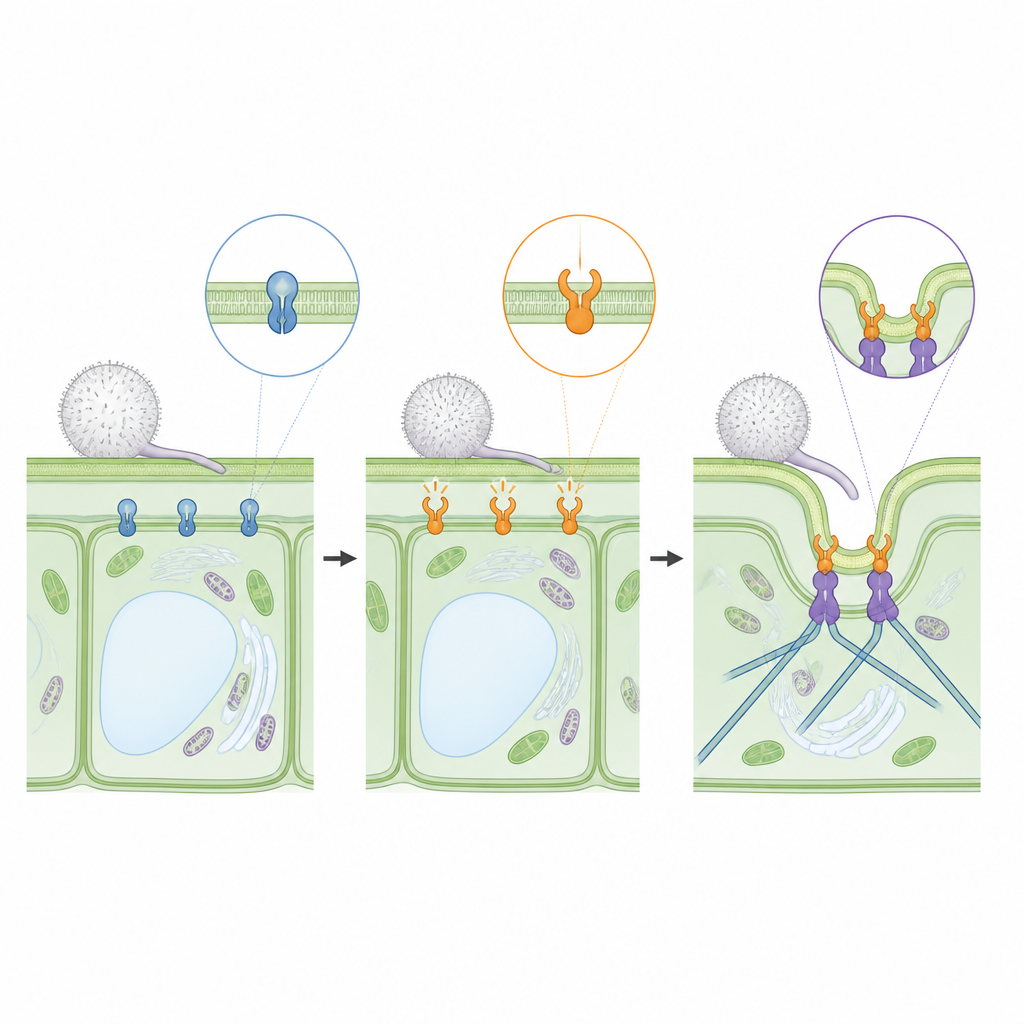
A molecular on off switch at the cell surface
Many cells, from humans to plants, rely on small proteins that act like on off switches. These switches flip between an inactive form and an active form depending on which small molecule they hold. In barley, RACB is one such switch that sits at the inner face of the cell membrane. When it is off, the plant is less welcoming to disease. When it is on, the cell reorganizes its internal structure, which in barley has been linked to greater susceptibility to the powdery mildew fungus Blumeria hordei. Earlier work had shown that permanently turning RACB on makes barley cells easier for the fungus to enter, while turning it down makes infection harder.
Capturing RACB in motion
The team used a combination of powerful structural tools to see RACB at atomic detail in different states. X ray crystallography provided snapshots of RACB bound to an “off” molecule and to two “on like” molecules that mimic its active form. Nuclear magnetic resonance and a technique that tracks how hydrogen atoms swap with heavy water then revealed how flexible different parts of the protein are in solution. Together, these experiments showed that two key regions of RACB, called switch I and switch II, shift position and flexibility step by step as the protein moves from off to partly on to fully on. Rather than behaving as a simple binary switch, RACB samples a range of shapes, with the active forms showing stronger and faster internal motions, especially around the switch regions.
How RACB grabs its helper protein
RACB does not act alone. During fungal attack, it recruits a barley protein called RIPb that can bind both the membrane and internal support fibers called microtubules. Using binding measurements and further structural work, the researchers showed that RIPb recognizes only the active, fully switched on form of RACB. They pinpointed a short stretch in RIPb, with the sequence QWRKAA, that nestles between RACB’s two switch regions. In high resolution crystal structures, this short RIPb segment forms a helix whose side chains form snug contacts with RACB, locking the switches into their active arrangement. When the team altered two critical positions in this motif, RIPb could no longer bind RACB in test tubes, yeast cells, or living barley cells, and the fluorescent signals that report on their partnership largely vanished.
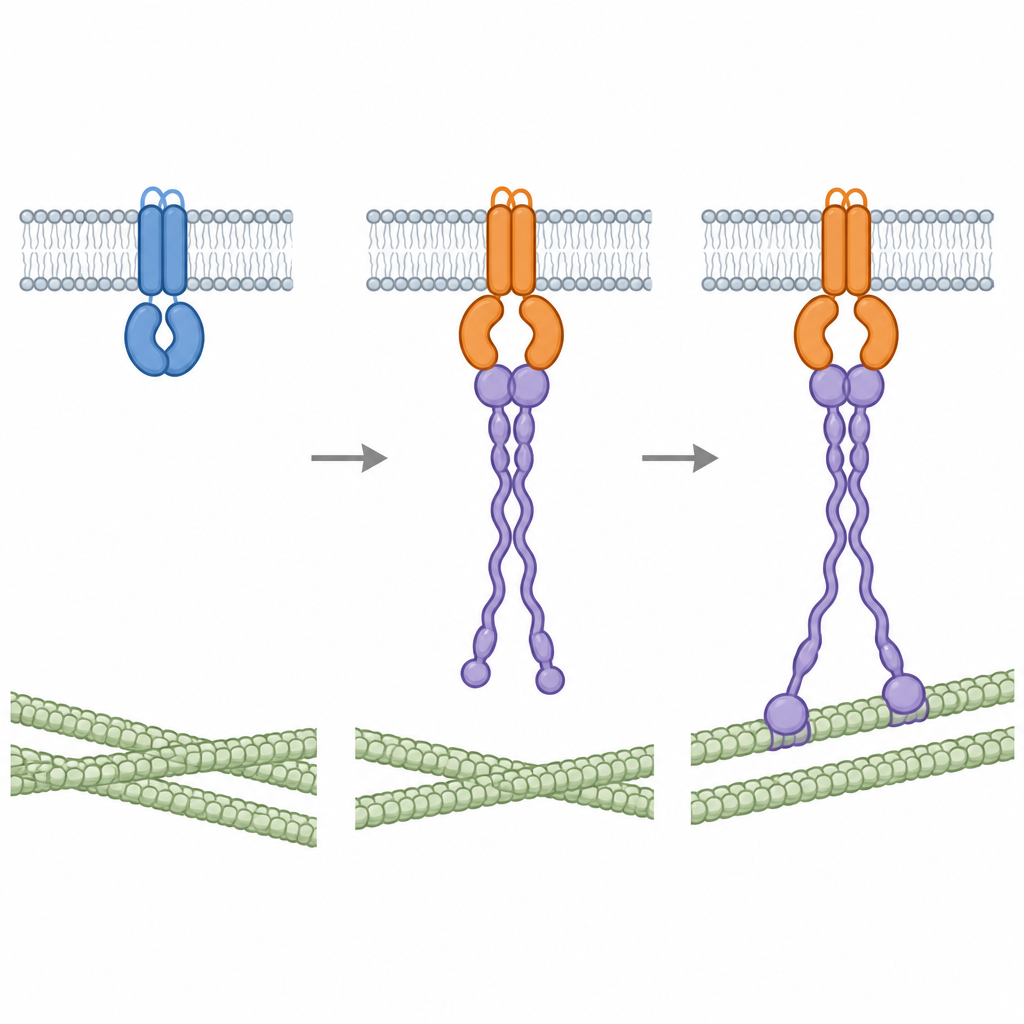
Building a bridge from membrane to inner scaffolding
By combining their structures with computer simulations, the authors built a model of how RACB and RIPb sit together on the inner surface of a barley cell. RACB is anchored to the membrane by a fatty tail and a patch of positive charge, while RIPb forms a dimeric rod that also carries positive charges near its tip. In the model, a pair of RACB molecules hold a pair of RIPb molecules, with their tails buried in the membrane and RIPb’s far ends reaching toward microtubules in the cell interior. This layout provides a physical bridge that could help reshape the membrane and guide internal scaffolding at the precise spot where the fungus attempts to invade.
What this means for protecting crops
The study concludes that barley’s RACB switch is controlled by subtle changes in shape and motion, and that the fungus benefits when RACB is stabilized in its fully active form by RIPb. The conserved QWRKAA segment in RIPb acts as a key that fits into the active RACB lock, connecting the cell membrane to the inner scaffolding needed for local remodeling. For non specialists, this means the fungus is not simply breaking in by brute force but is cleverly using the plant’s own control hardware to open the door. Understanding this detailed mechanism suggests future ways to breed or engineer barley plants in which this interaction is weakened, so that the same molecular switch supports growth and normal defense without giving the fungus an easy entry point.
Citation: Mohamadi, M., Bradai, M., Janowski, R. et al. Nucleotide-dependent switching and RIPb effector recognition of the barley susceptibility factor RACB. Commun Biol 9, 691 (2026). https://doi.org/10.1038/s42003-026-10316-7
Keywords: barley immunity, powdery mildew, small GTPase, cytoskeleton, plant pathogen interaction