Clear Sky Science · en
Molecular regulators of regeneration and strategies for overcoming genotype-dependent recalcitrance in wheat (Triticum aestivum)
Why wheat regeneration matters
Wheat underpins the diets of billions of people, yet improving this crop through modern genetics remains surprisingly difficult. Many of the best high-yield, disease-resistant wheat varieties are stubborn in the lab: their cells resist taking up new DNA and rarely grow back into full plants after gene editing. This review explains why that happens, what scientists are learning about the natural healing abilities of plants, and how new tools may soon let breeders fine tune almost any wheat variety for a changing climate and growing population.
How scientists change plant DNA
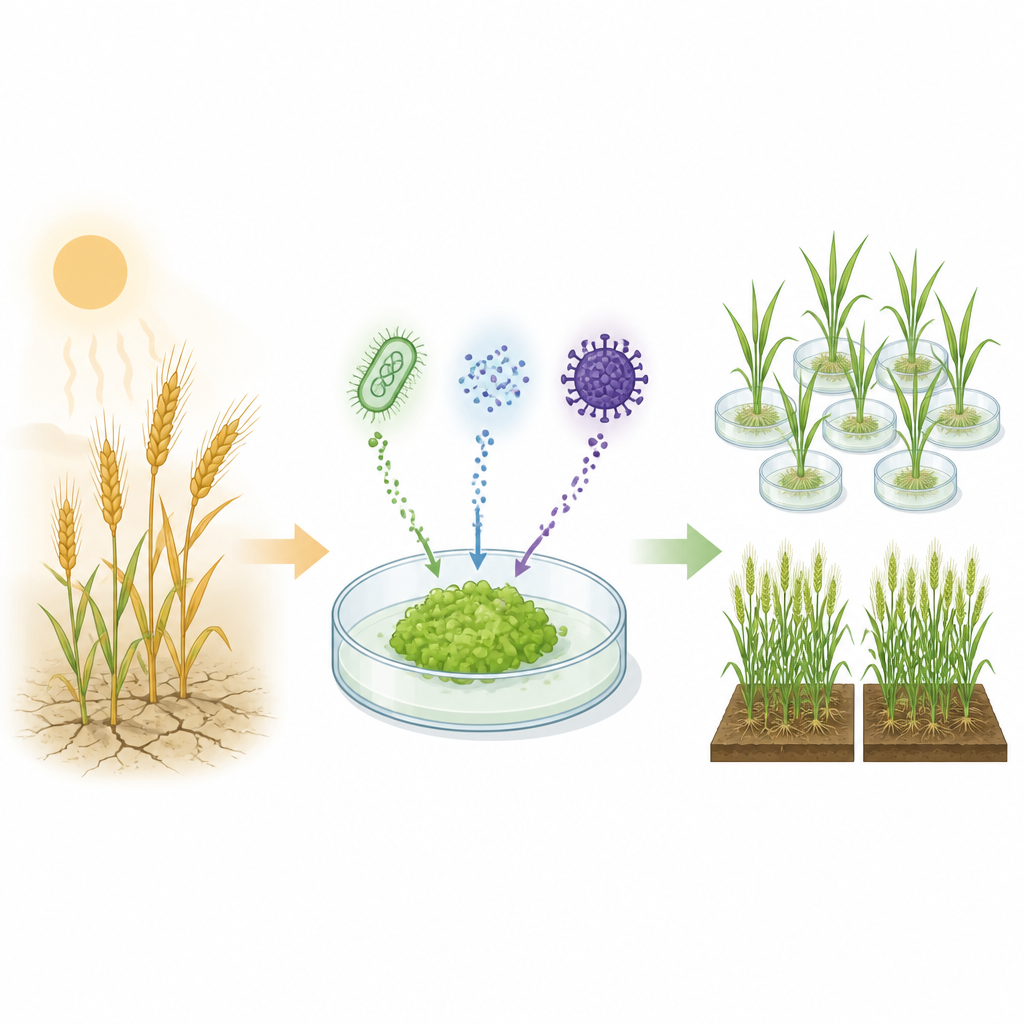
To understand today’s challenges, the authors first look back at the history of genetic transformation, the process of introducing new DNA into cells. Early work in bacteria revealed that DNA carries hereditary information, paving the way for recombinant DNA technology and, later, genetically modified crops. In plants, two main routes became workhorses. One uses a soil microbe that naturally injects DNA into plant cells, while another, the gene gun, shoots microscopic particles coated with DNA into tissues. More recently, tiny engineered particles and plant viruses have been harnessed as couriers that can carry gene editing tools directly into plant cells, often without permanently inserting foreign DNA. Each method has strengths and trade-offs, especially when applied to complex crops like wheat.
The roadblock of stubborn wheat varieties
Unlike some model plants that transform easily, wheat is notorious for its “genotype dependence”: a few lab-friendly varieties accept genetic changes and regenerate well, while many elite commercial lines refuse. Even with optimized microbe strains, carefully timed treatments, and improved culture recipes, standard approaches still fail in many cases. The authors describe how different delivery methods partially address this gap. Gene gun protocols can work in difficult lines but may cause messy DNA insertions. Nanoparticles and viral vectors can bypass the need for long tissue culture steps and help avoid permanent foreign DNA, yet they are still technically demanding and limited in how much cargo they can carry. Together, these options form a toolkit, but none yet offers a simple, universal solution for wheat.
Unlocking the plant’s own repair programs
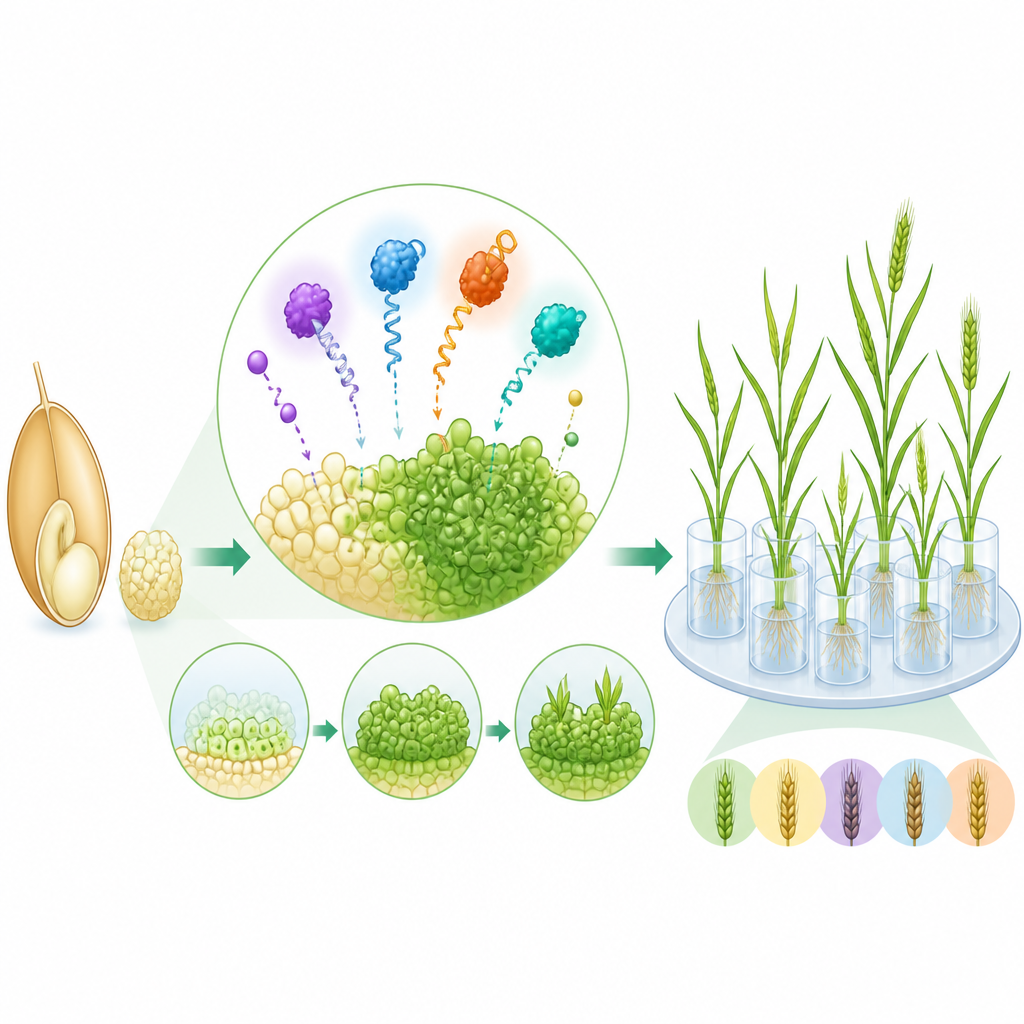
A powerful idea highlighted in the review is to coax wheat cells to tap into their natural healing and regrowth programs. Certain “morphogenic” genes act like master switches for regeneration, turning ordinary cells back into a flexible state from which they can form new organs. In crops such as maize, pairs like BABY BOOM and WUSCHEL have already boosted transformation rates, but constant activity of these strong regulators can distort plant growth. In wheat, newer helpers, including a combined GRF4-GIF1 protein, WOX family genes, and the TaLAX1 and DOF factors, can dramatically raise regeneration rates, even in hard-to-transform varieties. Clever “use-and-delete” designs remove these helpers once their job is done, so the final plants grow and reproduce normally.
Reading plant cells at high resolution
To move from trial-and-error to rational design, researchers are turning to multi-omics tools that read out which genes switch on, how DNA is packed, and how signals like hormones change as wheat cells regenerate. By sampling regenerating tissues over time, scientists have mapped coordinated shifts in gene activity and chromatin structure that mark the journey from embryo to callus to new shoot. These snapshots reveal large networks of regulatory genes, some shared with the model plant Arabidopsis and others unique to cereals. When key wheat regulators identified in these maps are tested experimentally, several sharply improve regeneration across multiple varieties, confirming that network insights can be turned into practical levers.
A stepwise plan toward flexible wheat breeding
The authors argue that cracking wheat’s resistance to transformation will require dissecting each stage of the process rather than only measuring final success. They propose carefully scoring how different varieties perform at specific steps, from the first signs of callus growth to root formation, and linking those traits to detailed genetic maps that cover the diversity of modern wheat. Visual markers that color regenerating tissues can speed this scoring. Combining these data with whole-genome resources and machine learning could pinpoint which genes and DNA variants limit regeneration in each background. Those insights, in turn, would guide tailored combinations of helper genes, stage-specific switches, and delivery methods for each step.
What this means for future wheat crops
In accessible terms, the review concludes that scientists are learning how to help reluctant wheat varieties “heal better” in the lab so they can be edited and improved more easily. By pairing smarter delivery systems with carefully timed molecular helpers and data-driven selection of plant material, it should become possible to transform a much broader range of wheat types. This would make it easier to introduce traits for yield, nutrition, and resilience into the varieties farmers already trust, strengthening global food security without being limited by a few lab-friendly lines.
Citation: Wang, Y.K., Wang, Y.P. & Zhou, LZ. Molecular regulators of regeneration and strategies for overcoming genotype-dependent recalcitrance in wheat (Triticum aestivum). Commun Biol 9, 671 (2026). https://doi.org/10.1038/s42003-026-10315-8
Keywords: wheat regeneration, plant transformation, gene editing, morphogenic regulators, crop breeding