Clear Sky Science · en
HLA polymorphisms shape divergent outcomes of Toxoplasma and Plasmodium infection in Eastern Indian HbE/β-thalassemia cohort
Why some people resist common parasites
People living in parts of India face a double challenge: inherited blood disorders and infections from parasites like the malaria parasite and Toxoplasma, a microbe often caught from food or animals. This study asks a simple but powerful question: why do some patients with a serious blood condition seem naturally better at holding off one parasite but not another, and what does that reveal about our immune system and our genes? 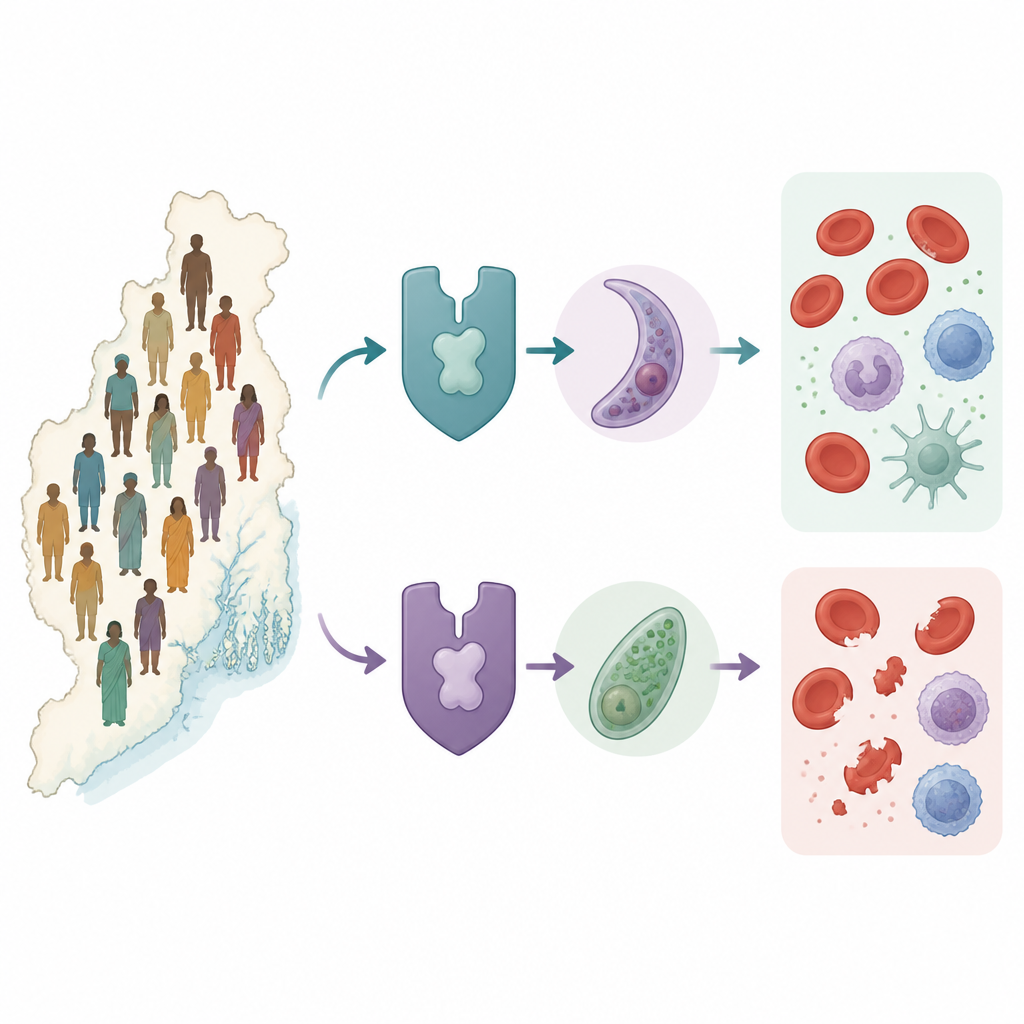
A blood disorder with a hidden twist
The research focuses on people with HbE/β-thalassemia, an inherited condition that disrupts normal hemoglobin and often forces patients to rely on repeated blood transfusions. In Eastern India, this disorder is common in the same regions where malaria and Toxoplasma infections are widespread. Scientists wondered whether this overlap is just bad luck, or whether there are genetic benefits that help balance the harm of the blood disease, allowing certain immune traits to spread in the population over time.
Looking at immune genes instead of transfusions
The team studied 71 patients with HbE/β-thalassemia and 50 healthy volunteers. Using sensitive DNA tests, they checked each person’s blood for silent infections by Plasmodium falciparum, the parasite that causes the deadliest form of malaria, and by Toxoplasma gondii. Surprisingly, the chance of carrying these parasites did not rise with the number of blood transfusions a patient received. Instead, when the researchers deeply sequenced key immune genes known as HLA, they found that particular versions, or alleles, were linked to who was infected and who was not. One HLA type, called A*33, was far more common in patients who tested negative for Toxoplasma, while another, C*07, lined up with a lower chance of malaria infection.
How protective alleles tame Toxoplasma
To move beyond statistics, the scientists isolated immune cells from patients and exposed them to parasites in the lab. Cells from people carrying A*33 allowed Toxoplasma to enter but then limited its growth inside the cell, while cells with a more common allele, A*24, filled up with multiplying parasites and were more likely to die. A*33 cells also showed higher levels of a warning signal molecule called interferon gamma, largely produced by activated killer T cells. Detailed structural work and binding experiments pointed to one Toxoplasma protein fragment, SAG2C, which fits tightly into the A*33 molecule. This snug fit appears to help the immune system recognize infected cells quickly and launch a strong response that keeps parasite numbers low and the host cells alive. 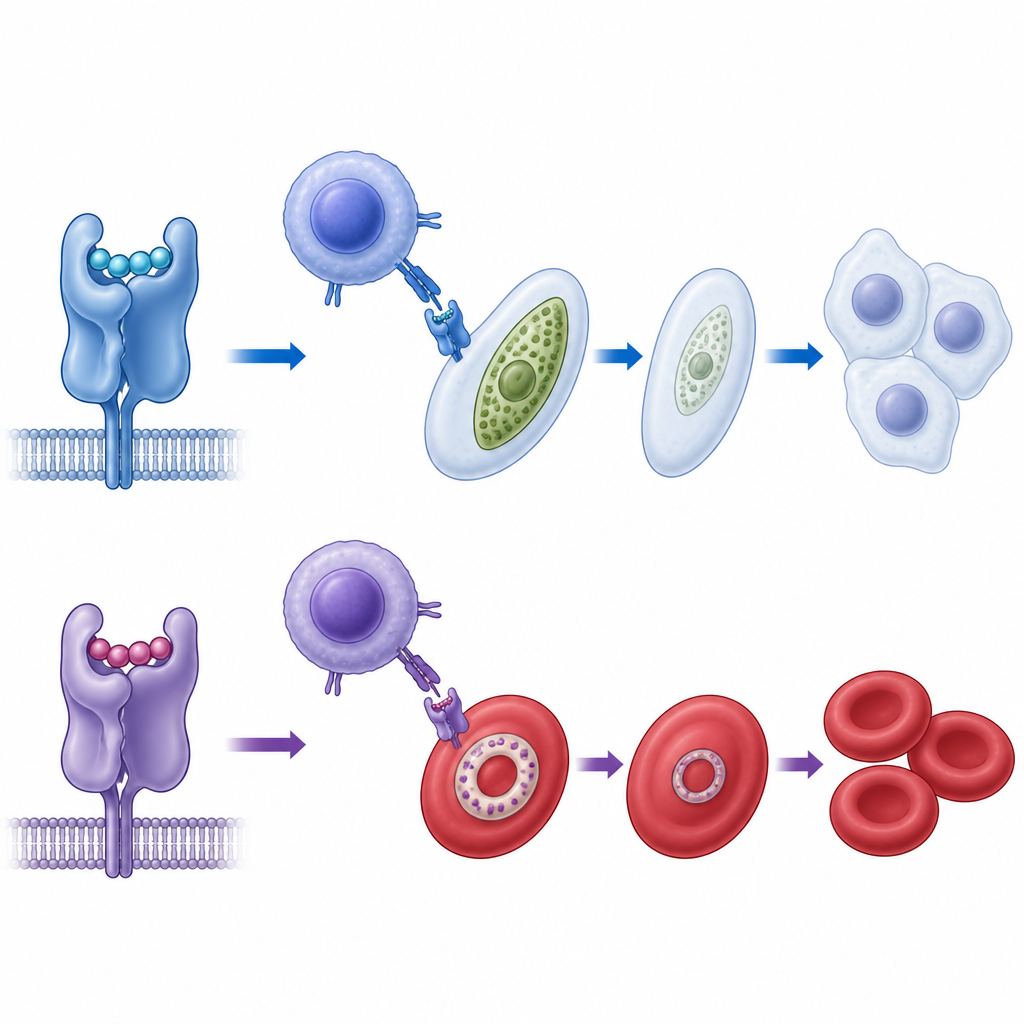
A different shield against malaria
When the team turned to malaria, A*33 did not provide the same shield. Instead, cells engineered to carry C*07 showed the stronger defense. After infection with malaria parasites, both C*07 and A*33 cells were invaded early on, but only C*07 cells blocked the parasites from maturing through their normal stages inside red blood cell–like hosts. Structural and binding studies showed that C*07 has a strong preference for a peptide from a malaria protein called MSP3, again suggesting that a good “lock and key” match between parasite fragment and HLA molecule helps the immune system halt the infection. In contrast, A*33 bound this malaria peptide only weakly, reinforcing the idea that protection is highly specific to each parasite and each HLA version.
What this means for patients and populations
Together, these findings show that some versions of HLA can help HbE/β-thalassemia patients quietly fend off serious parasites, even though the blood disorder itself is harmful. A*33 seems to favor strong immune control of Toxoplasma, while C*07 is better suited to restraining malaria. Over many generations in regions where these parasites are common, such selective advantages may help explain why certain HLA types and even damaging blood traits like HbE/β-thalassemia remain frequent. For patients, understanding these genetic patterns could one day guide more personalized monitoring of infection risk and help doctors identify who may need closer watching or different preventive strategies.
Citation: Bhattacharya, S., Rahaman, M., Suman, S. et al. HLA polymorphisms shape divergent outcomes of Toxoplasma and Plasmodium infection in Eastern Indian HbE/β-thalassemia cohort. Commun Biol 9, 690 (2026). https://doi.org/10.1038/s42003-026-10222-y
Keywords: HLA alleles, HbE beta thalassemia, Toxoplasma, Plasmodium falciparum, host parasite interaction