Clear Sky Science · en
Horseshoe bats (Rhinolophus nippon) suppress clutter noise through echolocation frequency control to detect prey
How bats create quiet to find dinner
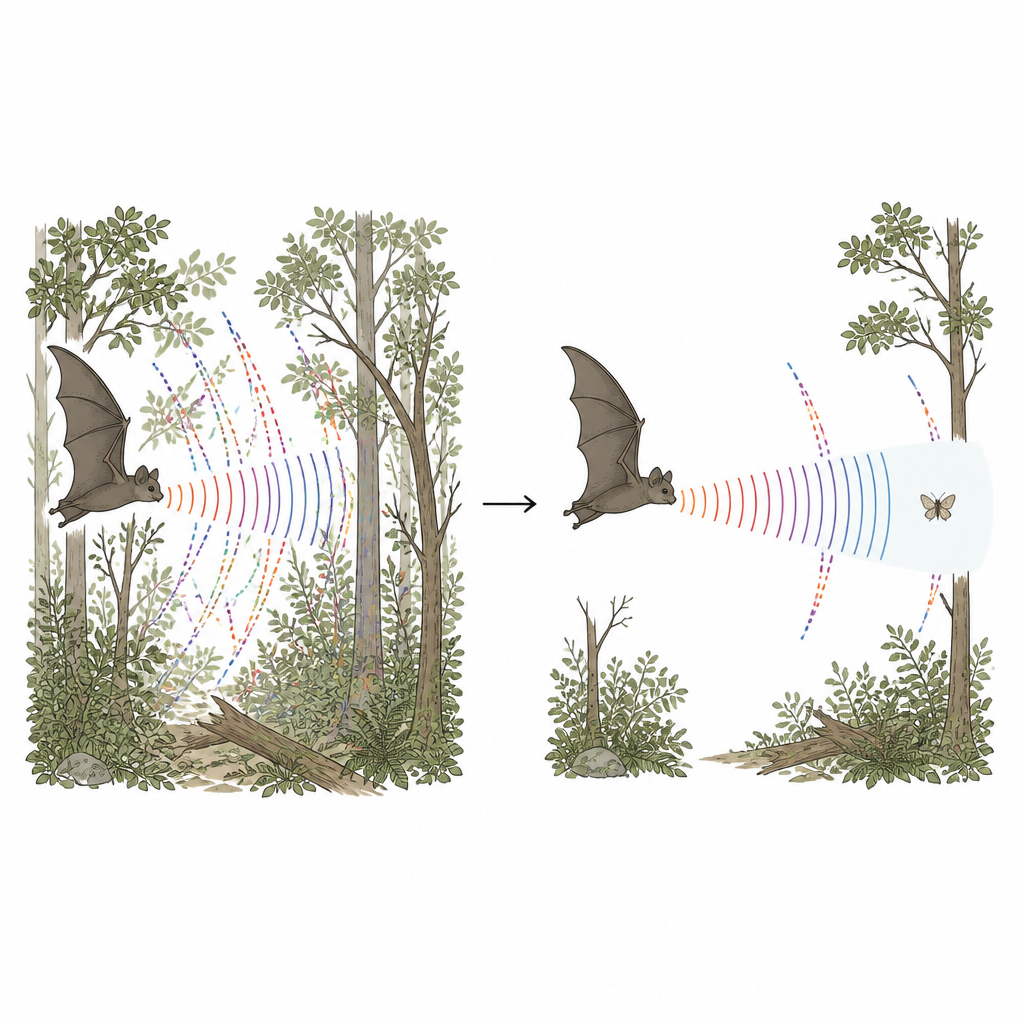
Finding a tiny flying insect in a noisy night sky is not easy. Yet horseshoe bats routinely pick out fluttering moths while shouting powerful sound pulses that flood their surroundings with echoes. This study shows that these bats do something clever with those echoes: they fine tune the pitch of their calls to carve out a quiet slice of sound where the signatures of prey stand out clearly.
Listening with built in sonar
Horseshoe bats hunt using echolocation, sending out long, steady cries and listening for returning echoes. As they fly, motion shifts the pitch of these echoes, a physical effect known as the Doppler shift. For decades, researchers knew that these bats slightly lower the pitch of their calls in flight so that the key part of each echo stays near a favored reference pitch, where their hearing is especially sharp. That process, called Doppler shift compensation, was thought mainly to keep echoes inside this sweet spot of hearing.
A puzzle about what bats pay attention to
There was a catch. During an attack, echoes come from both the moth and the surrounding walls or vegetation, but earlier work suggested that bats did not track the prey echo. Instead, they seemed to adjust to echoes from the background. To find out what really guides their behavior, the researchers first created artificial echoes in the lab. They recorded each bat’s call in real time, electronically shifted the pitch and loudness to create several echo streams, and played these “phantom” echoes back through tiny speakers. By arranging the echoes so that the loudest stream and the highest pitched stream did not match, they could see which one the bat followed.
Choosing pitch over loudness
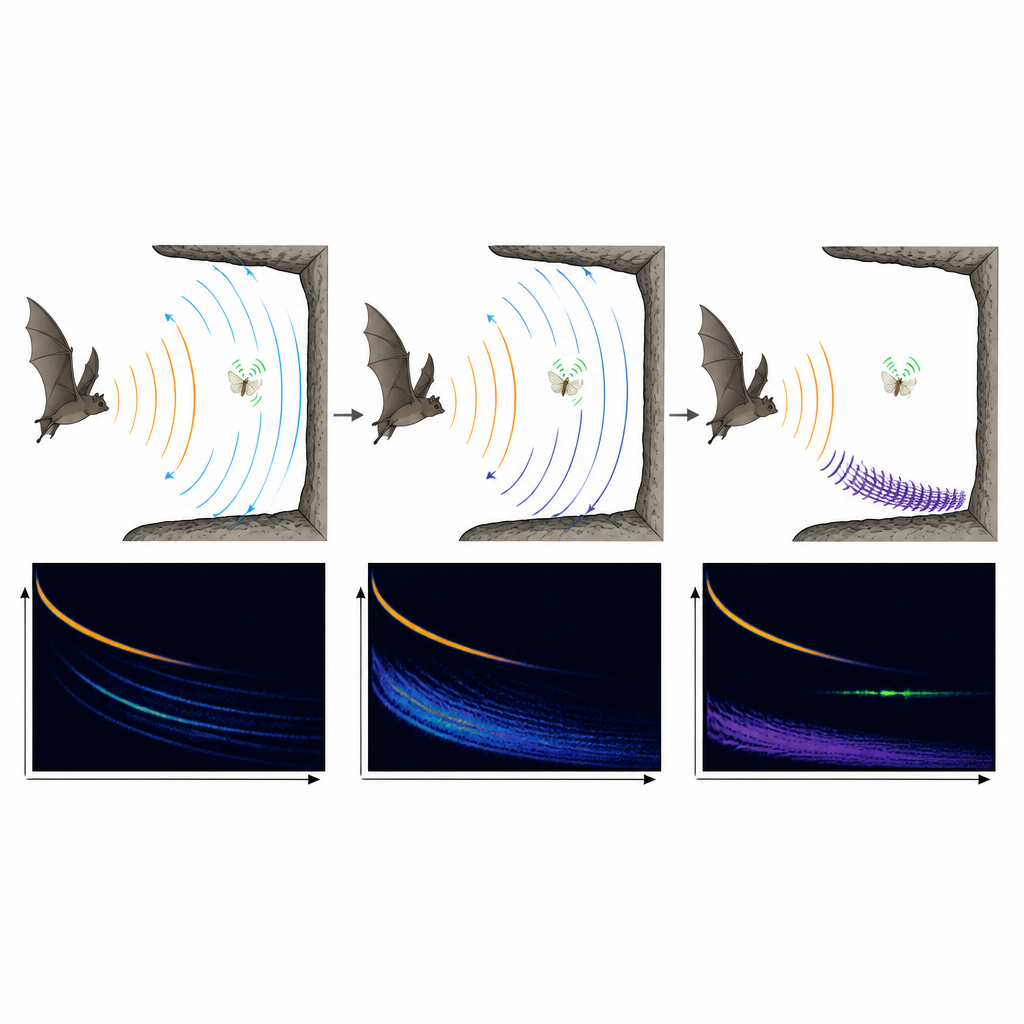
The bats consistently adjusted their call pitch to match the highest pitched echoes, even when those echoes were much weaker than others. To check that this happens in more natural settings, the team let bats fly in a room where some walls reflected sound strongly and others were muffled. Tiny microphones carried on the bats’ backs recorded the echoes they actually heard. Again, the animals tuned their calls to the highest pitched echoes, not the strongest ones. This had an unexpected side effect: most background echoes were pushed into a band of lower pitches, leaving a very quiet band just above the reference pitch.
Prey flashes in a quiet sound window
Next, the scientists studied real hunts. Bats wearing on board microphones attacked tethered moths whose beating wings created brief, shimmering changes in the echoes, known as spectral glints. These glints appeared squarely inside the quiet high pitch band, standing out clearly against the hushed background. The bats did not chase these fleeting peaks with their call adjustments, likely because the glints changed too fast. Instead, by continuing to follow the steadier background echoes, they kept the quiet band open so that the moth’s wing beats flashed brightly within it.
Jamming the bats’ special listening band
To test whether this quiet band truly mattered for catching prey, the researchers played narrow bands of noise while presenting moths to perched bats. Noise placed below the reference pitch, where most clutter echoes already sit, had almost no effect: bats launched attacks in every trial. When noise was placed within the normally quiet band above the reference pitch, attack rates dropped sharply. This shows that bats rely on that silent spectral window to notice the subtle glints from prey wings.
What this means for how animals sense the world
By carefully controlling the pitch of their own calls, horseshoe bats do more than keep echoes within a sensitive hearing range. They actively shape the soundscape so that echoes from the background are squeezed into one region, leaving a clear, quiet band where the telltale flicker of a moth’s wings becomes easy to hear. In effect, they use the physics of sound to boost the contrast between signal and noise, revealing how animals can refine their own senses not only through brain circuits but also by smart use of the laws of nature.
Citation: Yoshida, S., Mastumoto, H., Kobayasi, K.I. et al. Horseshoe bats (Rhinolophus nippon) suppress clutter noise through echolocation frequency control to detect prey. Commun Biol 9, 663 (2026). https://doi.org/10.1038/s42003-026-10217-9
Keywords: echolocation, horseshoe bats, Doppler shift compensation, prey detection, sensory ecology