Clear Sky Science · en
Two distinct modes of Vgll4-mediated Tead regulation control organ size in zebrafish
How Tiny Organs Know When to Stop Growing
Our bodies are full of small organs and tissues that somehow grow to the right size and then stop. This balance is crucial: too little growth and organs cannot function; too much and the risk of cancer rises. This study uses a transparent zebrafish embryo and one of its sensory systems to uncover how cells fine‑tune growth, revealing a built‑in tug‑of‑war between signals that encourage expansion and others that apply the brakes.
A Moving Chain of Sensors in a Baby Fish
To probe organ-size control, the researchers focused on the posterior lateral line, a row of tiny sense organs along a fish’s side that detect water movement. These organs arise from a compact group of about 120 cells, called the primordium, that buds off from a patch of tissue near the ear and then crawls along the skin while leaving sensory clusters behind. Because this structure is small, exposed at the surface, and develops in a predictable way, it is an ideal living laboratory for watching how growth is regulated cell by cell. Using high‑resolution microscopy and automated three‑dimensional cell counting, the team could precisely measure how many cells the primordium contains, how big it is, and whether its internal architecture remains intact as genes are switched on or off. 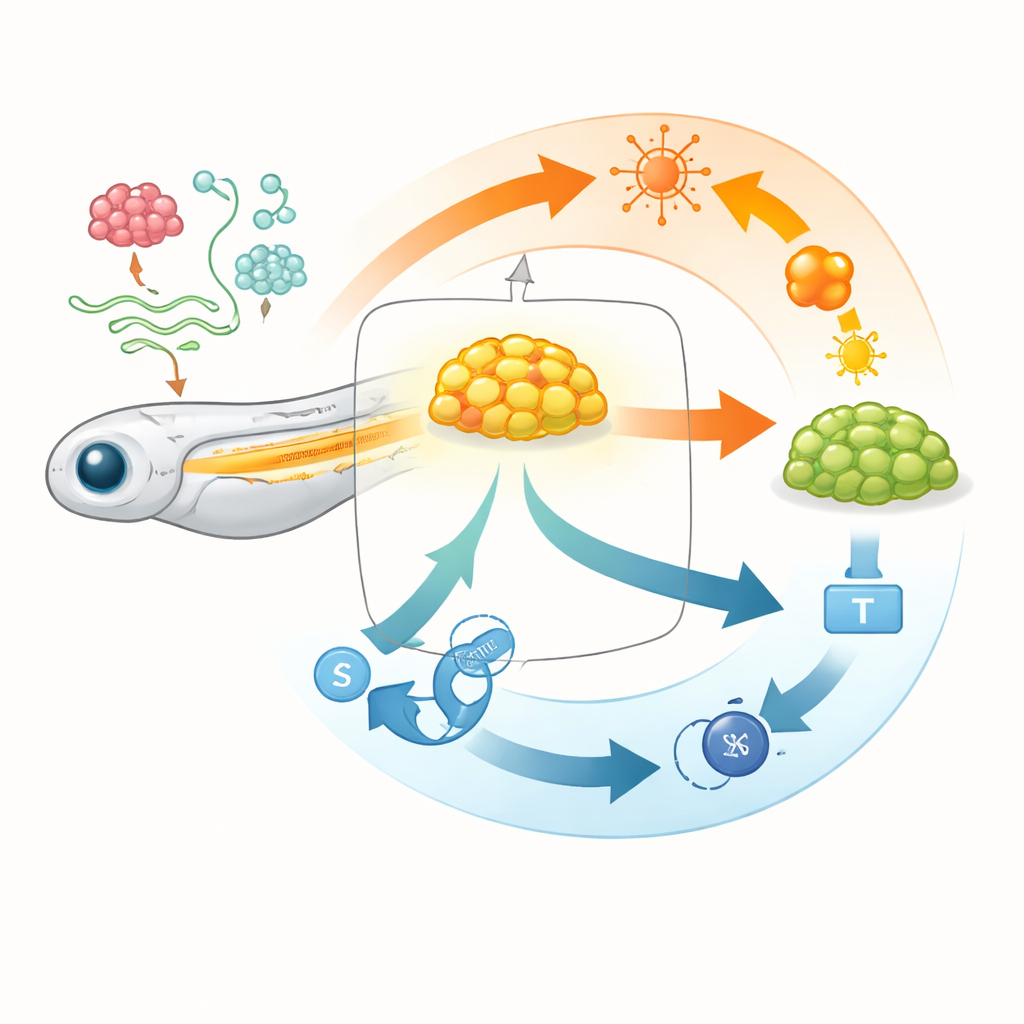
A Growth Switch That Needs a Partner
Earlier work had shown that a protein called Yap1, part of the Hippo signaling pathway, encourages cell multiplication. Here the authors demonstrate that Yap1’s ability to promote growth in the primordium absolutely depends on another family of proteins known as Teads, which sit on DNA and help control gene activity. When Yap1 was removed, or when a mutant form that can no longer latch onto Tead was used, the primordium ended up smaller and rounder, with roughly one‑fifth fewer cells. Supplying normal Yap1 restored cell numbers, but the Tead‑binding‑deficient version could not, showing that the Yap1–Tead partnership is the key growth-promoting switch in this tissue.
The Built‑In Brake: Two Versions of a Tumor Suppressor
Growth, however, is not simply turned on and left running. The team examined Vgll4, a protein previously known to act as a tumor suppressor in mammals by counteracting Yap1‑like signals. Zebrafish carry two relevant versions, Vgll4b and Vgll4l, that are both active in the primordium. When these genes were disabled, the primordium contained up to 50 percent more cells and became larger, even though its internal pattern of cell clusters was preserved. Conversely, adding extra Vgll4b trimmed cell numbers by about 20 percent. Vgll4l could also compensate, but only when present at higher levels, indicating that Vgll4b is the more potent brake. Molecular dissection showed that one specific region of Vgll4b, known as TDU2, is especially important for connecting to Tead and enforcing this growth limit.
Two Ways to Hold Growth in Check
By combining genetic crosses, artificial overexpression, and a fluorescent reporter that lights up when Yap1–Tead is active, the researchers uncovered a dual role for Vgll4. First, Vgll4 competes directly with Yap1 for access to Tead, preventing the formation of growth‑promoting complexes and dampening the signal that drives cell division. In embryos lacking Vgll4, boosting Yap1 had a much stronger effect on cell numbers than in normal fish, consistent with this competition. Second, even when Yap1 itself was absent, extra Vgll4 could still cause strong defects and misbehavior of the primordium, implying that Vgll4 can pair with Tead to actively switch genes off, rather than merely blocking Yap1. Thus, Vgll4 acts both as a physical rival to Yap1 and as a partner in its own right that pushes cells toward restraint. 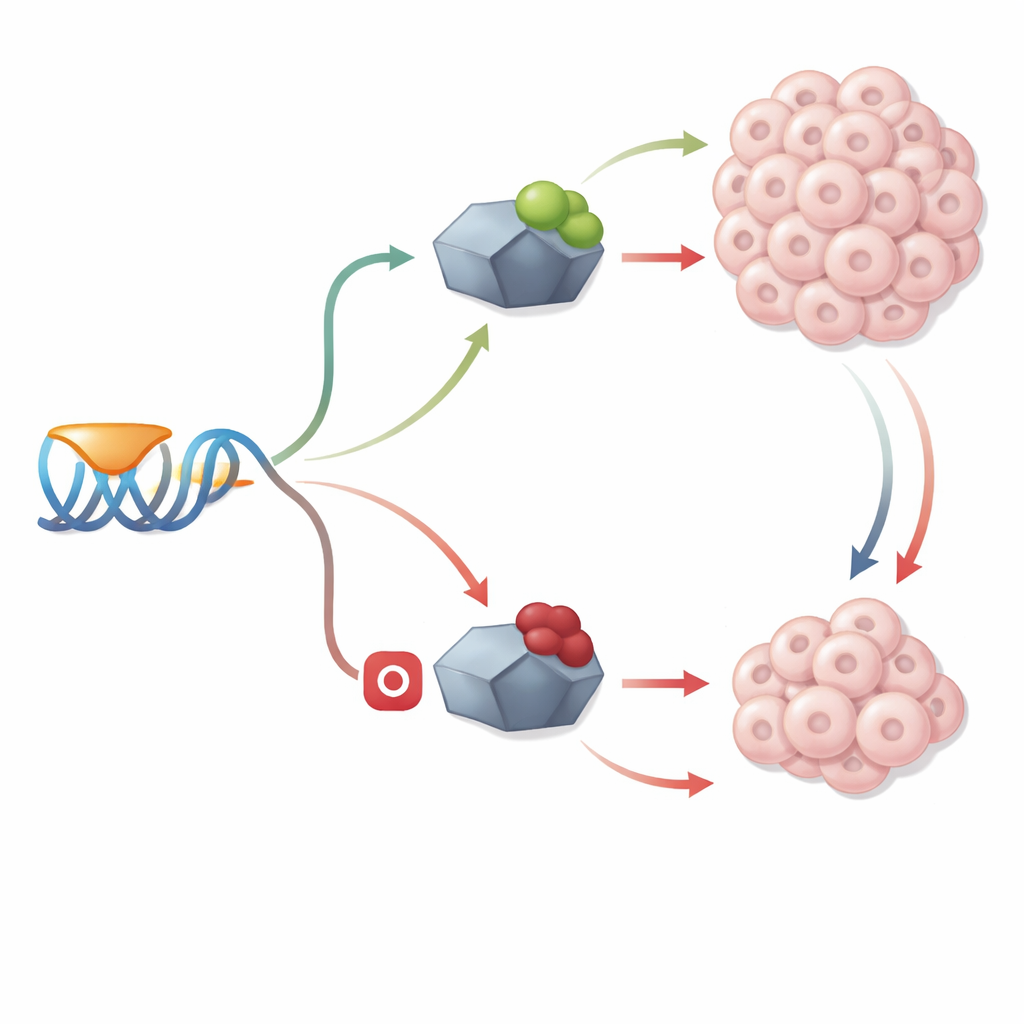
Timing the Push and Pull on Organ Size
Growth control also depends on when these molecular forces act. Using a drug that selectively blocks Yap1‑like proteins from binding Tead, the team pinpointed a critical early window: between about 14 and 19 hours after fertilization, when the primordium is just forming from the original placode of tissue near the ear. In that interval, Yap1 activity is needed to build up a sufficient pool of cells for the later migration. After this stage, blocking Yap1–Tead has little effect on final primordium size, and other pathways help maintain growth as the primordium travels and drops off sensory organs.
Why This Matters for Health and Disease
Together, these findings paint a clear picture of how a developing organ can reach the “just right” size. A pro‑growth signal (Yap1 working with Tead) expands the primordium early on, while an opposing set of proteins (Vgll4b and Vgll4l) both compete with Yap1 and actively repress Tead‑driven genes to hold that growth in check. This dual control makes the system robust: tissues can grow enough to form correctly, yet remain protected from runaway expansion. Because the same molecular players operate in many vertebrate organs, including human ones, understanding this balance in zebrafish offers clues to how organs normally shape themselves—and how tipping that balance might contribute to cancers or to regenerative therapies aimed at safely rebuilding damaged tissues.
Citation: Lardennois, A., Duda, V., Dingare, C. et al. Two distinct modes of Vgll4-mediated Tead regulation control organ size in zebrafish. Commun Biol 9, 574 (2026). https://doi.org/10.1038/s42003-026-10098-y
Keywords: organ size control, Hippo signaling, Yap1 Tead, VGLL4 tumor suppressor, zebrafish lateral line