Clear Sky Science · en
Fusobacterium nucleatum promotes tumor extravasation and metastasis in head and neck cancer via TLR4/MYB/ESPN axis
Hidden germs and wandering tumors
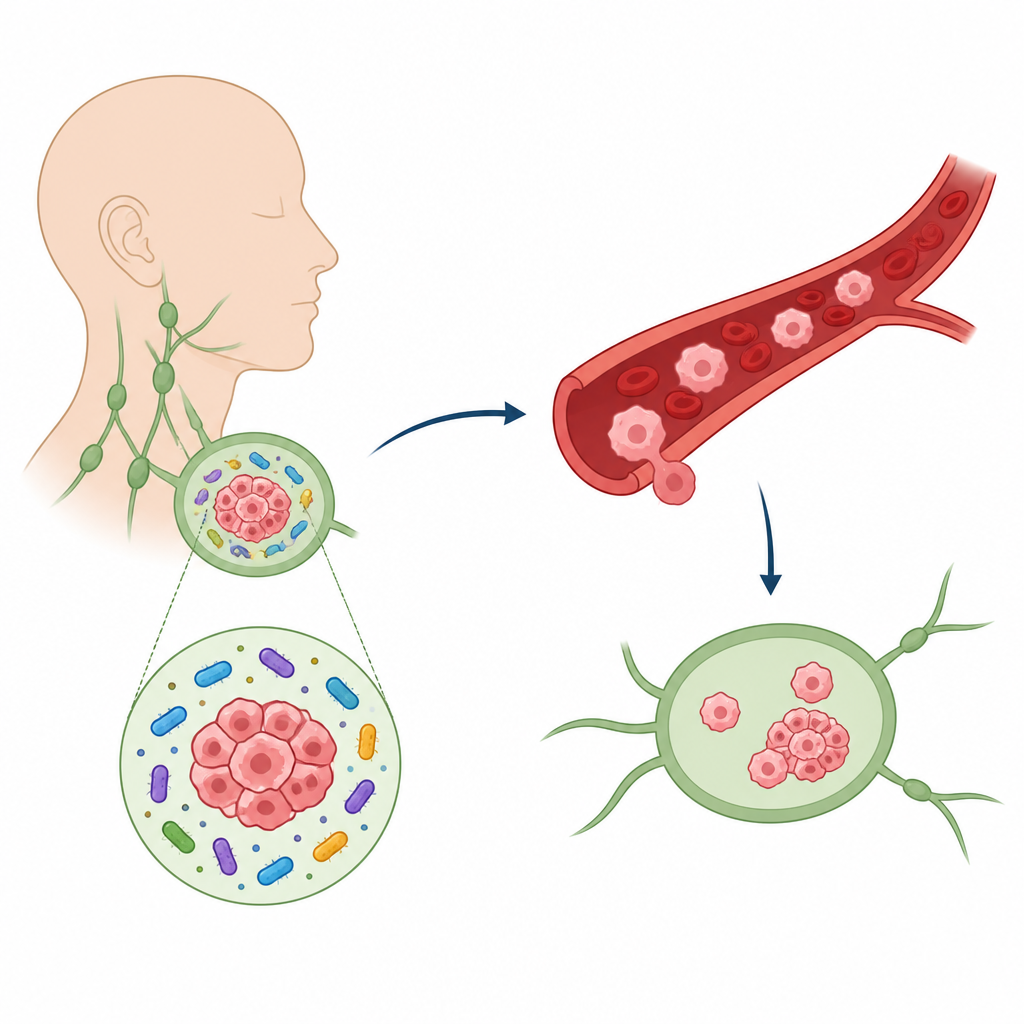
Cancer of the mouth, throat, and voice box is frightening not only because of the primary tumor, but because it often spreads to nearby lymph nodes and beyond. This study explores a surprising partner in that spread: a common mouth bacterium called Fusobacterium nucleatum. The researchers asked whether this microbe, normally part of dental plaque, could help head and neck cancer cells leave their original site, slip through blood vessels, and seed new tumors elsewhere.
When bacteria mark more dangerous cancers
Doctors already know that patients whose head and neck tumors reach the lymph nodes tend to do worse. Here, scientists analyzed tumor samples from several groups of patients and measured how much Fusobacterium nucleatum was present. They found that tumors with lymph node spread generally contained more of this bacterium than tumors that had not spread. Patients whose tumors carried higher levels of the microbe were more likely to see their cancer return sooner, even when other risk factors were taken into account. This suggests that the bacterium is not just a passenger, but a warning sign of a more aggressive disease.
How cancer cells escape blood vessels
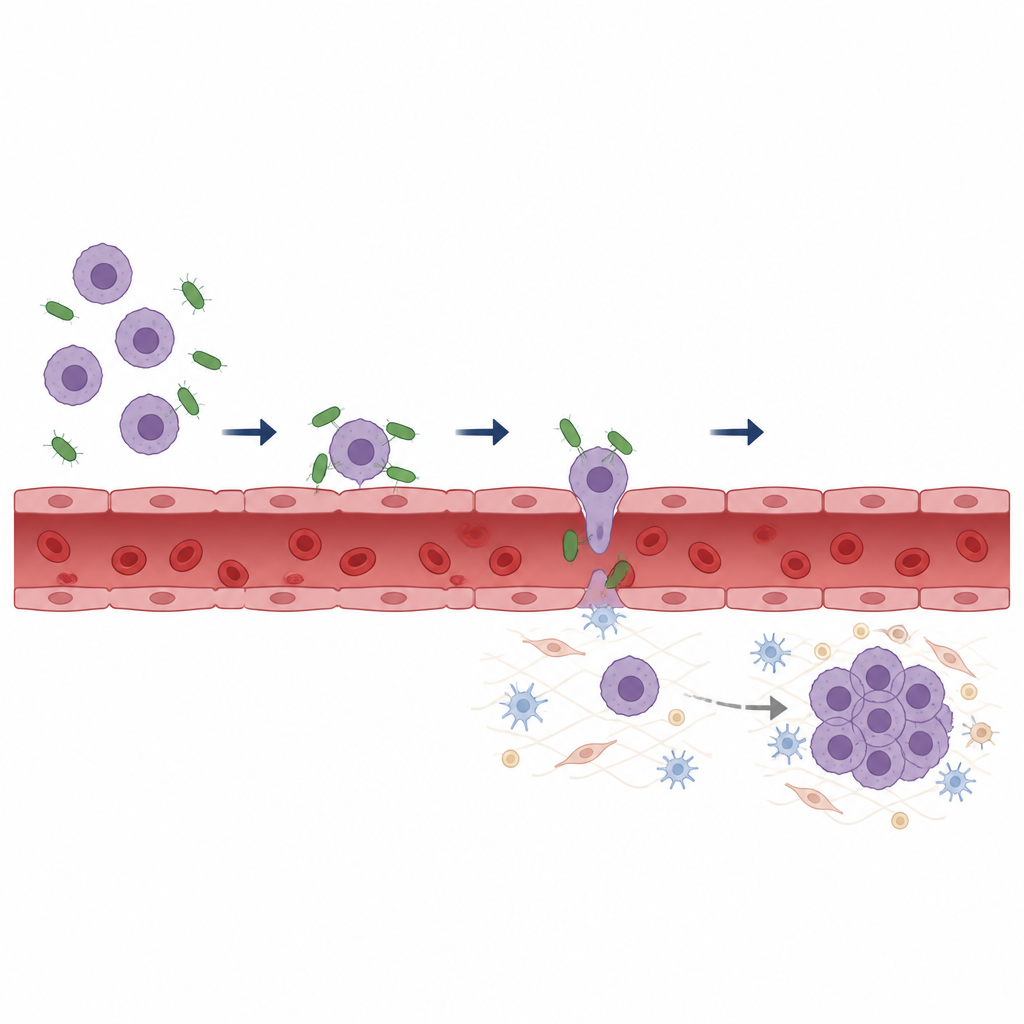
To understand what the bacterium actually does to cancer cells, the team turned to carefully controlled experiments. They exposed human head and neck cancer cells to Fusobacterium nucleatum and then injected these cells into mice. Over several weeks, cancer cells that had been in contact with the bacterium formed more metastatic growths than untreated cells. In dishes, the treated cells moved faster, invaded more easily through artificial barriers, and stuck more strongly to the cells that line blood vessels. They were also better at squeezing between those vessel-lining cells, a key step as tumor cells exit the bloodstream to form new colonies.
Rewiring the cell’s inner scaffolding
The authors then looked inside the cancer cells to see what changed after meeting the bacterium. They focused on the cell’s internal scaffolding, made of actin fibers that help cells crawl and extend thin spikes called filopodia. Under the microscope, bacterium-exposed cells showed more of these spikes and a disturbed actin network. Gene activity analyses highlighted a protein called ESPN, known for binding actin and shaping such protrusions. Levels of ESPN rose sharply after exposure to the microbe, and when researchers used genetic tools to lower ESPN, the boosted movement, invasion, and blood-vessel crossing caused by the bacterium largely disappeared. This points to ESPN as a crucial relay between the microbe’s presence and the cell’s newfound mobility.
A bacterial signal chain inside tumor cells
Digging deeper, the study uncovered a chain of signals linking the bacterium to ESPN. Cancer cells sense Fusobacterium nucleatum through a surface sensor that recognizes bacterial components. Once triggered, this sensor switches on a control protein called MYB inside the nucleus. MYB then binds directly to the stretch of DNA that controls the ESPN gene, turning up ESPN production. In patient samples, tumors with more Fusobacterium nucleatum also tended to show higher levels of both MYB and ESPN, especially when lymph nodes were involved. Together, these findings outline a pathway by which a microbe can tune the internal wiring of cancer cells to help them escape.
Antibiotics as a hint of future therapies
Finally, the team tested whether reducing the bacterium could blunt metastasis. Mice given cancer cells previously exposed to Fusobacterium nucleatum developed more and larger metastatic growths than controls. But when the animals received the antibiotic metronidazole, which is active against this microbe, the number and size of metastatic spots dropped. While this broad antibiotic also affects many helpful bacteria and is not a simple cure, the result suggests that selectively targeting cancer-associated microbes might one day complement surgery, radiation, and drugs.
What this means for patients
In plain terms, this work shows that certain mouth bacteria can help head and neck cancer cells become better travelers. By turning on an internal signal chain that ends with the actin-binding protein ESPN, Fusobacterium nucleatum makes it easier for tumor cells to latch onto blood vessels, slip through them, and settle in new tissues. The study does not yet change standard treatment, but it raises the possibility that measuring or modifying tumor-resident bacteria could help predict or limit metastasis. Future therapies might include highly targeted approaches to remove harmful microbes in and around tumors while sparing the rest of the body’s microbial allies.
Citation: Yuan, X., Huang, H., Wang, Z. et al. Fusobacterium nucleatum promotes tumor extravasation and metastasis in head and neck cancer via TLR4/MYB/ESPN axis. Commun Biol 9, 664 (2026). https://doi.org/10.1038/s42003-026-09913-3
Keywords: head and neck cancer, Fusobacterium nucleatum, cancer metastasis, tumor microbiome, antibiotic treatment