Clear Sky Science · en
Psilocybin shapes the slow, global propagation of brain activity over the cortical layout of 5HT2a receptors
Why this matters for mind and brain
Psychedelic drugs like psilocybin are attracting attention for their possible benefits in treating mental health problems, but we still know little about how they reshape activity across the whole brain. This study looks beneath the usual brain scan summaries to see how slow, sweeping waves of activity move across the cortex under psilocybin, and how this motion relates to both the drug’s molecular targets and people’s subjective experiences.
Slow waves as the brain’s background traffic
At rest, the brain is not quiet. Instead, large, slow waves of activity roll across the cortex over several seconds, traveling from regions devoted to basic senses and movement toward higher-order regions involved in thought and self reflection, and back again. These travelling waves appear to organize communication among distant brain areas and line up with a broad axis that separates unimodal sensory zones from more abstract, transmodal zones. The author used functional MRI data from volunteers scanned during ordinary rest, under a control stimulant drug, and after taking psilocybin, to see how these waves changed across conditions.
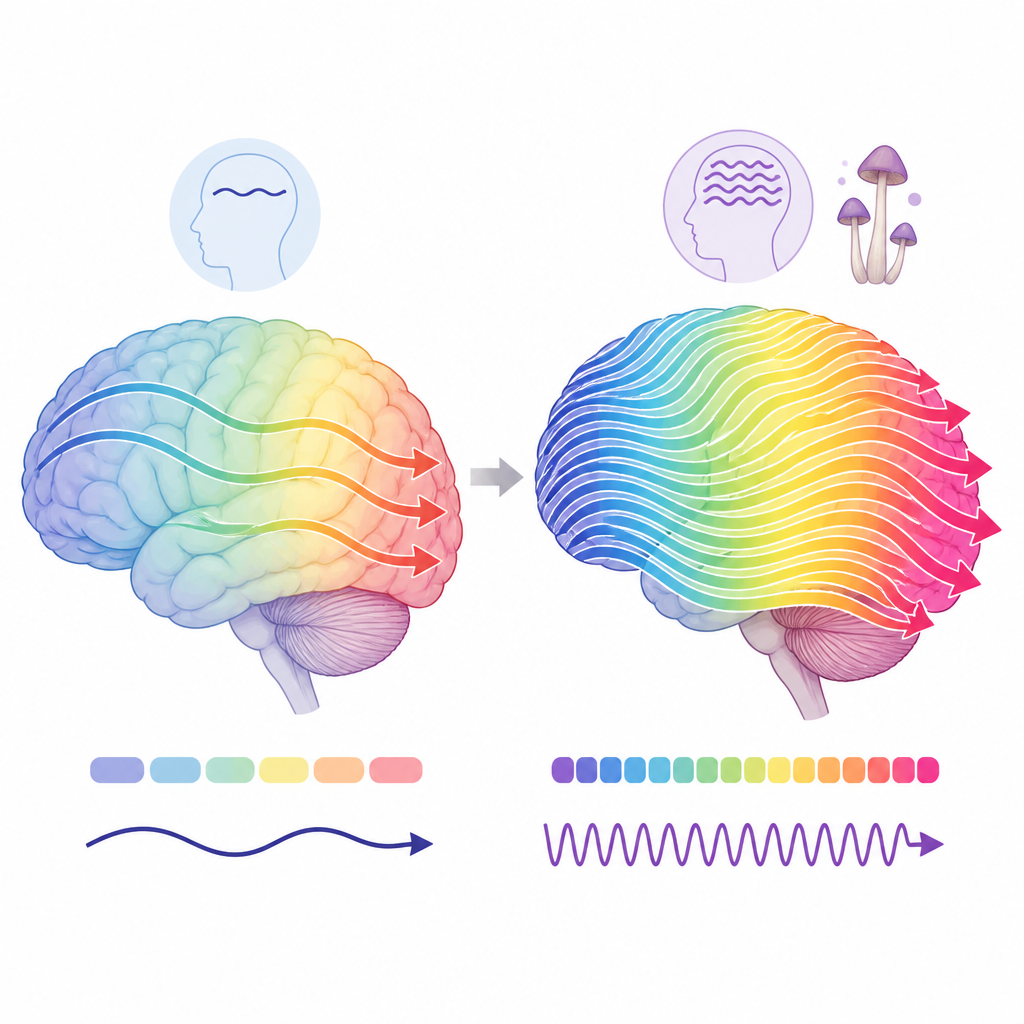
Psilocybin speeds and multiplies global waves
By tracking the timing of blood-oxygen signals in many tiny brain locations, the study identified moments when activity surged across the cortex and behaved like a travelling wave. Under psilocybin, participants showed more such waves and, importantly, those waves moved faster along the cortex-wide gradient than during baseline or under the control drug methylphenidate. The direction of travel, from lower-level to higher-level regions or the reverse, did not change in proportion, suggesting that psilocybin alters the vigor and tempo of this background traffic rather than flipping its flow. When the author compared these wave properties to familiar functional connectivity measures, faster waves were closely tied to a “flattening” of the brain’s main connectivity gradient and to higher overall connectivity, two effects repeatedly seen in psychedelic studies.
Linking brain maps to serotonin receptors
Psilocybin exerts its effects largely by stimulating a specific serotonin receptor type, called 5HT2a, which is more abundant in some cortical regions than others. The study asked whether the spatial pattern of these receptors along the cortex-wide gradient helps shape how waves move. By examining the “energy” of each wave as it passed along the gradient, the author found that waves are not uniform: their strength dips in the middle of the axis and rises again toward the end. Under psilocybin, the early part of the wave, especially for waves traveling from sensory to higher-order regions, showed extra energy. This shift occurred near cortical zones where receptor levels change sharply, suggesting that the landscape of serotonin sensitivity can steer and boost the propagating waves.
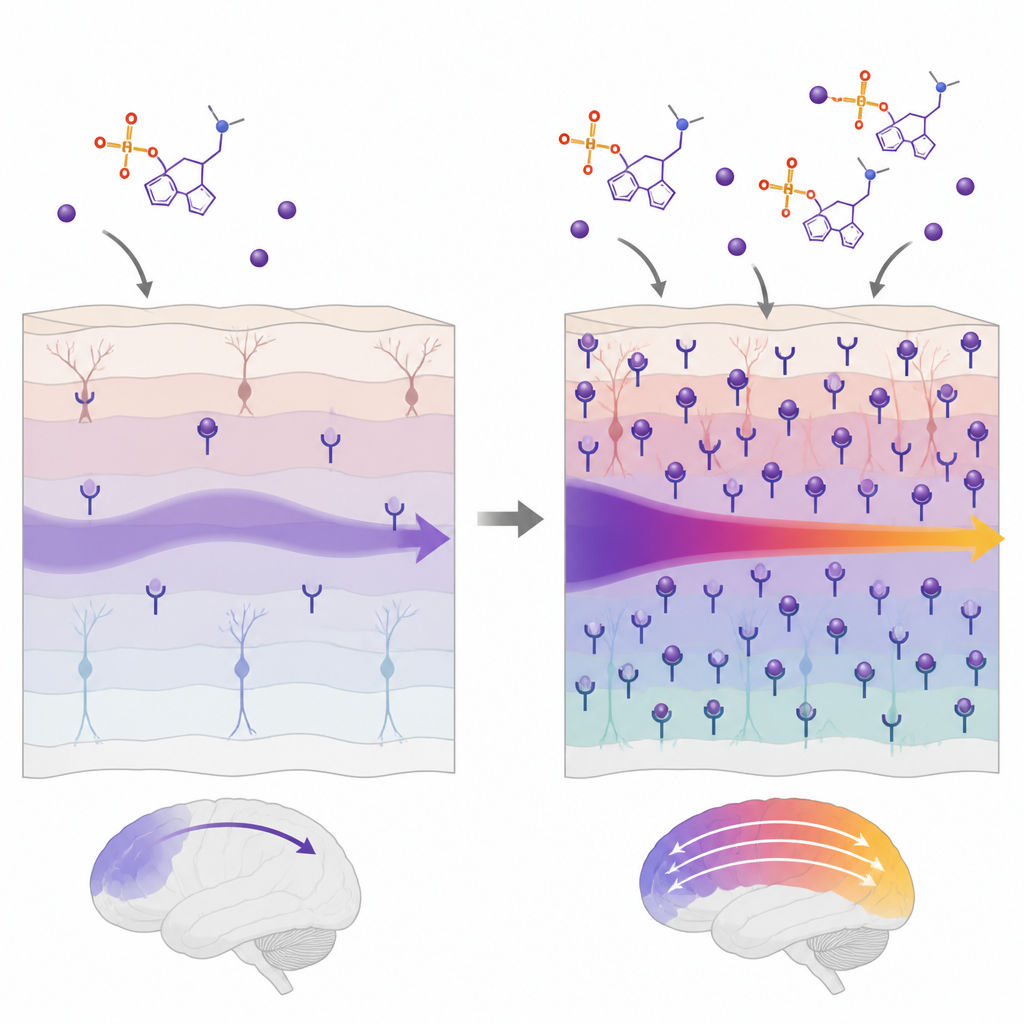
Connecting waves to psychedelic experience
The study also related brain dynamics to what participants reported feeling. Using a standard questionnaire that captures the intensity of the psychedelic experience, faster wave speeds across individuals were associated with stronger reported experiences, even when both baseline and psilocybin sessions were considered. Other features of the waves, such as how many occurred or the balance of upward versus downward travel, did not show a clear link to subjective ratings. This points specifically to propagation speed as a possible bridge between molecular actions at receptors, large-scale brain communication, and changes in consciousness.
What this means for psychedelic science
Taken together, the results suggest that some of the widely discussed connectivity changes seen under psychedelics arise from a more fundamental shift in how slow activity waves traverse the cortex, guided in part by where serotonin receptors are most concentrated. Rather than simply “disrupting” brain networks, psilocybin appears to speed up and energize intrinsic global waves, which in turn reshapes connectivity patterns and may help open windows for brain-wide plasticity. For a layperson, this means that psilocybin’s effects on mood and perception may depend not only on which brain regions are involved, but also on how pulses of activity sweep through them over time.
Citation: Mäki-Marttunen, V. Psilocybin shapes the slow, global propagation of brain activity over the cortical layout of 5HT2a receptors. Commun Biol 9, 672 (2026). https://doi.org/10.1038/s42003-026-09912-4
Keywords: psilocybin, travelling brain waves, functional connectivity, serotonin 5HT2a receptors, psychedelic neuroscience