Clear Sky Science · en
Crosslinked F-actin networks regulate load-dependent energy conversion
How Cells Turn Fuel into Force
Every move your body makes, from a heartbeat to a developing embryo changing shape, depends on cells turning chemical fuel into mechanical force. This paper looks inside that process at a very fine level, asking a deceptively simple question: how does the internal "scaffolding" of a cell control how efficiently it turns the energy from ATP—the cell’s fuel—into motion and force? The authors show that small proteins that tie together actin filaments can act like hidden dials, tuning how hard molecular motors pull and how much energy they spend.
Building a Tiny Lab Inside a Droplet
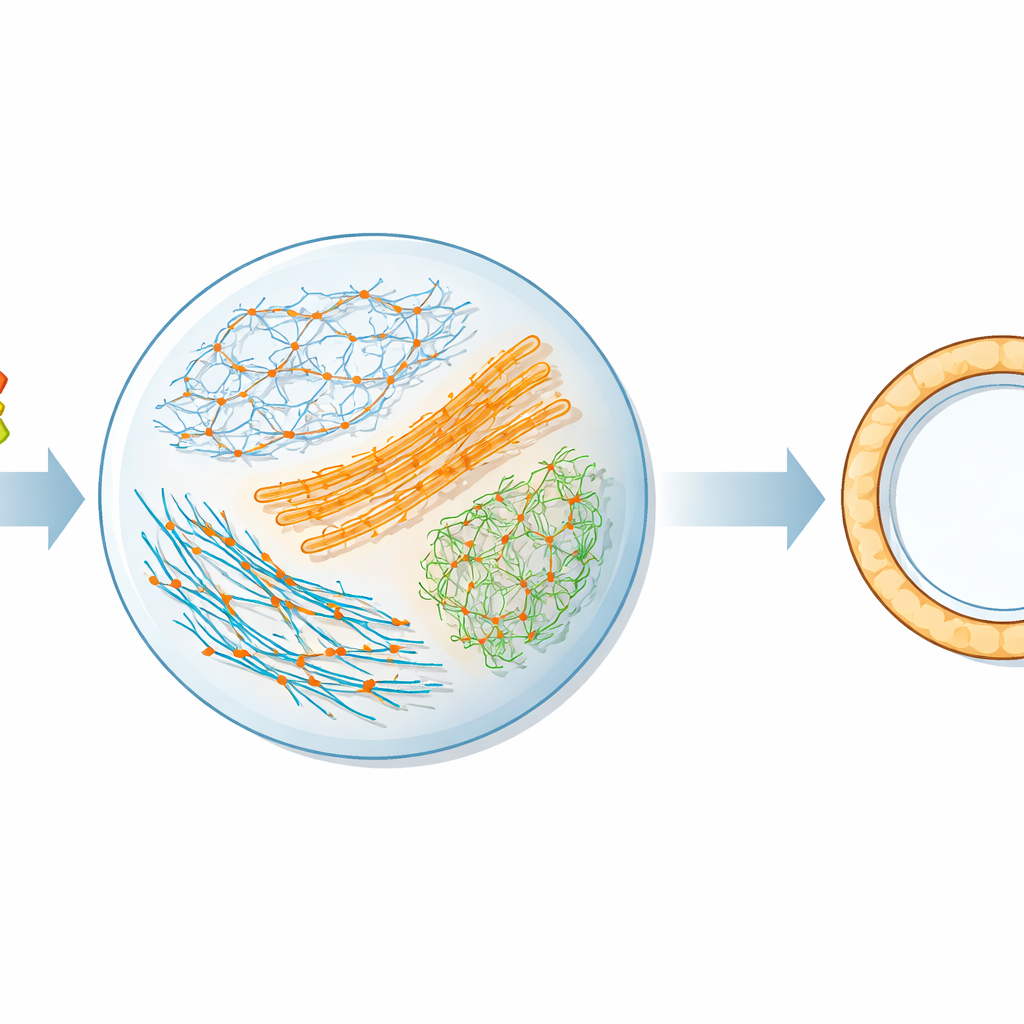
To study this process in a controlled way, the researchers built a miniature version of the cell’s force-generating machinery. They mixed purified actin filaments, which form the cell’s internal skeleton, with myosin motors, which crawl along actin and generate contractile forces. This mixture was encapsulated in microscopic water-in-oil droplets to mimic a cell-sized compartment. They used a fluorescent chemical system to track how fast ATP was burned, and at the same time imaged how the actin network moved and contracted. By following both fuel use and motion together, they could estimate how much mechanical power the myosin motors produced and how efficiently energy was converted into work.
More Actin, More Power
The first step was to see how changing the amount of actin affected the motors. As they increased actin concentration, myosin burned ATP faster and the network contracted more strongly. The relationship followed classic enzyme behavior, showing that the motors were acting like catalysts whose speed depends on how much filament they can bind. Using image-based motion analysis, the team calculated an “apparent strain” (how much the network volume shrank) and an “inferred mechanical power” from that contraction. Both quantities rose with actin concentration, and so did the apparent efficiency—the fraction of chemical energy that seemed to be turned into mechanical work. At high actin levels, the network became stiffer, allowing forces to spread more effectively and boosting the overall power output.
Crosslinkers as Hidden Control Knobs
Cells do not rely on actin alone; they use crosslinking proteins to tie filaments together into different architectures. The authors tested four common crosslinkers—α-actinin, fascin, fimbrin, and filamin—that create networks with distinct spacing and filament alignment. When they added α-actinin, which makes relatively loose, mixed-polarity connections, both ATP consumption and mechanical power increased, but efficiency stayed about the same. In contrast, fascin, which bundles filaments into tightly packed, uniformly aligned cables, made myosin burn ATP more slowly while still increasing mechanical power and efficiency. Fimbrin and filamin showed more complex behavior: at low levels they boosted fuel use and power, but at higher levels they sharply reduced ATP consumption, in some cases nearly stalling the motors while leaving a portion of the network still capable of contracting.
How Load Changes the Way Motors Work
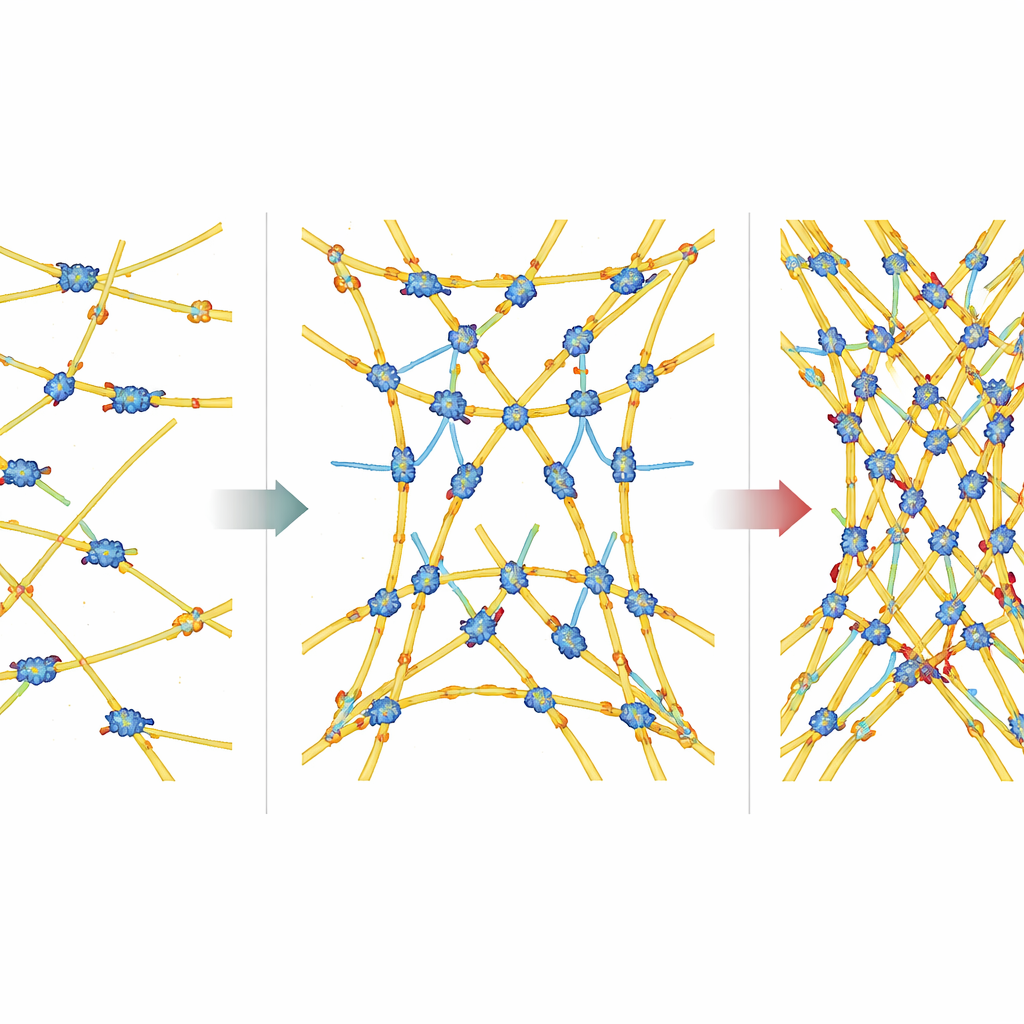
These patterns point to an important idea: myosin motors are sensitive to mechanical load. When they pull against a stiff, tightly crosslinked network, they remain in their force-generating state longer, effectively gripping the filament more firmly. The authors used ATP consumption rates to estimate an effective “duty ratio,” the fraction of time a motor spends in that strongly bound state, and combined it with mechanical power to gauge how load-dependent the system was. Fascin- and filamin-based networks showed strong load dependence: as crosslinking increased, motors slowed their cycling but delivered higher force over time. Networks formed by α-actinin and fimbrin produced more modest changes. These differences mirror where the crosslinkers are found in cells—fascin and filamin in highly dynamic structures that push and pull on the environment, α-actinin and fimbrin in more stable, supportive regions.
Why This Matters for Living Cells
In simple terms, this work shows that cells can tune their “fuel economy” and power output not just by changing how many motors they use, but by reorganizing the actin scaffold they pull on. Some crosslinkers create architectures that encourage energetic, load-sensitive pulling well-suited to fast movement and reshaping. Others support steady, less load-sensitive behavior ideal for maintaining structure. By choosing and mixing these crosslinkers, cells may adjust how much energy they spend to generate the forces needed for division, migration, and development. The study thus connects the microscopic details of cytoskeletal architecture to the big-picture question of how living systems manage and deploy their energy.
Citation: Sakamoto, R., Sun, Z.G. & Murrell, M.P. Crosslinked F-actin networks regulate load-dependent energy conversion. Commun Biol 9, 572 (2026). https://doi.org/10.1038/s42003-026-09843-0
Keywords: actomyosin, cytoskeleton, cell mechanics, ATP consumption, actin crosslinkers