Clear Sky Science · en
Cleavage region organizes the structural architecture of the SINE-derived B2 repressive ribozyme
Hidden switches in our DNA
Much of our DNA is packed with repetitive pieces once dismissed as junk. This study focuses on one such piece in mice, called B2, and shows that it behaves like a tiny molecular switch that can cut itself and help shut down gene activity when cells are under stress. Understanding how this switch is built and how it moves in three dimensions helps explain how cells rapidly turn genes off in tough conditions, with possible links to development, infection, cancer, and brain disease. 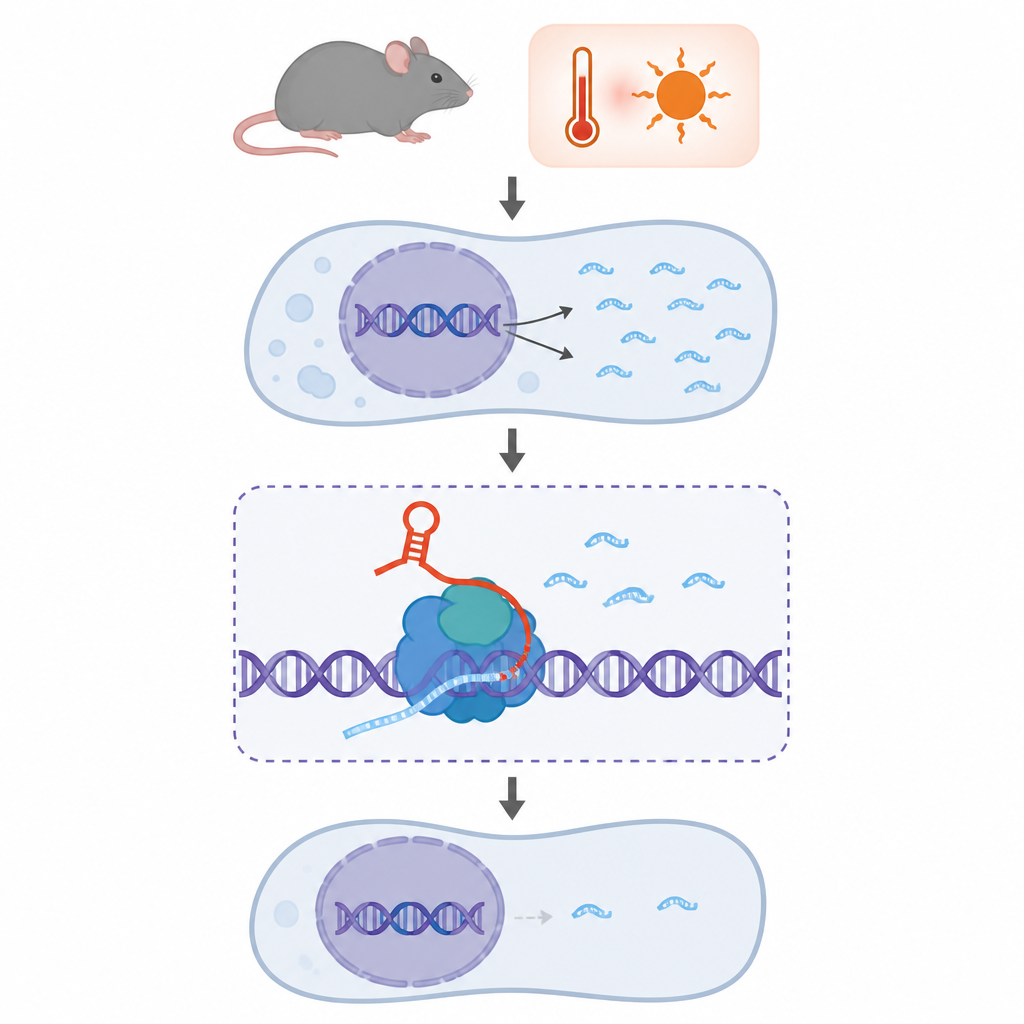
Repetitive RNA that calms busy genes
B2 comes from a family of short repeated elements that litter mammalian genomes. In mice, B2 RNA is copied from DNA by a cell enzyme and is especially active in early embryos and during stress, such as heat shock or viral infection. Earlier work showed that B2 RNA can latch onto the main gene‑reading machine, RNA polymerase II, and slow or block the copying of many genes at once. More recently, B2 was found to be a self‑cleaving ribozyme, an RNA that can cut itself, and its activity is tuned by EZH2, a protein better known for modifying chromatin. This places B2 at the crossroads of gene regulation, stress response, and epigenetics.
Shaping a tiny molecular knife
To find out how B2’s shape underlies its function, the authors combined several techniques. Chemical probing (called SHAPE) revealed which parts of the RNA are stiff and which are flexible, outlining its secondary structure, the pattern of base‑paired stems and loops. Small‑angle X‑ray scattering (SAXS) then provided low‑resolution three‑dimensional outlines of the RNA in solution, capturing not just one rigid form but an ensemble of shapes. Computer modeling stitched these data together into all‑atom models, allowing the team to see how specific regions fold, move, and interact. They focused on a central “cleavage region” that contains the self‑cutting site and is also critical for binding EZH2 and blocking RNA polymerase II.
What happens when the key region is tweaked
The team compared normal B2 RNA to several natural and engineered variants. A natural version called B2J has just two point mutations. It keeps almost the same basic secondary structure but becomes more flexible in 3D, sampling many more conformations and showing weaker self‑cleavage. A mutant lacking only the main cleavage site, B2Δ(96–105), unexpectedly rearranges nearby stems into a longer, more rigid arm. Its overall size stays similar, but it loses much of its catalytic activity and its ability to repress transcription, suggesting that tightening this region limits access to the active shape. 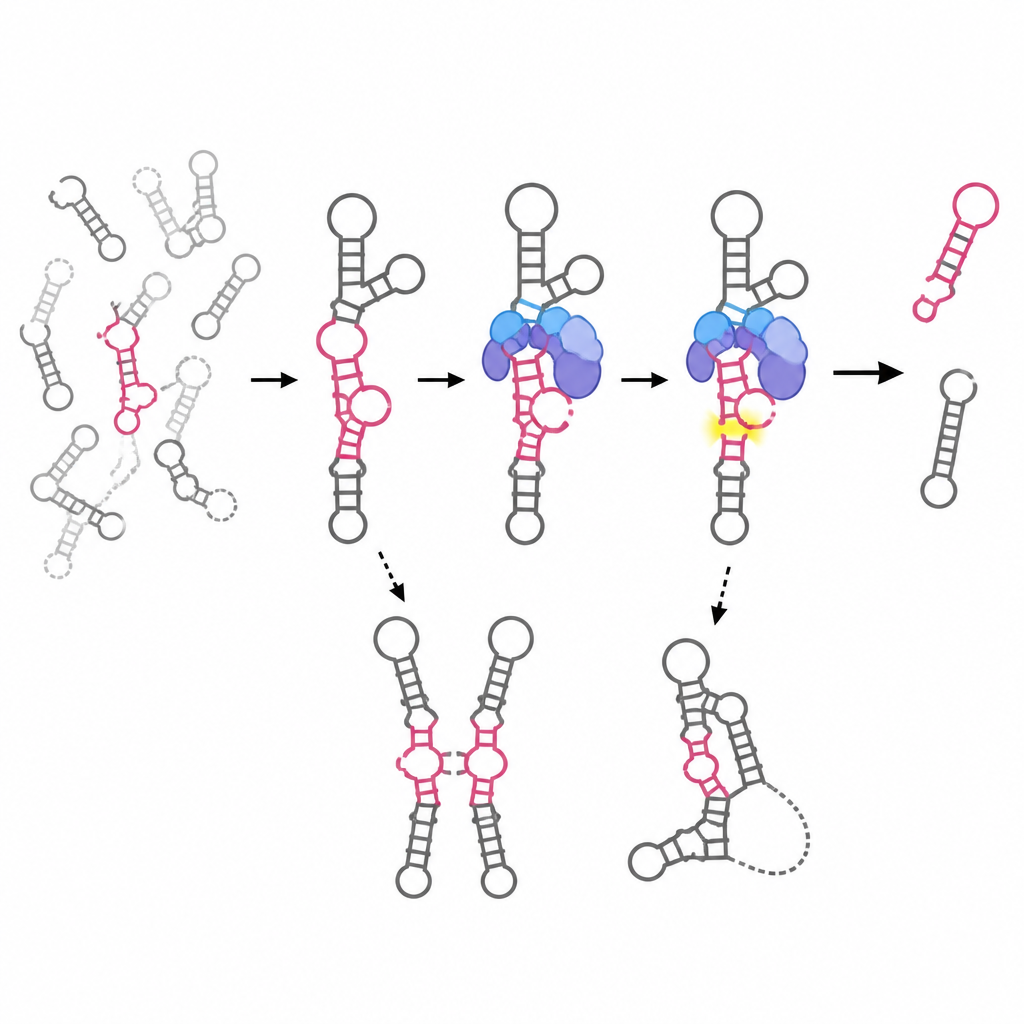
When the cutting domain is removed entirely
An even larger deletion, B2Δ(81–124), removes the whole cleavage domain. Chemical probing shows that, beyond an intact 5′ region, much of the remaining RNA becomes unstructured. SAXS reveals that this mutant looks bigger and more elongated, and modeling together with binding tests suggests it can form RNA dimers rather than staying as a single strand. This change in architecture coincides with loss of EZH2 binding and complete loss of transcriptional repression, both in test‑tube assays using nuclear extracts and in living cells, where this mutant no longer reduces global RNA synthesis or alters nuclear appearance the way normal B2 does.
Why these moving parts matter
Overall, the study shows that the cleavage region of B2 RNA is not just the site of cutting but the organizer of its whole structure and function. Subtle point changes make the RNA more floppy and less efficient, while deletions that stiffen or erase the region disrupt its partnership with EZH2 and its ability to quiet RNA polymerase II. By tying specific three‑dimensional shapes and shape ensembles to distinct biological outcomes, the work explains how a tiny piece of so‑called junk DNA can act as a finely tuned stress‑responsive brake on gene activity.
Citation: Singhal, A., Mrozowich, T., Rivera, C. et al. Cleavage region organizes the structural architecture of the SINE-derived B2 repressive ribozyme. Commun Biol 9, 649 (2026). https://doi.org/10.1038/s42003-026-09819-0
Keywords: B2 SINE RNA, self-cleaving ribozyme, RNA structure, stress response, transcriptional repression