Clear Sky Science · en
HUH-tagged Cas9 as a platform for efficient ssODN-mediated knock-in via embryo and adult injection in insects
Making Gene Editing Easier in Insects
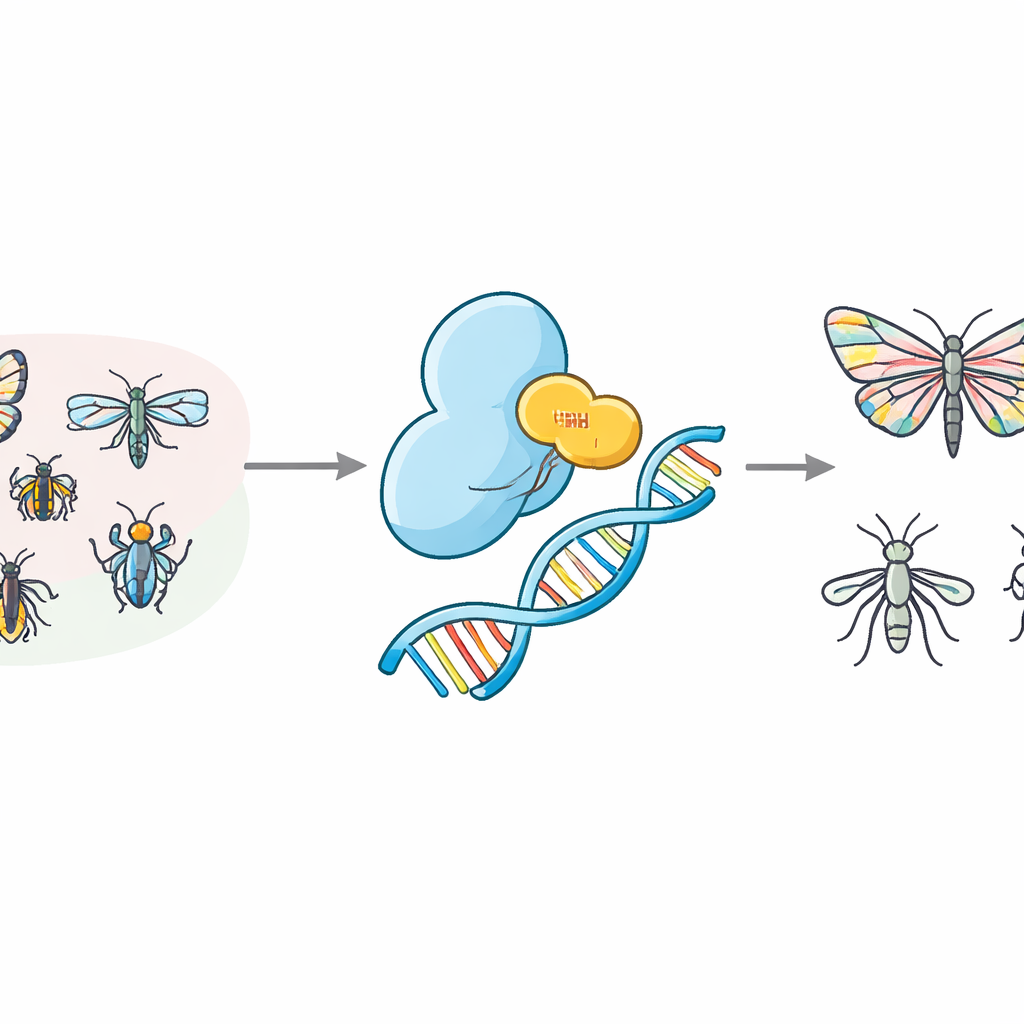
Insects shape our world, from pollinating crops to spreading disease, yet scientists still struggle to precisely rewrite their DNA, especially in species that are hard to rear or handle in the lab. This paper introduces a refined version of the CRISPR gene-editing tool that makes it much easier to add or remove specific genetic sequences in a wide range of insects, using simple injections into adults or embryos. By improving both the efficiency and practicality of gene editing, the work opens doors to studying insect biology, controlling pests, and developing new model species for research.
Why Editing Insect Genes Is So Tough
CRISPR-Cas9 has revolutionized genetics, but most insect experiments still rely on delicate injections into early embryos. That approach demands specialized equipment, carefully timed egg collections, and considerable skill, and often works only in a handful of well-studied species. A newer method called adult injection bypasses some of these hurdles: researchers can inject ready-made Cas9 protein and guide RNA into adult females, and the edits appear in their offspring. While this shortcut works well for knocking genes out—disrupting them by introducing small DNA breaks—it has been much less effective for the more demanding task of knocking genes in, which requires inserting new DNA sequences at precise locations.
A Small Protein Tag With a Big Impact
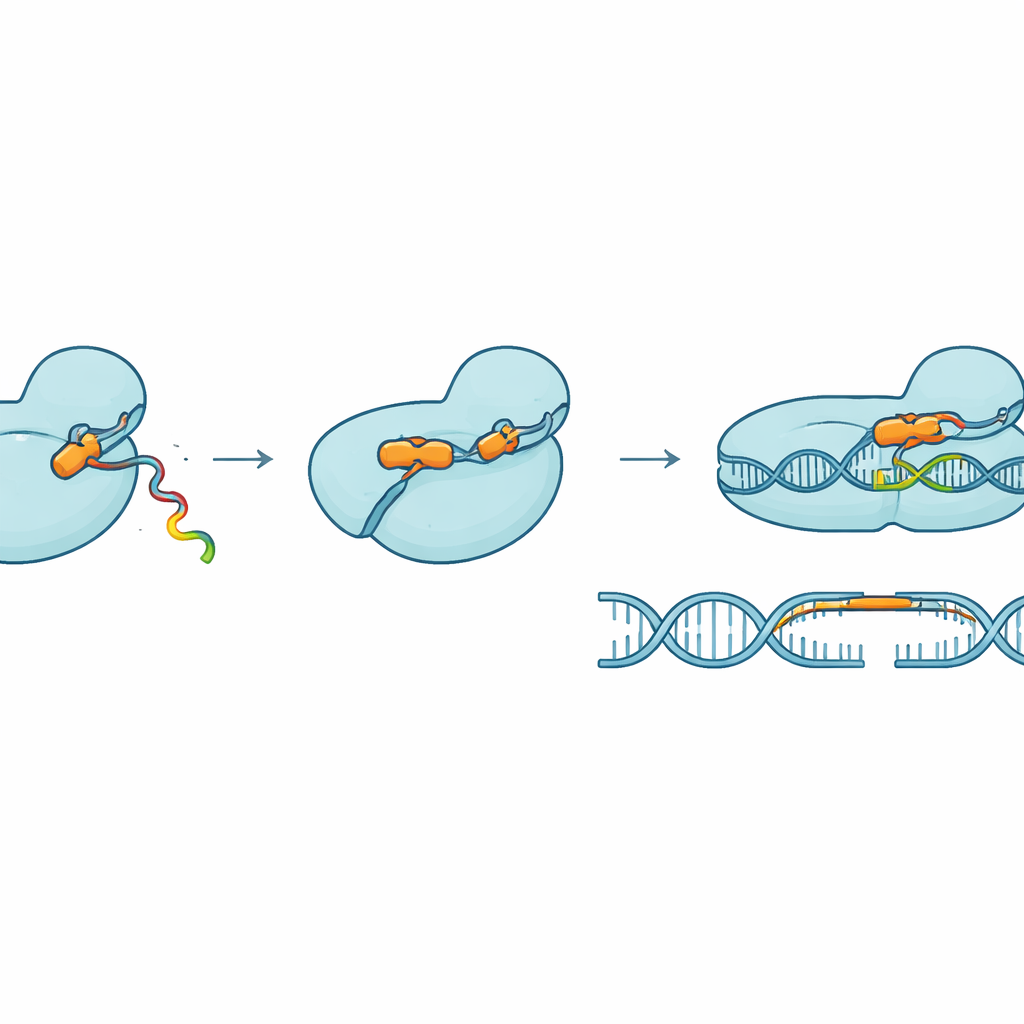
The authors set out to boost this precision step by physically tethering the repair DNA to Cas9, so that when Cas9 cuts the genome, the correct template is already in place. They used a protein fragment known as a HUH-tag, derived from a virus protein called PCV Rep, which naturally forms a covalent bond with single-stranded DNA that carries a short recognition sequence. By fusing this PCV-tag to Cas9, and adding a 13-letter recognition segment to the repair DNA molecules (short single-stranded oligos), they created a Cas9 complex that drags its repair template directly to the break site. To make this fusion protein easier to produce and purify, they also attached a SUMO tag that improves solubility, and they carefully refined a three-step purification protocol to obtain highly active protein.
Stronger Editing in Beetles, Crickets, and Bugs
Testing their engineered Cas9 in the red flour beetle, the team found that the PCV-tag fusion not only worked, but surprisingly boosted even basic gene knockout efficiency up to fivefold compared with untagged Cas9. Follow-up experiments in insect cell cultures revealed why: the PCV-tag carries built-in signals that draw Cas9 into the nucleus, where the DNA resides, increasing the chances of successful editing. When they used tethered repair DNA in adult beetles, the rate of precise “knock-in” of a tiny marker sequence into an eye-color gene rose about two- to threefold, and many edited animals carried a high fraction of the desired allele in their cells.
Zooming In on Precise DNA Add-Ins
The team then asked whether the same strategy would help in more conventional embryo injections, using two distantly related insects: the two-spotted cricket and the milkweed bug. In crickets, they aimed to add a small epitope tag—a short protein sequence that can be recognized by antibodies—to a gene essential for metamorphosis. With commercial Cas9, only about one in nine embryos carried the correct insertion at both junctions. With the SUMO-PCV-Cas9 fusion and tethered repair oligos, this jumped to nearly two in five, and some animals carried only the precise knock-in sequence with no detectable byproducts. In milkweed bugs, they used a similar strategy to tag a gene involved in gonad development, obtaining roughly double the knock-in efficiency of standard Cas9 and successfully passing the edited allele to the next generation. Microscopy confirmed that the tagged protein appeared in the same tissues where the gene is normally active, showing that the edits were both precise and functional.
What This Means for Future Insect Research
Together, these results show that attaching a HUH-tag to Cas9 provides a simple, broadly useful way to make insect genome editing more powerful and accessible. The tag helps pull Cas9 into the nucleus and lock repair DNA to the cutting enzyme, improving both gene knockouts and precise gene insertions with only minimal changes to existing protocols. Because the approach works in both adult and embryo injections, and requires only a short added sequence on the repair DNA, it can be adapted to many insect and arthropod species, from emerging lab models to agricultural pests and disease vectors. For non-specialists, the takeaway is that a small protein add-on has turned an already transformative gene-editing tool into a more precise and practical instrument for exploring—and potentially managing—the insect world.
Citation: Shirai, Y., Kao, J.A., Kumar, T. et al. HUH-tagged Cas9 as a platform for efficient ssODN-mediated knock-in via embryo and adult injection in insects. Commun Biol 9, 514 (2026). https://doi.org/10.1038/s42003-026-09777-7
Keywords: insect genome editing, CRISPR-Cas9, knock-in efficiency, HUH-tag PCV, adult injection methods