Clear Sky Science · en
Phasic and tonic arousal distinctly shape human decision bias
Why our moment-to-moment alertness matters
Even when we look at the same scene twice, we do not always make the same call about what we see. Sometimes we say “yes, I see it,” other times “no, I don’t,” even with identical evidence. This study asks why our decisions are so variable, and focuses on a subtle culprit: natural ups and downs in arousal, the brain’s state of alertness. By separating slow background arousal from brief bursts of arousal, the authors show that these two modes nudge our choices in different ways, helping explain why we can be cautious at one moment and bold the next.
Two kinds of alertness, two kinds of bias
Scientists have long suspected that arousal comes in at least two functionally distinct flavors. There is a steady baseline level (tonic arousal) and short, task-related bursts (phasic arousal). Both are driven by chemical messengers in the brain such as noradrenaline and acetylcholine. In people, these hidden shifts can be tracked indirectly through the pupil: larger pupils at rest reflect higher tonic arousal, while quick dilations around the time of a decision reflect phasic arousal. Earlier work hinted that these two regimes might affect how biased we are in our decisions, but the underlying brain processes and the roles of different chemical systems were still unclear.
Testing decisions under pressure
To probe this, 28 male volunteers performed a demanding yes/no task: they had to detect faint striped patterns (Gabor patches) hidden in flickering visual noise. In some blocks, being too cautious was punished: if they missed a target, they heard an unpleasant buzzer, encouraging a more liberal, “say yes” strategy. In other blocks, false alarms were punished instead, encouraging a more conservative, “say no” strategy. While they worked, the researchers recorded their pupil size and brain activity with EEG. On different days, the same participants also received a drug boosting catecholamines (atomoxetine), a drug boosting acetylcholine (donepezil), or a placebo, in a double-blind crossover design. This allowed the team to study both natural fluctuations in arousal and experimentally raised baseline arousal.
Slow changes push us toward “yes”
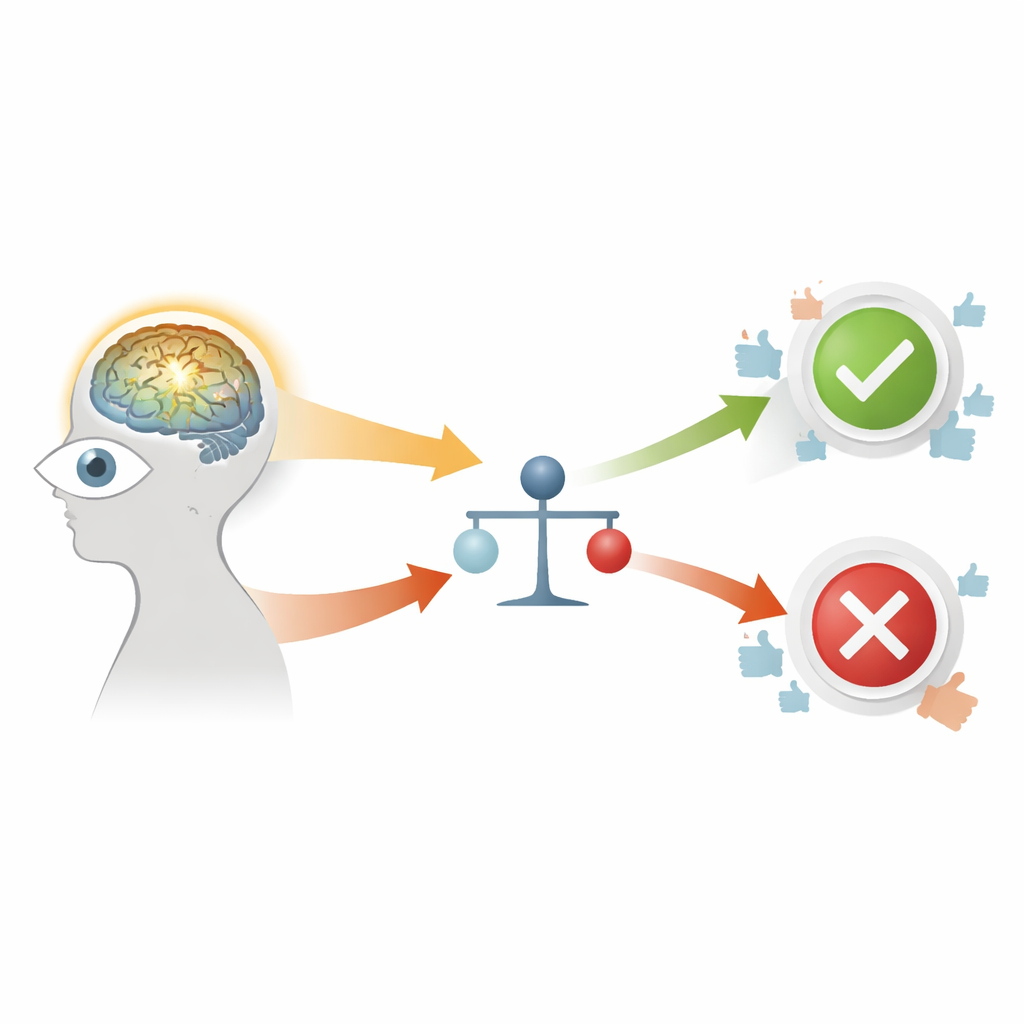
The first key finding concerns tonic arousal. When the average pupil was larger before a trial, people were more likely to say “yes,” regardless of whether the task context currently favored liberal or conservative responding. In other words, high tonic arousal was linked to an inherent, context-independent tendency to endorse the presence of a signal. Modeling their behavior with a signal detection framework confirmed that higher tonic arousal corresponded to a lower decision criterion—a shift toward more liberal decision-making—without reliably changing how sensitive they were to the actual visual evidence. Pharmacological boosts of catecholamines and acetylcholine showed trends in the same direction: more “yes” choices overall, but no strong change in how well participants could tell signal from noise.
Fast bursts flatten strategic bias
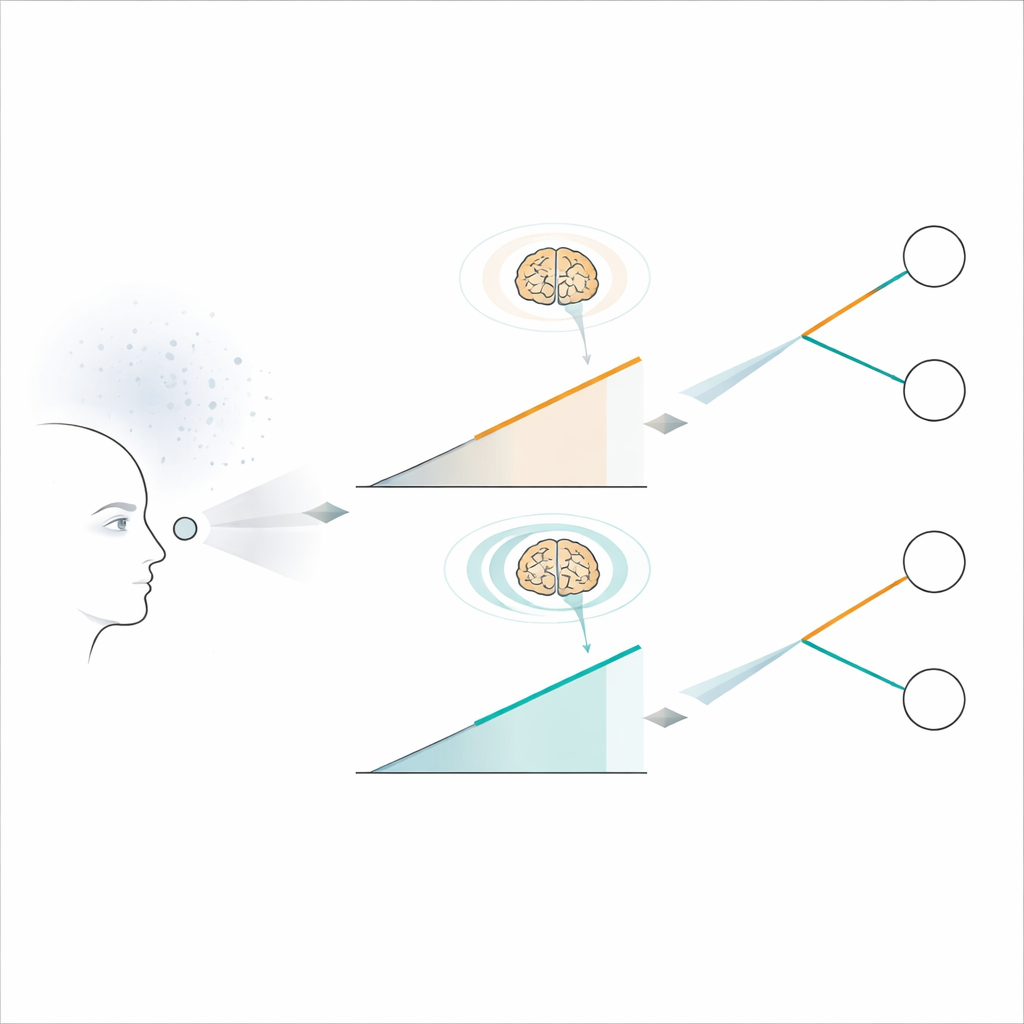
Phasic arousal told a different story. Brief pupil dilations locked to the response were largest on trials that went against the currently encouraged bias: “yes” responses during conservative blocks and “no” responses during liberal blocks. Unlike tonic arousal, these bursts were not tied to an overall tendency toward “yes,” but instead signaled a momentary reduction of strategic bias. Detailed computational modeling of the decision process showed how this works. Strategic bias in the task was mainly implemented as a “head start” in the decision process—a bias in the starting point of evidence accumulation toward the favored response. High phasic arousal selectively weakened this starting-point bias, bringing the initial state closer to neutral and making behavior less tilted by the current punishment scheme. EEG recordings backed this up: preparatory activity over motor cortex, favoring the more likely response before the stimulus even appeared, was clearly seen when bias was strong but shrank on trials with strong phasic pupil responses.
What changes—and what stays stable—in the brain
The authors also checked whether the bias manipulation altered early sensory processing of the visual patterns or general brain rhythms over frontal and occipital areas. Using a separate “localizer” task and machine-learning classifiers trained on EEG, they found that conservative settings sharpened the fidelity of sensory representations (higher sensitivity) but did not shift those neural representations toward one decision or the other. Likewise, they did not find reliable bias-related changes in classic markers such as frontal theta or occipital alpha power. Instead, the clearest neural signature of strategic bias lay in low-frequency, lateralized activity over motor regions that prepared the hand associated with the currently favored response—activity that phasic arousal transiently dampened.
How brain state shapes everyday choices
Taken together, the study paints a nuanced picture of how brain state shapes our decisions. Slow, baseline arousal gently tilts us toward saying “yes” more often, independently of the rules or incentives of the moment. In contrast, fast arousal bursts that occur around a decision help us escape from context-induced habits by temporarily neutralizing a built-in “head start” for the favored choice. For everyday life, this means that our fluctuating alertness is not just about being awake or drowsy; it continuously and differentially shapes whether we lean into or resist our current biases when facing ambiguous evidence.
Citation: Nuiten, S.A., De Gee, J.W., Zantvoord, J.B. et al. Phasic and tonic arousal distinctly shape human decision bias. Commun Biol 9, 553 (2026). https://doi.org/10.1038/s42003-026-09776-8
Keywords: arousal, decision bias, pupillometry, neuromodulators, visual detection