Clear Sky Science · en
iAODE for benchmarking and continuum modeling of single-cell chromatin accessibility
Following the Lives of Individual Cells
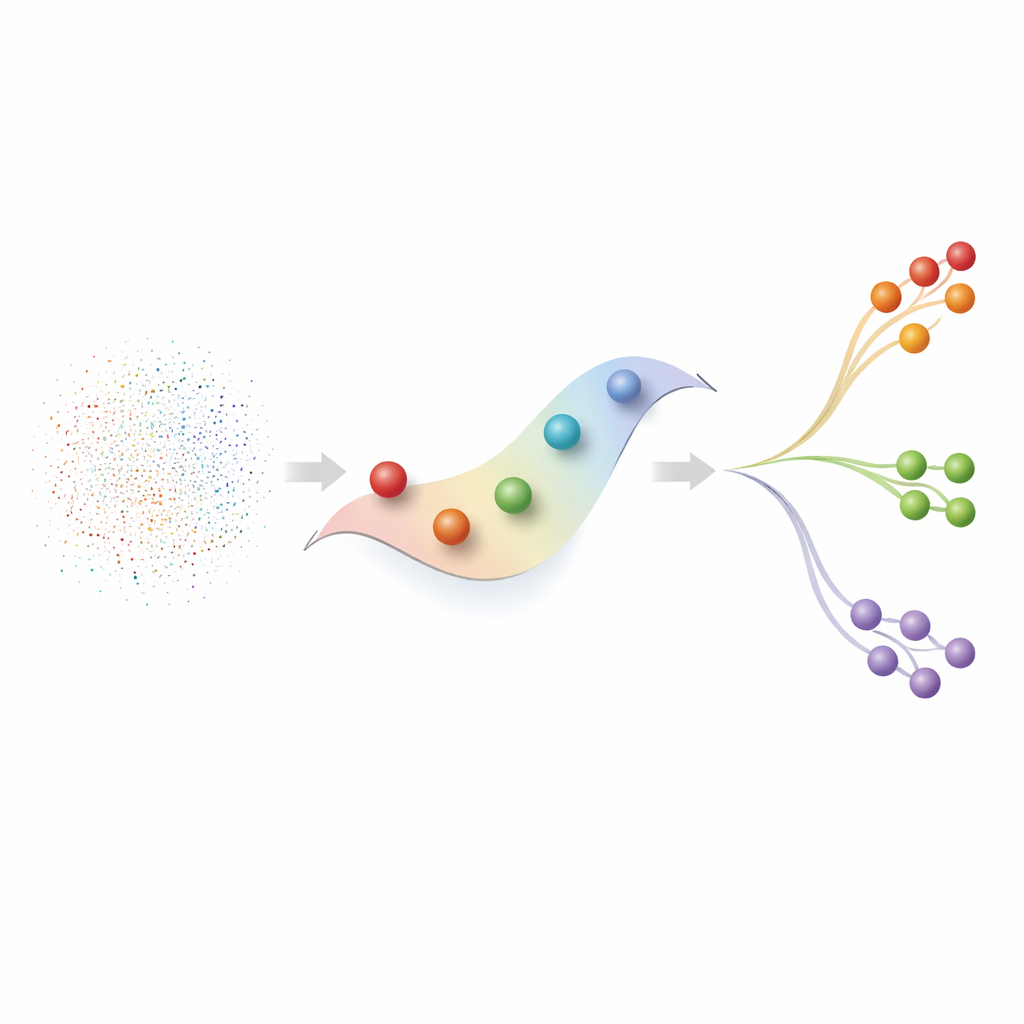
Our bodies are made of trillions of cells constantly changing as we grow, heal, and age. Modern single-cell sequencing can freeze these cells in time and read which parts of their DNA are exposed and active. But these snapshots are noisy and incomplete, making it hard to see the continuous journeys cells take as they mature or change fate. This paper introduces a new computational framework, called iAODE, that turns those scattered snapshots into smooth "movies" of cellular change and provides a rigorous way to judge how well different methods recover such cellular storylines.
Why Chromatin Openness Matters
Genes are switched on and off not just by their sequences, but by whether the surrounding DNA is open and accessible. A technique called single-cell ATAC-seq measures these open regions cell by cell. However, the resulting data are extremely sparse: most positions look like zeros, either because the DNA is truly closed or simply wasn’t captured. Existing tools usually compress this data into a low-dimensional map and then, as a separate step, try to reconstruct developmental paths by ordering cells along pseudo-time. That separation means models are not explicitly trained to respect smooth temporal change, and it is unclear which types of internal representations are best for recovering real biological trajectories.
A New Way to Learn Continuous Cell Journeys
iAODE rethinks this pipeline by building continuity into the heart of the model. It starts from a popular deep-learning framework (a variational autoencoder) that learns a compact "latent" space capturing essential patterns in the data. On top of this, the authors add a neural ordinary differential equation (Neural ODE), which treats each cell’s position in this latent space as a point along a smooth path through time. The encoder not only compresses the data but also predicts a relative time for each cell, while the ODE component learns how latent states flow from earlier to later positions. Two further design choices—weakening a standard penalty that forces latent dimensions to behave independently, and adding a compressed reconstruction bottleneck—encourage groups of features to vary together in biologically meaningful modules and help filter out noise.
Building a Fair Playground for Comparison
To evaluate iAODE and its design choices, the authors assemble one of the largest standardized benchmark collections for this field: 248 single-cell chromatin accessibility datasets and 123 single-cell RNA datasets, spanning multiple species, technologies, and sizes. They also design a suite of 20 metrics that separately measure three aspects: how continuous and well-shaped the latent trajectories are, how faithfully structure is preserved when projected for visualization, and how well clusters and regulatory couplings are captured. By first testing these metrics on carefully simulated data with known trajectories, they show that the scores change smoothly and predictably as continuity is dialed up or down—an essential sanity check before applying them to real biology.
What the Benchmarks Reveal
Armed with this playground, the team systematically dissects iAODE. Turning individual components on and off shows that the ODE piece mainly provides a global backbone and clear directionality of change, while the low-penalty regularization and bottleneck sharpen geometry and make the model more resilient to noise. Across hundreds of chromatin datasets, the full iAODE model consistently produces smoother, more robust trajectories than established deep generative methods such as scVI, PeakVI, and an earlier ODE-based tool, as well as traditional techniques like principal component analysis and diffusion maps. The same pattern holds when the framework is applied to single-cell RNA data, suggesting that its core ideas generalize beyond chromatin. Visual examples from brain and blood cell datasets show that iAODE’s latent axes align with known marker genes and regulatory regions, and that groups of latent features are enriched for expected biological processes, indicating that the learned trajectories are not only smooth but interpretable.
Why This Matters for Understanding Cell Fate
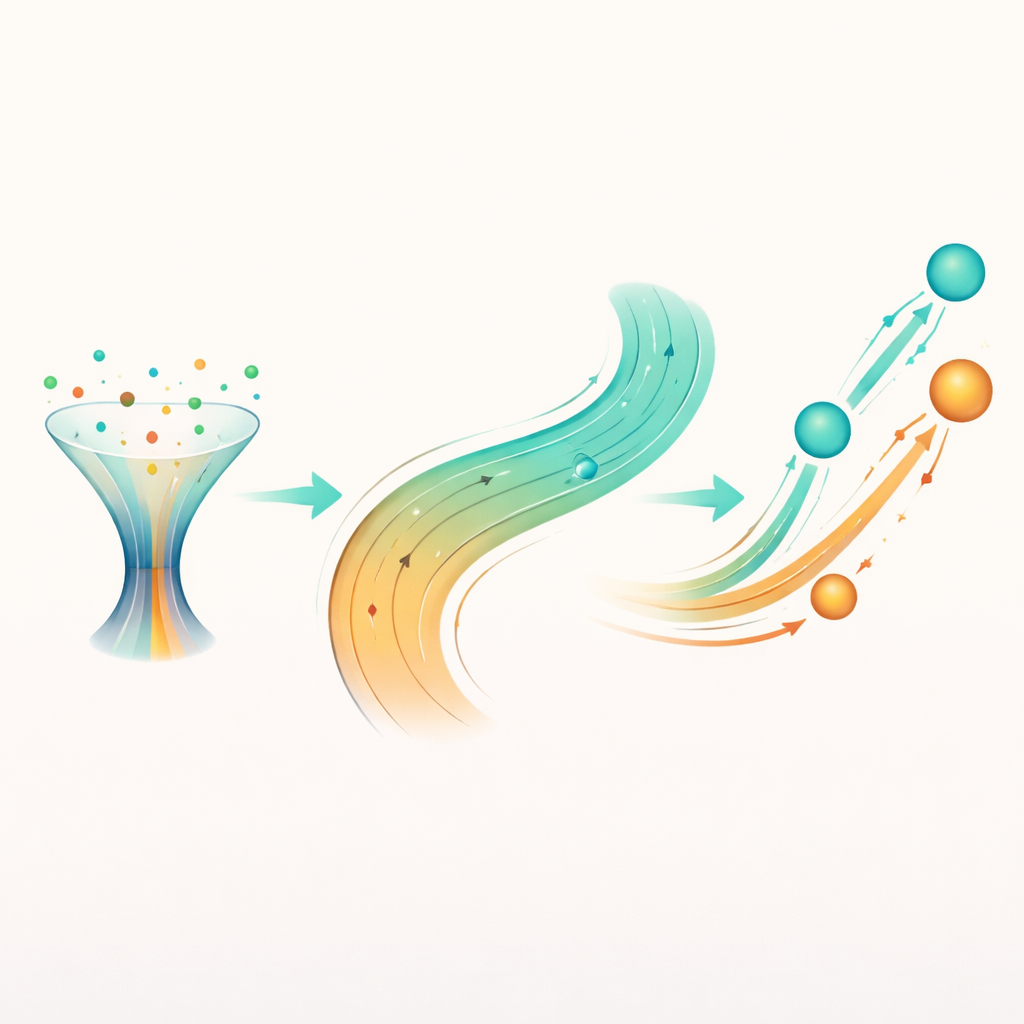
In essence, this work argues that continuity in cellular development should be treated as a design principle, not an afterthought. By weaving a smooth dynamical model into the representation step and carefully relaxing constraints that would otherwise break apart coordinated signals, iAODE delivers latent spaces where cell states form flowing paths rather than disjoint clusters. The accompanying benchmark datasets and metrics give the community a common yardstick for comparing methods that aim to reconstruct such paths. For researchers, this means more reliable maps of how cells progress through development, immune responses, or disease, and a clearer way to connect these paths to underlying regulatory programs encoded in the genome.
Citation: Fu, Z., Chen, C., Wang, S. et al. iAODE for benchmarking and continuum modeling of single-cell chromatin accessibility. Commun Biol 9, 507 (2026). https://doi.org/10.1038/s42003-026-09768-8
Keywords: single-cell genomics, chromatin accessibility, cell trajectory modeling, deep generative models, Neural ODE