Clear Sky Science · en
Single-nucleus RNA sequencing provides insights into the genetic mechanisms underlying reproductive adaptability in Tibetan sheep (Ovis aries)
Life at the Roof of the World
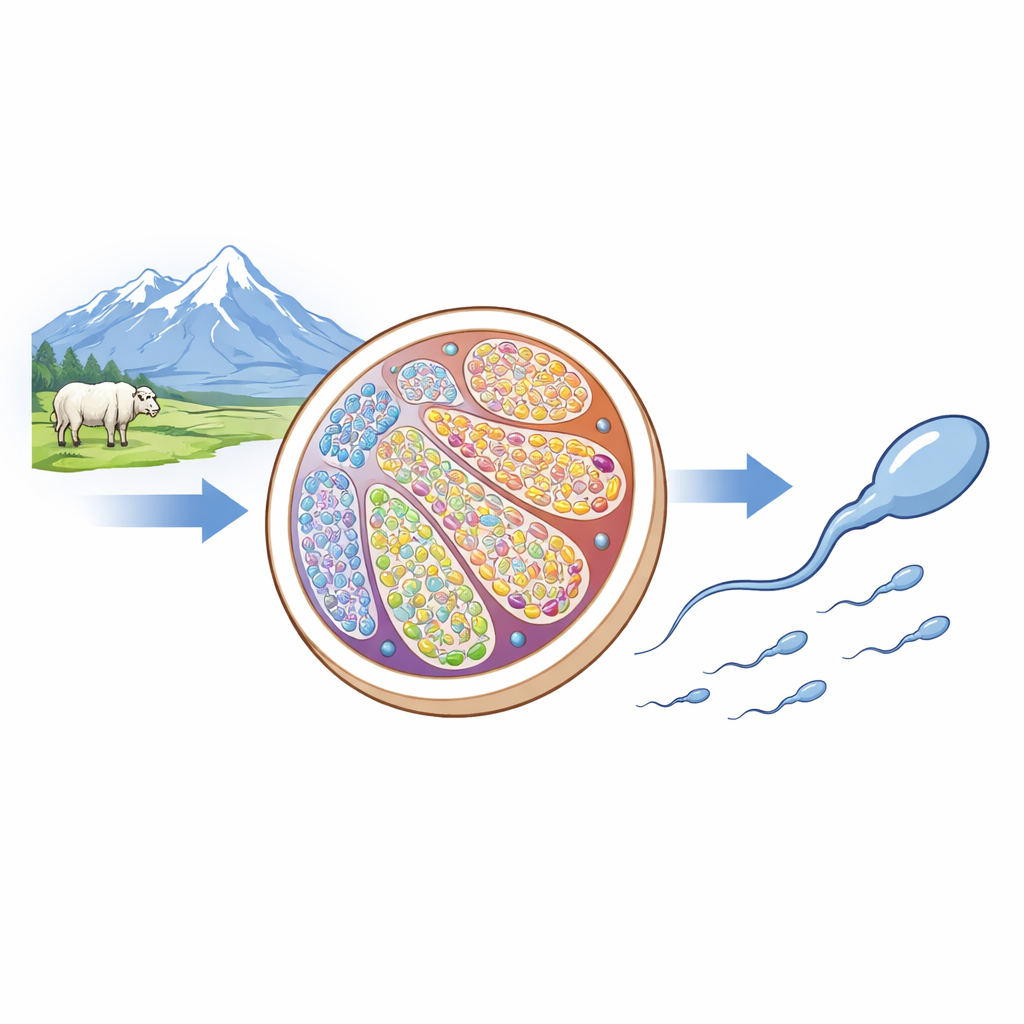
The Tibetan Plateau is one of the toughest places on Earth to raise animals: the air is thin, the cold is biting, and food can be scarce. Yet Tibetan sheep not only survive there, they reproduce—albeit slowly—under conditions that would challenge most livestock. This study asks a deceptively simple question with big implications for herders and biologists alike: how do the testes of Tibetan sheep develop from birth to adulthood in such an extreme environment, and what hidden genetic programs allow them to adapt their fertility to life at high altitude?
Peering Inside a Complex Organ
The testis is a miniature factory where many kinds of cells work together to turn stem cells into mature sperm. The authors used a powerful method called single-nucleus RNA sequencing, which reads out which genes are active inside tens of thousands of individual cell nuclei. They collected testes from Tibetan rams at four key ages, from newborns to fully mature adults, and built a detailed cell “atlas” showing which cell types are present at each stage and what those cells are doing. In total, they identified 21 distinct clusters of cells, covering all major germ cells that become sperm and six types of supporting somatic cells that create the sperm-producing environment.
Following Stem Cells Along Their Journey
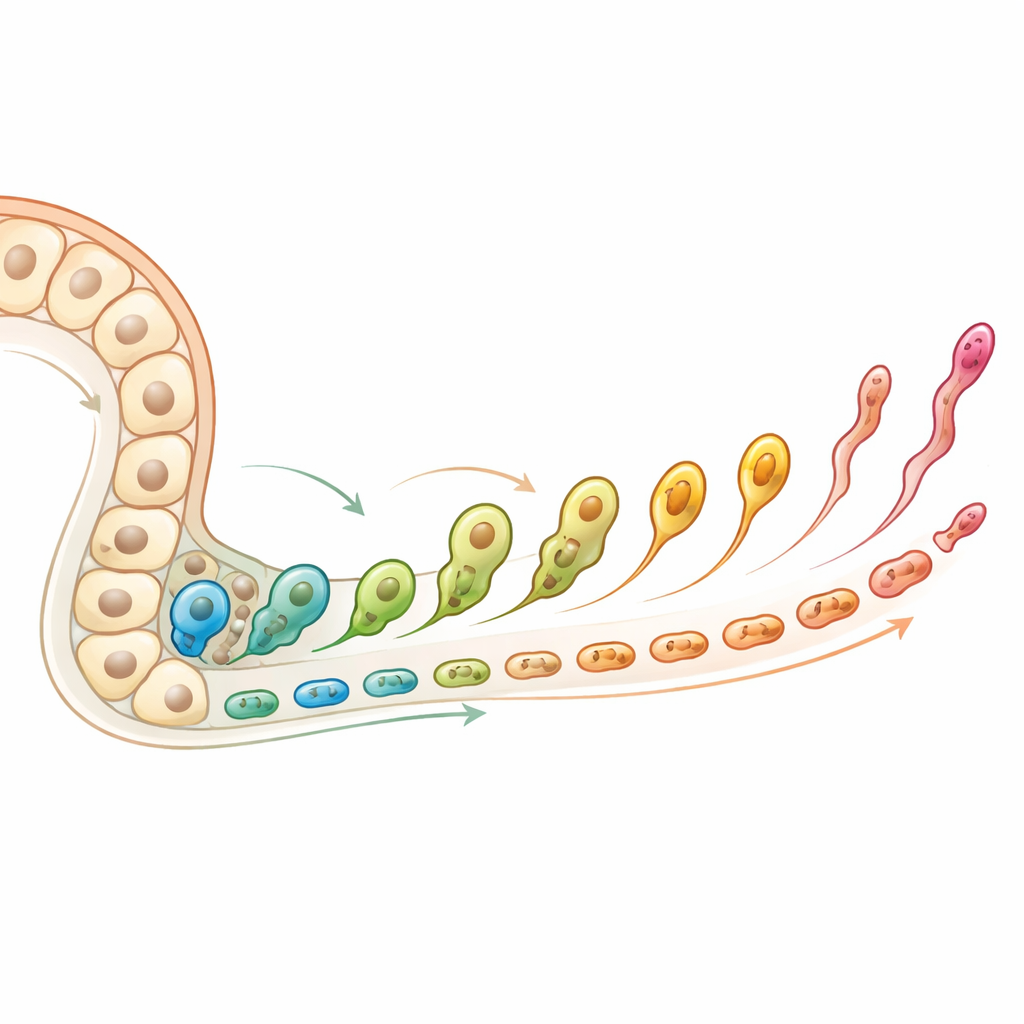
A central focus was the population of spermatogonial stem cells, the renewable seed stock for sperm production. The researchers discovered that these stem cells are not a single uniform group. Instead, they fall into two main states: a quiescent state that divides rarely and an active state that divides more often and begins to resemble progenitor cells. By ordering cells along a developmental “pseudotime” axis, the team traced how stem cells progress into progenitors and then into differentiating spermatogonia, spermatocytes undergoing meiosis, and finally spermatids that mature into sperm. Along this path, the cells switch their energy strategy: early stem-like cells rely more on glycolysis (a sugar-burning pathway suited to low oxygen), while later-stage cells increasingly use oxygen-dependent mitochondrial respiration. This metabolic shift echoes how many stem cells in the body balance survival in low-oxygen niches with the demands of differentiation.
How Support Cells Grow Up
Sertoli cells, often described as “nurse” cells, build the microenvironment where sperm develop and help form the blood–testis barrier that shields germ cells from the immune system. Previous work in other mammals mainly split Sertoli cells into immature and mature stages. In Tibetan sheep, the authors uncovered a richer story: three distinct immature states, a transitional state that bridges youth and adulthood, and a mature state that dominates after sexual maturity. As Sertoli cells mature, their gene activity shifts toward stronger energy production, cytoskeletal remodeling, waste clearance, and innate immune defense. Intriguingly, some Sertoli cells contain messenger RNAs normally associated with late-stage sperm, likely because they engulf residual sperm material; these lingering messages may hint at subtle cross-talk between dying germ cells and their caregivers.
Conversations Between Cells
Producing sperm in a harsh environment requires many cells to “talk” to one another. By analyzing known ligand–receptor pairs—molecular handshakes between cells—the study maps a dense communication network across the testis. Sertoli cells emerge as major hubs, physically anchoring germ cells and sending chemical signals that guide stem cell maintenance, entry into meiosis, and maturation. Other support cells, such as Leydig cells and immune cells, contribute pathways involved in growth factors, adhesion proteins, and immune regulation. Some of these signaling patterns resemble those seen in other mammals, but others appear rewired in Tibetan sheep, suggesting species-specific adjustments that may help maintain sperm production under chronic hypoxia and cold stress.
Why This Matters
For non-specialists, the take-home message is that fertility in Tibetan sheep is not just a matter of whether sperm are present, but of how a whole ecosystem of cell types grows up and cooperates over time. This study charts that ecosystem in unprecedented molecular detail, showing how stem cells balance rest and activity, how support cells gradually assume their protective roles, and how metabolic and signaling switches guide each step from birth to adult fertility. These insights offer a scientific foundation for improving breeding strategies in high-altitude flocks and provide a blueprint for studying reproductive adaptation in other livestock that face the challenges of thin air and extreme climates.
Citation: Wang, Hh., Li, Tt., Li, Dp. et al. Single-nucleus RNA sequencing provides insights into the genetic mechanisms underlying reproductive adaptability in Tibetan sheep (Ovis aries). Commun Biol 9, 452 (2026). https://doi.org/10.1038/s42003-026-09729-1
Keywords: Tibetan sheep reproduction, spermatogonial stem cells, single nucleus RNA sequencing, Sertoli cell maturation, high-altitude adaptation