Clear Sky Science · en
Deep learning-based precision phenotyping of spine curvature identifies novel genetic risk loci for scoliosis in the UK Biobank
Why spine shape matters
Scoliosis, a sideways curve of the spine, can lead to pain, fractures, and reduced quality of life, yet many people with meaningful curvature never receive a diagnosis. This study shows how modern computer vision and genetics can work together to spot spine problems earlier and reveal the DNA variants that quietly influence how our spines bend as we age.
Looking for hidden curves
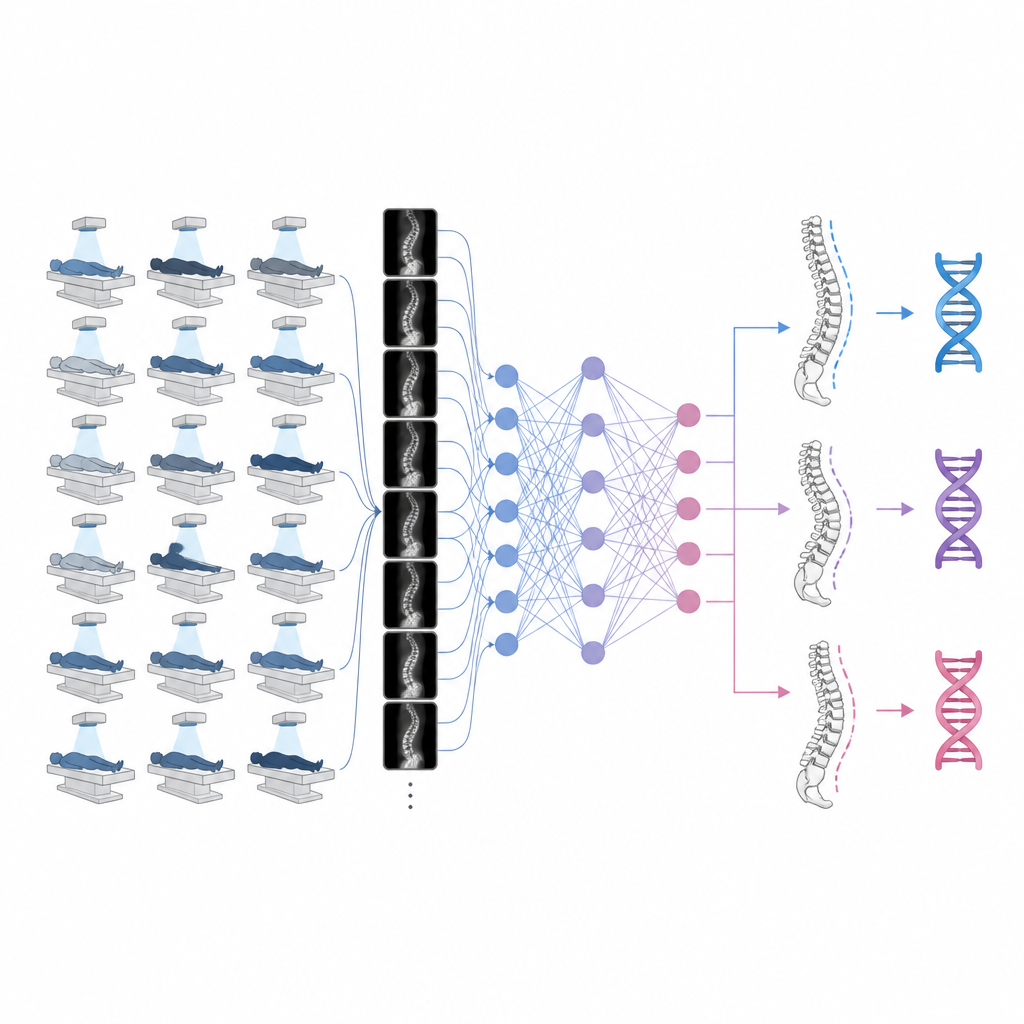
Doctors usually judge scoliosis using the Cobb angle, a measurement taken from upright X rays that classifies people as having scoliosis or not. Large population biobanks, however, tend to hold billing codes rather than detailed measurements, and those codes mostly capture only the most severe cases. The authors turned instead to full body bone scans from more than 57,000 adults in the UK Biobank. These scans, taken while participants lay on their backs, contain a clear silhouette of the spine, offering a chance to measure curvature continuously in everyone, not just in patients who happened to be labeled with scoliosis in their medical records.
Teaching computers to trace the spine
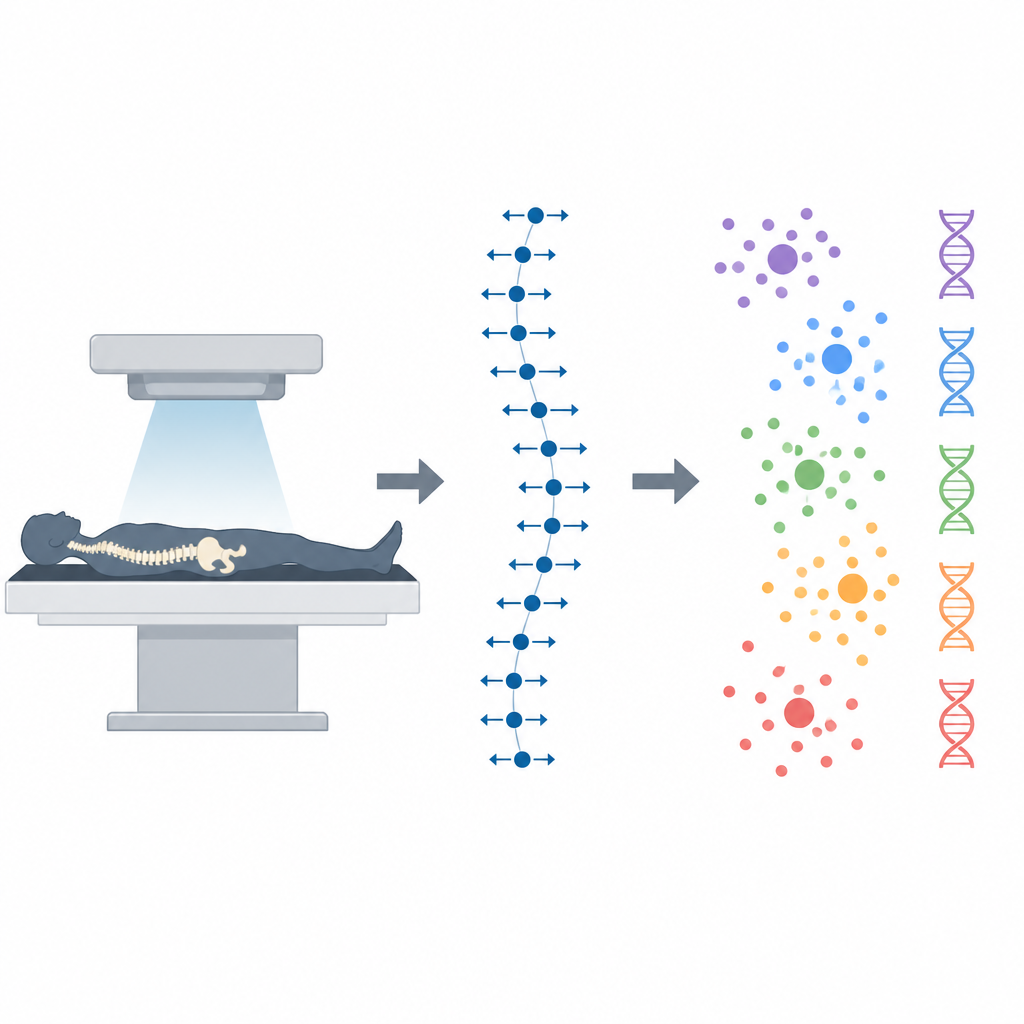
Using a small set of carefully hand labeled images, the team trained a deep learning model to find and outline each person’s spine on their scan. The model, based on a popular medical imaging architecture, learned to separate the bright spine from the rest of the body with 99 percent pixel level accuracy. For every segmented spine, the researchers placed 20 evenly spaced points along its length, rotated the spine so that its ends lined up vertically, and then summed how far each point shifted left or right from one step to the next. This produced a simple, continuous number for each person that captured how much their spine wandered sideways, in millimeters, from top to bottom.
Checking that the new measure makes sense
To be useful, this automated curvature score needed to track established clinical measures and real world outcomes. In a set of 150 people, the score closely matched Cobb angle readings made by orthopedic surgeons, with a strong positive correlation. People whose Cobb angle met the typical scoliosis cutoff had much larger curvature scores than those below it, and those with a scoliosis diagnosis code in their records also showed higher curvature on average. Curvature tended to rise steadily with age, fitting with the idea that wear and tear and bone loss can gradually bend the spine. Using thresholds derived from diagnosed cases and Cobb angles, the team estimated that thousands of UK Biobank participants likely have clinically important curvature that never appears in their medical coding.
Connecting spine shape to DNA
Armed with these curvature scores, the researchers scanned the genomes of white British participants for common variants linked to how curved their spines were. They found three regions of the genome that passed strict statistical tests. One sits near PAX1, a gene already tied to adolescent scoliosis and vertebral development, and showed a stronger effect in women than in men, echoing earlier work on female biased scoliosis risk. Two other regions had not been reported in scoliosis before: one near genes involved in limb and bone development, and another overlapping a long noncoding RNA between genes linked to protein quality control and spine related inflammation. Overall, the image based study detected genome wide signals where a traditional case control study using only diagnosis codes in the same resource did not.
Spine curves and the rest of the body
The team also asked how curvature relates to other traits in the same people. Higher curvature was associated with more back pain, lower spine bone density, weaker hand grip, more leg length differences, and a higher chance of osteoporosis, spinal fractures, and spondylosis, even after accounting for age, body size, and lifestyle factors. In contrast, knee and hip osteoarthritis showed little relationship to spinal bending in this group. These patterns support a picture in which side to side curvature in older adults is intertwined with broader age related changes in muscle, bone, and posture, rather than being an isolated problem.
What this means for future care
By turning routine spine images into precise, automated measurements, this work shows how deep learning can expose the genetic and physical roots of conditions that medicine often records only in broad strokes. The new curvature measure uncovers many people whose spines are as curved as diagnosed patients yet lack a formal label, and it highlights genetic regions that may be especially important for age related or degenerative forms of scoliosis. While more studies are needed to confirm the roles of these genes and to extend the approach to more diverse populations, the study points toward a future in which subtle changes in medical images help flag at risk individuals earlier and guide research into how and why our spines change shape over a lifetime.
Citation: Zeosky, M., Kun, E., Reddy, S. et al. Deep learning-based precision phenotyping of spine curvature identifies novel genetic risk loci for scoliosis in the UK Biobank. npj Digit. Med. 9, 381 (2026). https://doi.org/10.1038/s41746-026-02540-6
Keywords: scoliosis, spine curvature, deep learning, genetic risk, UK Biobank