Clear Sky Science · en
Complex magnetic exchange, anisotropy and skyrmionic textures in 2D ferromagnets with transition metals and chalcogens
Why tiny magnetic swirls matter
Modern electronics shuffles electric charge; the next generation aims to control the spin of electrons as well. This paper explores a new family of ultra-thin crystals that could host tiny, whirlpool-like magnetic patterns called skyrmions—exotic structures that may store information far more efficiently than today’s memory chips. By understanding how magnetism works in these sheets only one atom thick, the authors chart a path toward smaller, faster, and more energy‑saving spin-based devices.
Peeling magnets down to a single layer
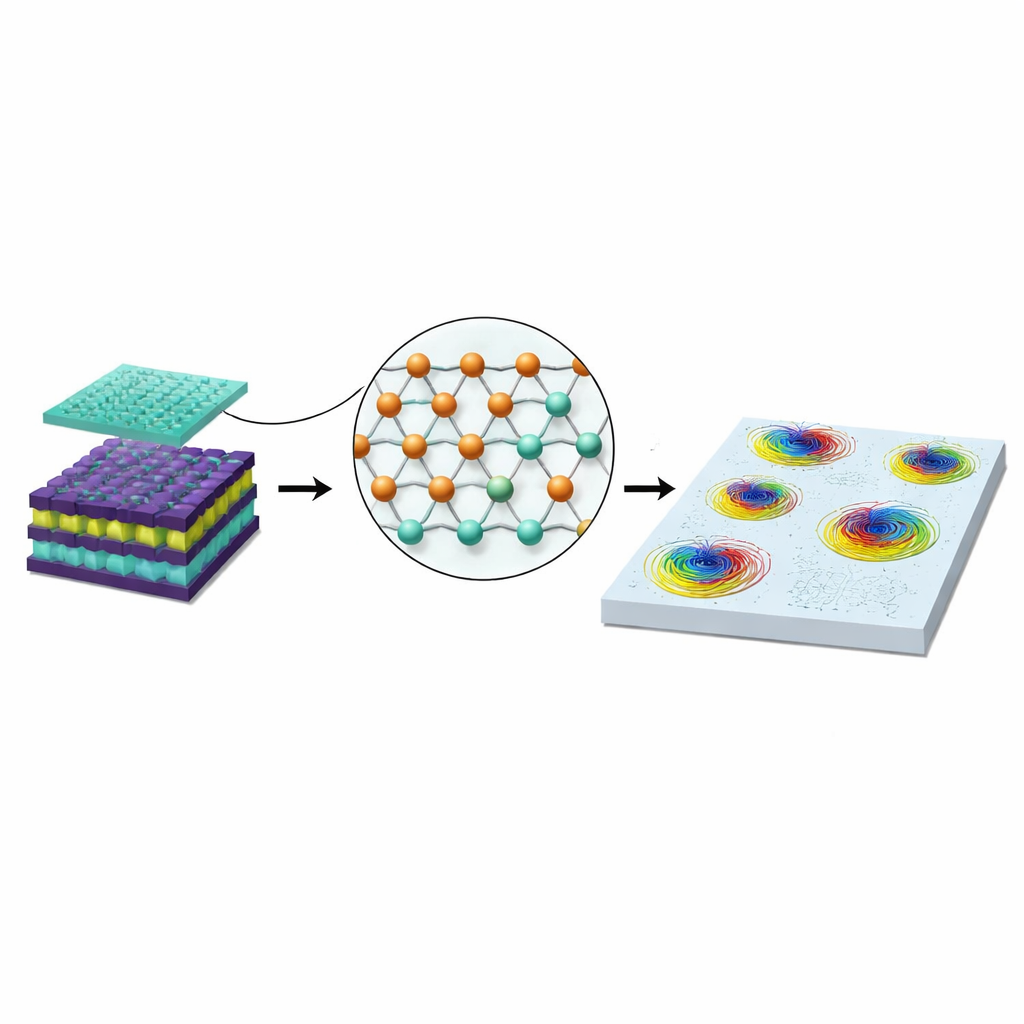
The study focuses on metallic crystals with the formula FeXZ2, where iron (Fe) is combined with niobium or tantalum (X = Nb, Ta) and a chalcogen element such as sulfur, selenium, or tellurium (Z = S, Se, Te). One member of this family, FeNbTe2, was recently made and shown to be ferromagnetic, meaning its atomic magnets line up in the same direction. The authors use advanced quantum calculations to ask: if you peel these materials down to a single atomic layer, will the sheet remain stable and magnetic? Their simulations show that monolayers of all studied compounds are not only energetically favorable, but also dynamically, thermally, and mechanically robust. The bonds in the layers are strong, vibrations do not destabilize the structure, and the sheets survive simulated heating well above room temperature.
How atoms arrange and talk to each other
In these monolayers, iron atoms sit in pairs embedded in a framework built from the other elements. The researchers analyze how electrons are shared and transferred between atoms, finding metallic bonding between the iron pairs and more covalent bonds between niobium or tantalum and the chalcogens. They quantify how tightly the atoms bind and compare their energies to known two‑dimensional magnets, concluding that the FeXZ2 family should be experimentally accessible. An extensive structural search over hundreds of possible two‑dimensional arrangements reveals that a slightly skewed, monoclinic pattern is the most favorable—closely matching the structure observed in bulk FeNbTe2 and suggesting that exfoliation down to a single layer should preserve the same basic architecture.
Unusual directions for magnetism
With the atomic scaffolding established, the authors probe the magnetic ground state. Across all compounds, the lowest‑energy state is ferromagnetic: the iron spins prefer to align. But the story is more intricate than simple alignment. The strength of interaction between neighboring spins is dominated by direct iron–iron coupling at very short distances, while more distant neighbors communicate indirectly through the chalcogen atoms. Surprisingly, these weaker, second‑neighbor links largely control the temperature at which magnetism disappears. Classical simulations indicate that the monolayer magnets lose their order below room temperature, at tens to hundreds of kelvin—comparable to other well‑known two‑dimensional magnets. Crucially for devices, these materials exhibit strong magnetic anisotropy: they strongly prefer spins to point along particular directions. Even more striking, in many cases the “easy” direction is tilted away from the usual straight-up or in‑plane orientations, producing a canted axis that could allow magnetic bits to be switched without needing an external magnetic field.
Twisted magnets and tiny whirlpools
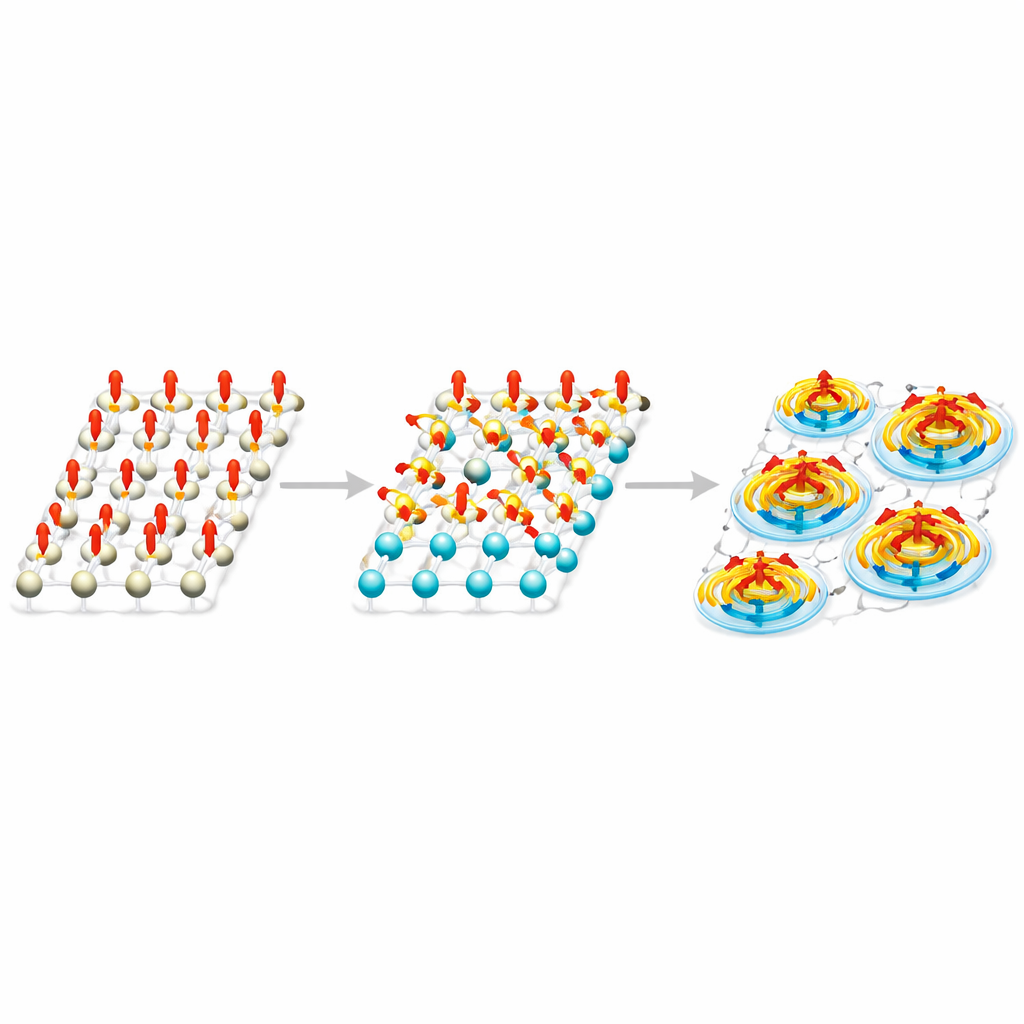
The work then zooms in on special “Janus” versions of the monolayers, where the top and bottom chalcogen layers are made of different elements (for example, one side selenium, the other tellurium). This top–bottom asymmetry breaks inversion symmetry and turns on a subtle interaction that favors twisting between neighboring spins. When combined with the usual tendency toward alignment and the built‑in anisotropy, this twist-promoting interaction can stabilize skyrmions—nanoscale swirls where spins wrap from pointing down at the center to up at the edges. By translating their microscopic calculations into effective continuum parameters and feeding them into micromagnetic simulations, the authors find that Janus FeNbSeTe in particular can host stable Néel‑type skyrmions even with no external magnetic field applied. These whirls are only about 8–9 nanometers across and survive up to roughly 45 kelvin in the simulations.
From theory to future spin‑based devices
For non‑experts, the main takeaway is that this family of iron‑based two‑dimensional materials checks several crucial boxes at once: their single layers are structurally sound, they are ferromagnetic, they have unusually strong and tilted preferred directions for their magnetic moments, and certain asymmetric variants naturally support tiny, robust magnetic whirlpools without the need for an applied field. While their operating temperatures are still below room temperature, the results suggest clear routes—such as chemical tuning or strain—to push their performance higher. In the long run, such materials could underpin memory and logic devices that write and move information by sliding skyrmions around instead of shuttling electric charge, potentially cutting energy use and enabling far denser data storage.
Citation: Ershadrad, S., Machacova, N., Mukherjee, A. et al. Complex magnetic exchange, anisotropy and skyrmionic textures in 2D ferromagnets with transition metals and chalcogens. npj 2D Mater Appl 10, 46 (2026). https://doi.org/10.1038/s41699-026-00691-4
Keywords: 2D magnets, skyrmions, spintronics, Janus materials, magnetic anisotropy