Clear Sky Science · en
CBVB-nH complexes as prevalent defects in metal-organic vapor-phase epitaxy-grown hexagonal boron nitride
Lighting up a new quantum material
Hexagonal boron nitride—often called "white graphene"—is emerging as a key material for future quantum technologies, from ultra-secure communication to nanoscale sensors. Yet the light it emits does not come from a perfect crystal, but from tiny imperfections called defects. This paper explores a particularly important family of such flaws, made from carbon, missing boron atoms, and hydrogen, that seem to dominate in a widely used industrial growth method. Understanding these hidden structures helps explain puzzling emission lines in the visible range and offers a recipe for engineering quantum-ready boron nitride.
Why tiny flaws matter
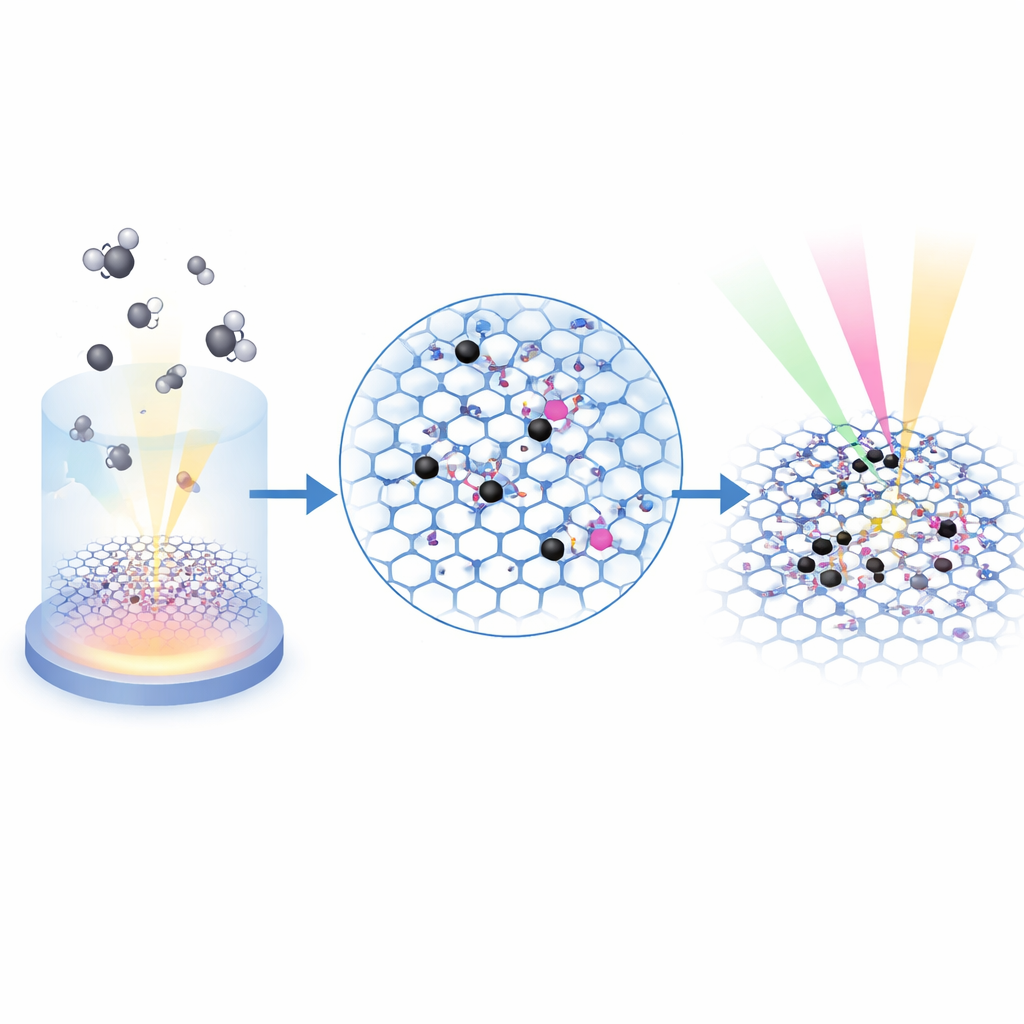
In many modern quantum devices, carefully chosen defects act as artificial atoms embedded in a solid, emitting single particles of light or hosting controllable spins. Hexagonal boron nitride (hBN) is especially attractive because it can be grown in large, uniform sheets and integrated with existing semiconductor technologies. But growing hBN by metal-organic vapor-phase epitaxy (MOVPE)—a standard wafer-scale process—inevitably introduces impurities and vacancies. Among them, combinations of carbon impurities, boron vacancies, and hydrogen atoms stand out as likely culprits behind strong visible emission around 2 electronvolts, a long-observed but incompletely understood feature in MOVPE-grown samples.
Building blocks of complex defects
The authors use advanced quantum-mechanical simulations to first examine simple defects: empty boron sites (boron vacancies), those same vacancies partially or fully saturated with hydrogen, isolated carbon atoms sitting on a boron site, and roaming hydrogen atoms in the spaces between. Under nitrogen-rich conditions—common in certain MOVPE recipes—these defects are energetically cheap to form, especially when hydrogen bonds to the nitrogen atoms around a missing boron. Hydrogen both passivates dangling bonds and alters the charge state of the vacancy, setting the stage for strong electrostatic attraction to positively charged carbon substitutions. Mobile hydrogen and vacancies at growth temperatures mean that these basic building blocks can readily move and interact.
Defect complexes that love to form
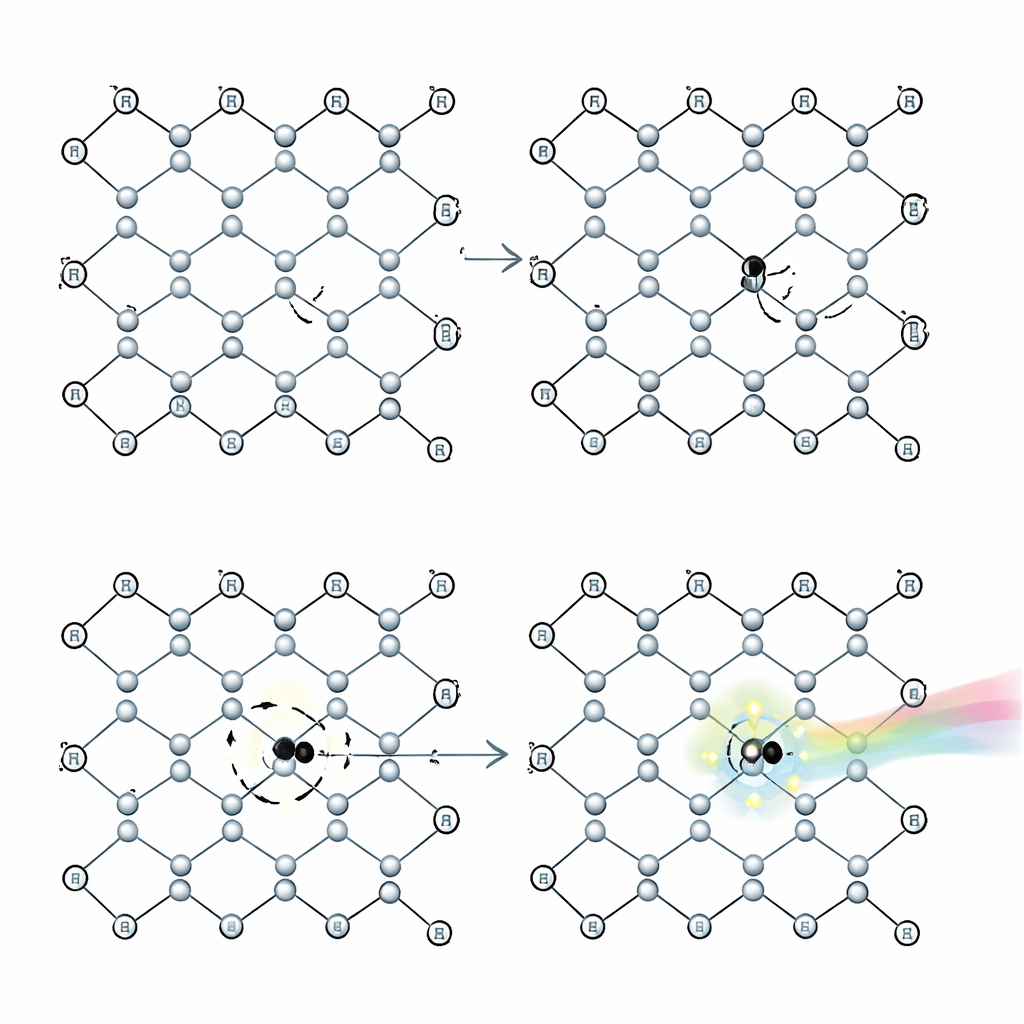
Next, the study focuses on composite defects in which a carbon atom on a boron site (CB) sits near a boron vacancy decorated with zero to three hydrogen atoms (VB–nH). These complexes, collectively called CBVB–nH, are found to have remarkably low formation energies and high binding energies when one or two hydrogens are present. The reason is simple but powerful: opposite charges attract. Positively charged carbon donors are drawn toward negatively charged hydrogen-passivated vacancies, and once they meet, the resulting complexes are energetically difficult to pull apart. Under MOVPE conditions—where carbon and hydrogen are supplied in abundance and boron vacancies are known to be plentiful and mobile—this makes CBVB–H and CBVB–2H the natural, dominant defect species rather than a rare curiosity.
Connecting defects to visible light
A key puzzle in experiments on MOVPE-grown hBN is a broad band of visible light centered around 2 electronvolts, with two robust peaks at 1.90 and 2.24 electronvolts that appear across many growth conditions. Earlier work suggested these peaks came from recombination between spatially separated donors and acceptors. The present study proposes a more specific and efficient mechanism: light is emitted when a positively charged carrier (a hole) is captured by negatively charged CBVB and CBVB–H complexes. By carefully modeling how the lattice distorts and how strongly electrons couple to vibrations, the authors predict emission energies of about 2.24 and 2.03 electronvolts, with broad line shapes closely matching the observed peaks. They also outline realistic pathways by which illumination can generate the necessary holes via internal excitations and ionization of boron vacancies.
Heat treatment and defect reshuffling
Experiments show that briefly heating MOVPE-grown hBN films in nitrogen boosts the intensity of the 1.90 and 2.24 electronvolt peaks, but only for certain growth recipes. The simulations suggest a two-part explanation. First, boron vacancies become mobile at annealing temperatures, allowing them to diffuse until they are trapped by carbon donors to form more CBVB complexes. Second, some hydrogen is released from heavily hydrogenated vacancies or grain boundaries and can then be captured by these complexes, creating additional CBVB–H centers. This dynamic reshuffling of defects during annealing naturally explains why the enhancement is strongest in films that initially host many unpaired vacancies and carbon atoms.
What this means for future devices
Taken together, the results paint CBVB–nH complexes as central players in the optical behavior of MOVPE-grown hexagonal boron nitride. They form readily under realistic growth conditions, survive thermal processing, and account quantitatively for the prominent visible emission peaks through hole-capture processes strongly coupled to lattice vibrations. For technologists, this means that adjusting carbon and hydrogen content, vacancy densities, and annealing steps provides a practical toolkit for tuning the brightness and energy of emission in hBN. More broadly, the work offers a blueprint for turning unavoidable imperfections in a two-dimensional material into well-understood, designable features for quantum photonics.
Citation: Maciaszek, M., Baur, B. CBVB-nH complexes as prevalent defects in metal-organic vapor-phase epitaxy-grown hexagonal boron nitride. npj 2D Mater Appl 10, 39 (2026). https://doi.org/10.1038/s41699-026-00675-4
Keywords: hexagonal boron nitride, defect complexes, quantum emitters, metal-organic vapor-phase epitaxy, visible photoluminescence