Clear Sky Science · en
HERVOminer: a sequence similarity-based approach for recognizing endogenous retrovirus origin of the peptidome
Old Viruses Hidden in Our DNA
Our DNA is full of ancient viral remnants that long ago lost the power to infect us. For most people they are silent, forgotten passengers. This study shows how these sleeping virus fragments can be turned into useful signposts on cancer cells, helping the immune system recognize and attack tumors and potentially enabling new types of shared cancer vaccines.
Why Cancer Cells Look Different
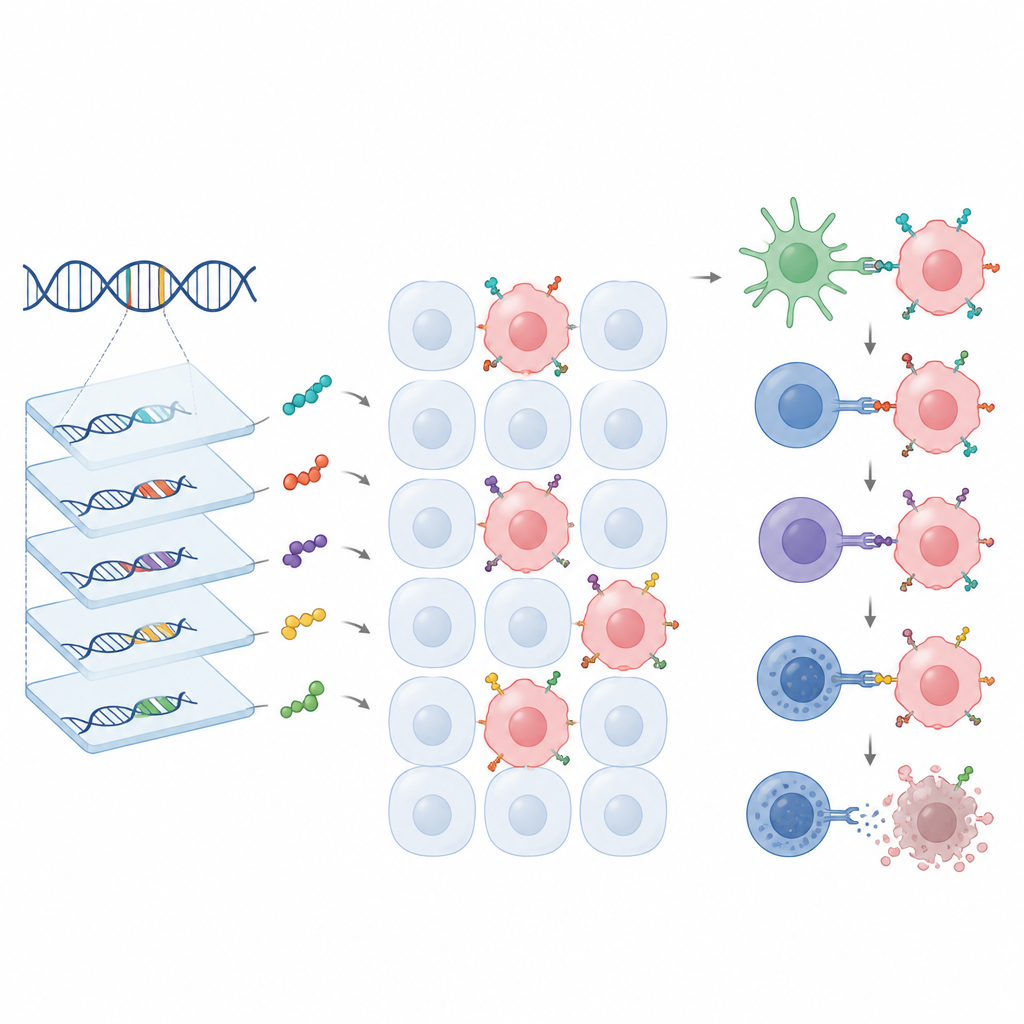
Cancer cells often display unusual protein fragments, called antigens, on their surface. Some come from mutations unique to each patient, which makes designing broad treatments difficult. Others, however, can come from stretches of DNA that are normally quiet in healthy cells. In tumors, chemical marks that usually keep these regions shut down can be lost, leading the old viral DNA, known as human endogenous retroviruses, to switch back on. When this happens, parts of the viral-like proteins are displayed on the tumor cell surface, where immune cells may see them as foreign.

Finding Needles in a Genetic Haystack
Because viral-derived sequences in our genome are highly repetitive and very similar to one another, it has been technically hard to work out exactly which viral fragment a given tumor antigen comes from. Many existing tools focus only on one portion of these elements or struggle when the same sequence appears in many places in the genome. The team behind this study created a new approach, called HERVOminer, that systematically searches for close matches between short peptides measured from tumor cells and a curated library of viral-like protein segments encoded in our DNA. It then links those matches back to precise genome locations and checks how strongly each viral fragment is switched on in tumor and normal tissues.
Testing the Method in Colon Cancer
To see how well HERVOminer works, the researchers applied it to data from 15 people with colorectal cancer. Using protein measurements from tumor samples and RNA sequencing from tumor and nearby normal tissue, they looked for peptide fragments that matched human endogenous retrovirus regions. Three promising peptides were chosen for deeper analysis. HERVOminer was able to narrow thousands of possible matches down to a small set of likely source regions for each peptide and to show whether these regions were more active in tumors than in normal tissue, a key requirement for safe targeting.
Do These Viral Signals Wake Up T Cells?
Finding candidate antigens is only useful if immune cells can actually respond to them. The team therefore tested blood cells from healthy donors whose immune systems could, in principle, see these peptides. When exposed to two of the candidate viral-derived peptides, the donors’ T cells produced more immune signaling spots in laboratory assays, a sign of recognition. In further experiments, T cells trained to respond to the peptides were able to kill cells engineered to display the corresponding viral fragments, and the killing increased as more T cells were added. These results suggest that the antigens HERVOminer finds can indeed trigger targeted immune attacks.
Beyond a Single Cancer Type
The researchers also checked whether HERVOminer could rediscover viral-derived peptides that had already been shown to be safe and active in clinical studies of kidney and ovarian cancers. The tool correctly linked these known peptides back to their reported viral source regions and uncovered additional genome locations in colorectal tumors that produced the same peptide sequences, often with higher activity in tumors than in normal tissue. This hints at a broad landscape of shared viral-like antigens that differ by cancer type but may still be widely shared among patients.
What This Means for Future Treatments
For a non-specialist, the key message is that our own ancient viral DNA can help mark cancer cells for destruction. HERVOminer offers a way to pinpoint which viral fragments are active in tumors, confirm that their protein pieces appear on the cell surface, and show that T cells can respond to them. By making it easier to find these shared tumor-specific antigens across many patients, this approach could guide the design of “off-the-shelf” cancer vaccines and cell therapies that focus the immune system on targets that are largely absent from healthy tissues.
Citation: Wu, CH., Fok, T.W., Huang, K.CY. et al. HERVOminer: a sequence similarity-based approach for recognizing endogenous retrovirus origin of the peptidome. npj Precis. Onc. 10, 178 (2026). https://doi.org/10.1038/s41698-026-01370-9
Keywords: endogenous retrovirus, tumor-specific antigens, cancer immunotherapy, colorectal cancer, neoantigen discovery