Clear Sky Science · en
FLT3-SYK inhibitor and Ixazomib combination impact HOXA and oxidative stress control by β-catenin, SQSTM1 and NRF2 in AML
Why this research matters
Acute myeloid leukemia (AML) is a fast‑moving blood cancer that often comes back after treatment. Many patients relapse even after strong chemotherapy, and new targeted drugs have helped only some groups. This study explores a strategy that attacks leukemia cells on two fronts at once: blocking powerful growth signals while also dismantling the cells’ internal stress‑defense system. The work spans lab experiments, mouse models, and an early‑phase clinical trial, offering a glimpse of a possible new option for patients with otherwise resistant disease. 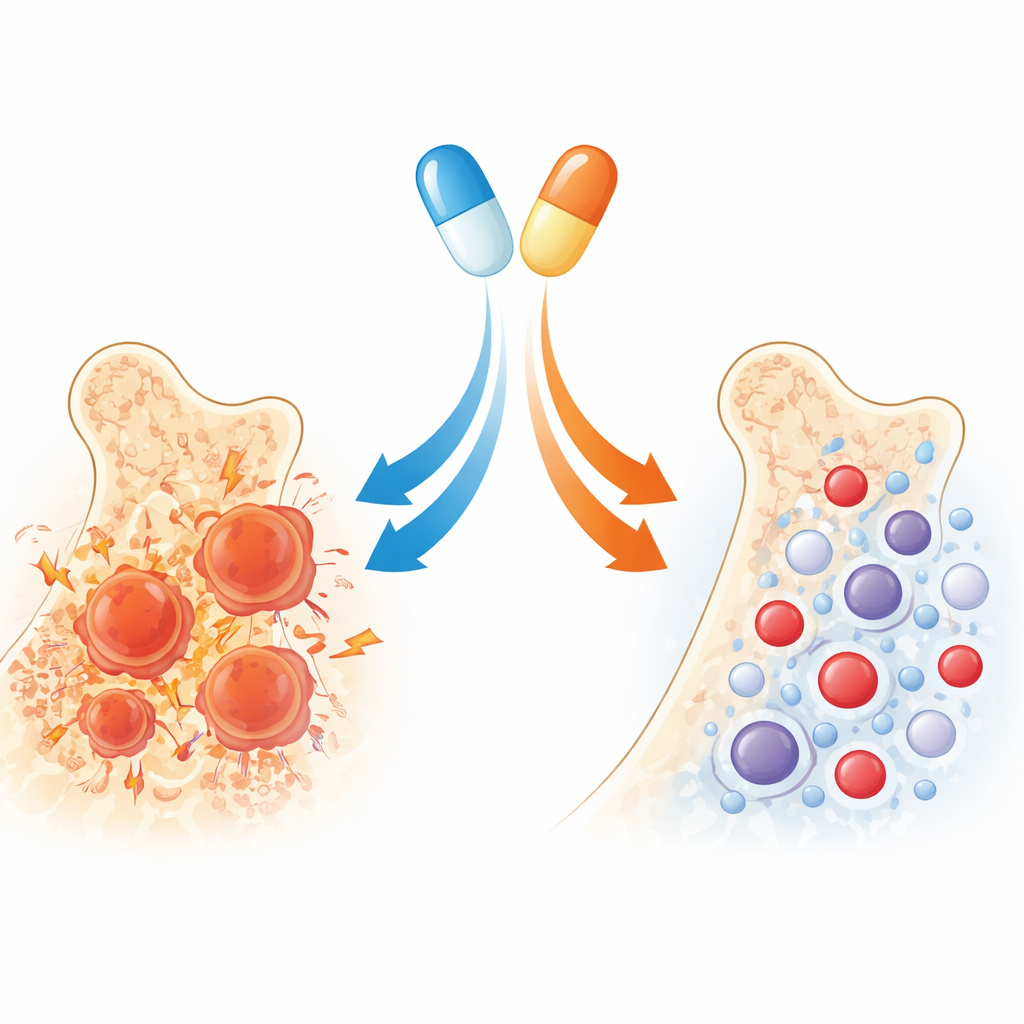
How leukemia cells stay one step ahead
The authors began by comparing leukemia cells from AML patients with healthy blood cells. They found that AML cells crank up several key control switches: growth‑driving enzymes called FLT3 and SYK, developmental genes from the HOXA family, and a signaling protein called β‑catenin. At the same time, these cells rely heavily on burning fuel in their mitochondria, a process known as oxidative phosphorylation, to power growth and survive stress. Another set of molecules, including NRF2 and p62/SQSTM1, act like emergency managers that help leukemia cells withstand both natural stress and the damage caused by chemotherapy.
Knocking out the cancer’s stress shield
Past work had hinted that blocking the cell’s protein‑disposal machinery, the proteasome, could weaken β‑catenin and related stress programs in AML. Building on this, the team studied Ixazomib, an oral proteasome‑blocking drug, and how it alters β‑catenin’s behavior. In leukemia samples, Ixazomib pushed β‑catenin out of the nucleus, tagged it for destruction, and boosted markers of internal stress. These changes were tied to increased cell death. The protein p62/SQSTM1 emerged as a central hub: when the researchers reduced p62 levels, it pulled down NRF2 and changed β‑catenin activity, revealing a tightly linked network that leukemia cells use to manage oxidative stress and maintain survival signals. 
Combining forces against stubborn leukemia
The key idea of the study was to pair Ixazomib with TAK‑659, a drug that blocks both FLT3 and SYK. In genetically engineered mice bearing aggressive AML, this combination sharply shrank the leukemia population in bone marrow and blood. Normal blood‑forming cells re‑appeared, and abnormal white blood counts and immature progenitor patterns moved back toward normal. In lab tests using leukemia cells from different patients, the two‑drug mix worked particularly well when cancers depended on FLT3 or had strong stress‑adaptation signatures. Even when one drug alone had limited impact, the pair often showed strong cooperative killing of leukemia cells at clinically realistic doses.
First tests in patients
Guided by these results, the investigators launched a small phase I/II clinical trial of TAK‑659 plus Ixazomib in adults with relapsed or refractory AML, most of whom did not carry FLT3 mutations. Over the first two treatment cycles, many patients showed rapid drops in white blood cell counts, fewer leukemia blasts in blood and bone marrow, and lower bone‑marrow cellularity. In several cases, molecular tests revealed early and deep silencing of the same gene programs highlighted in the lab: HOXA genes, FLT3, survival protein BCL2, and the stress‑response partners NRF2, p62/SQSTM1, and related factors. Protein studies confirmed that β‑catenin was being pushed out of the nucleus and marked for breakdown, matching the proposed mechanism from cell and mouse experiments.
What this could mean for patients
To a non‑specialist, the take‑home message is that the researchers have mapped a chain of signals that AML cells use both to grow and to resist damage, and have shown that these signals can be disrupted from two directions at once. By combining a FLT3/SYK blocker with a proteasome inhibitor, they were able to weaken leukemia growth drivers and strip away the cells’ stress shield in parallel, leading to significant leukemia clearance in preclinical models and encouraging responses in a small group of heavily pretreated patients. While larger trials are needed to confirm safety and long‑term benefit, this work points toward a treatment approach that targets not just one mutation but an entire survival network, potentially offering hope for people with high‑risk, treatment‑resistant AML.
Citation: Pasupuleti, S.K., Rangaraju, S., Layer, J. et al. FLT3-SYK inhibitor and Ixazomib combination impact HOXA and oxidative stress control by β-catenin, SQSTM1 and NRF2 in AML. npj Precis. Onc. 10, 168 (2026). https://doi.org/10.1038/s41698-026-01332-1
Keywords: acute myeloid leukemia, targeted therapy, proteasome inhibitor, oxidative stress, β-catenin signaling