Clear Sky Science · en
Drivers of winter Arctic sea ice variability
Why shrinking winter ice matters to all of us
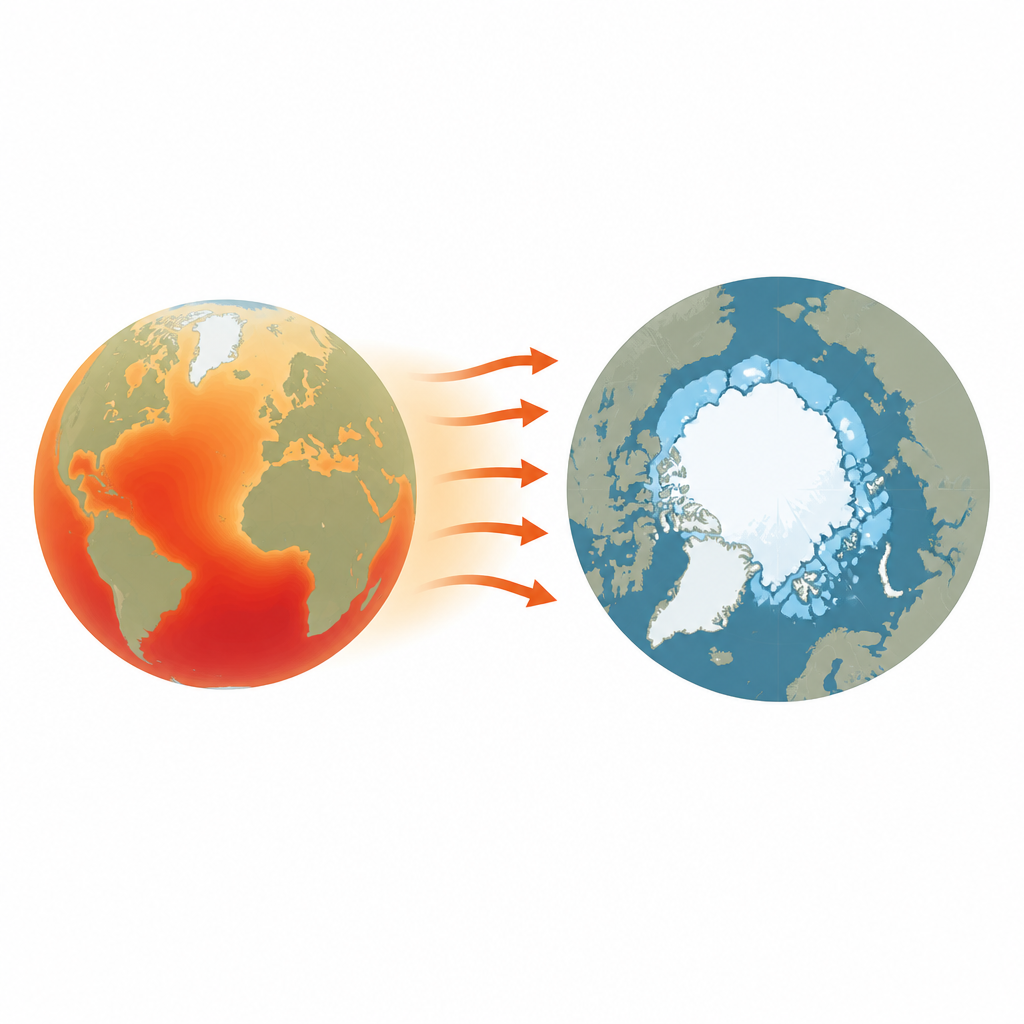
Far from being a distant curiosity, Arctic sea ice acts like Earth’s thermostat. In winter it helps regulate how much heat escapes from the ocean, shapes storm tracks, and even influences extreme weather in Europe and North America. This study asks a deceptively simple question with big consequences: how much of the recent winter ice loss is caused by human driven global warming, and how much comes from the climate system’s own natural swings?
Unraveling overlapping climate rhythms
The researchers looked at winter conditions from 1950 to 2024, focusing on October through March when Arctic warming is strongest. They combined maps of global sea surface temperatures with Arctic sea ice, near surface air temperature, and sea level pressure. Using a statistical method that teases out linked patterns in these fields, they separated the mixed signals into a few main “modes” of behavior. They then checked which well known climate rhythms these modes lined up with, such as long term global warming, multidecadal swings in the Atlantic, and year to year shifts like El Niño.
The clear fingerprint of human warming
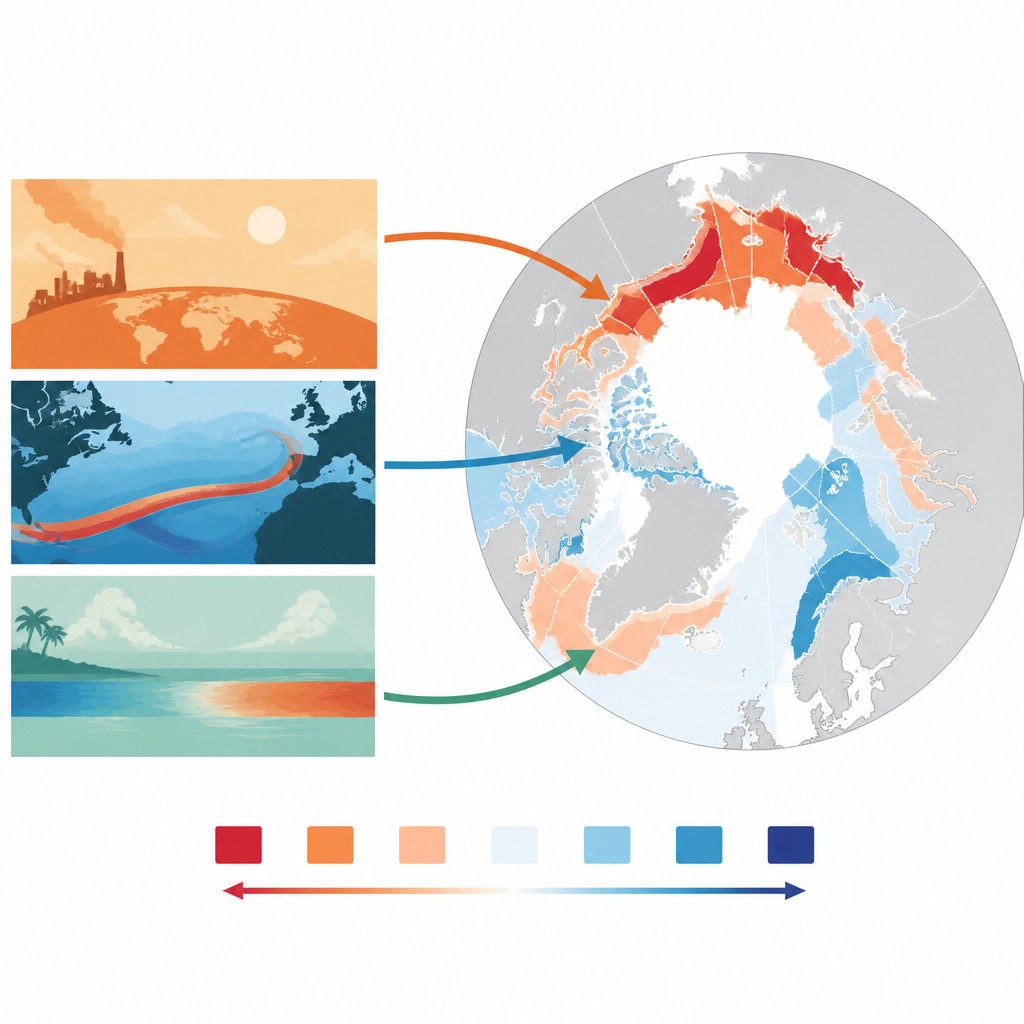
The leading mode they found matches what you would expect from rising greenhouse gases. Oceans around the globe show a near uniform warming pattern, and the Arctic responds with widespread winter sea ice loss and strong low level warming in the same regions. The time history of this mode closely tracks an index of global warming. Causal tests that go beyond simple correlation show that changes in global temperature are not just happening alongside ice loss, but are actively driving many of the changes in winter Arctic sea ice, especially along the edges where ice meets open water.
Slow Atlantic swings and faster atmospheric twists
A second mode reflects slower, multidecadal variations centered in the North Atlantic. When the Atlantic is in a warm phase, extra ocean heat flows toward the Arctic, thinning winter ice mainly in the Barents and Kara Seas and in Baffin Bay. This imprint resembles the human driven pattern but is weaker and more regional. Two additional modes capture year to year ups and downs tied to shifting winds and pressure patterns over the Atlantic and Pacific. These create dipoles of more ice in some Arctic areas and less in others, often by redirecting warm and cold air rather than by steadily heating the ocean surface.
From cause to effect in the Arctic
To test cause and effect, the team applied two specialized techniques that examine whether one time series helps predict another in a way consistent with an underlying physical link. Both methods show that the global warming signal has a broad, robust influence on winter Arctic ice, while the Atlantic multidecadal pattern leaves a narrower footprint in specific seas. El Niño’s influence is clear in the statistics but more patchy in space, reflecting that its impact on the Arctic often travels along winding atmospheric pathways. In modes dominated by human warming and slow Atlantic changes, local heat exchange between ocean and atmosphere plays the leading role, while the faster modes are driven more by shifting winds and air mass movements.
What this means for future winters
Putting these pieces together, the study concludes that since about 1980, human driven warming has been the main cause of winter sea ice decline across most Arctic regions, with multidecadal Atlantic changes adding extra thinning in a few key areas. Natural year to year variations still shuffle ice around, but they sit on top of a strong downward trend. For a layperson, the message is straightforward: the Arctic winter ice cover is shrinking not just because the climate wiggles naturally, but primarily because the planet is warming, and this loss is reshaping weather patterns far beyond the polar circle.
Citation: Vaideanu, P., Stepanek, C., Nichita, D.R. et al. Drivers of winter Arctic sea ice variability. npj Clim Atmos Sci 9, 118 (2026). https://doi.org/10.1038/s41612-026-01438-0
Keywords: Arctic sea ice, winter climate, global warming, Atlantic variability, El Niño